
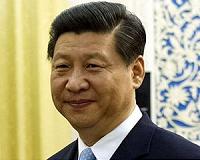
Chinese President Xi Jinping called Monday for rich nations to honour their commitment to provide $100 billion a year to developing countries to tackle climate change.
Xi told the UN climate summit in Paris that developed countries should accept "more shared responsibilities" for limiting global warming and helping poor countries adapt to a climate-afflicted world.
"Developed countries should honour their commitment of mobilising $100 billion each year from 2020 and provide stronger financial support to developing countries afterwards," Xi said, according to an official translation of his remarks.
"It is also important that climate-friendly technologies be transferred to developing countries."
Rich nations pledged at a UN summit in Copenhagen in 2009 to muster $100 billion (94 billion euros) annually in financial support to poor countries starting in 2020.
The money is meant to help them cut greenhouse gas emissions that drive global warming, as well as to adapt to rising sea levels, droughts and other potentially catastrophic impacts.
However, six years later poor nations are frustrated that rich countries are yet to fully commit to the fund.
The debate over the money highlights a long-standing feud between rich and poor nations over how to distribute responsibility for tackling climate change.
While China and the United States have pledged to work together to fight global warming, Xi made clear on Monday that poor nations should not have to sacrifice economic growth.
"Addressing climate change should not deny the legitimate needs of developing countries to reduce poverty and improve their people's living standards," Xi said.
"The Paris conference should reject the narrow minded mentality of a zero-sum game and call on all countries — developed countries in particular — to assume more shared responsibilities for win-win outcomes."
Rich nations acknowledge a historical responsibility for global warming.
But holding temperature increases below two degrees Celsius (3.6 degrees Fahrenheit) — the UN-endorsed goal — will be impossible if emerging giants such as China and India fail to step up their efforts, they argue.
China raises alarm over rising seas amid climate talks
Shanghai (AFP) Nov 30, 2015 –
A new Chinese government report raises the alarm over rising sea levels caused by climate change which could potentially threaten the country's developed eastern coast, according to state media and the New York Times.
The release of the official report, now in its third edition, came shortly before the UN Conference of Parties (COP21) summit, which began on Monday with the aim of striking a global deal limiting dangerous climate change.
China is the world's second biggest economy but also its largest polluter, estimated to have released between nine and 10 billion tonnes of carbon dioxide in 2013.
Beijing pledged last year to peak carbon dioxide output by "around 2030" — suggesting at least another decade of growing emissions.
The government report said the sea levels off China's coast have risen 2.9 millimetres annually from 1980 to 2012, according to an article posted on a government-backed website, while glaciers shrank just over 10 percent since the 1970s.
Temperatures are rising at the rate of 1.5 degrees Celsius every 100 years and could jump a further 1.3 to 5.0 degrees Celsius by the end of the century, said the China Climate Change website, which operates under the state planner.
The New York Times said the report, which was compiled under the authority of the Ministry of Science and Technology, spells out "sombre scenarios" including threats to infrastructure from increased rainfall and melting permafrost, among the possible fallout from climate change.
"Climate change will make the urban conurbations along the coast the regions most affected by climate change nationwide," it cited the report as saying.
"Some cities may even face risks of massive disasters that are hard to forecast."
The report, called "The Third National Climate Change Assessment Report", cites projections that the sea off eastern China could rise between 40 to 60 centimetres by the end of the century compared to 20th century averages, the newspaper said.
A separate study by US-based research group Climate Central predicted that China would be the country hit hardest by rising sea levels if global temperatures rose by four degrees Celsius.
It estimated some 145 million people live in Chinese cities and coastal areas that would eventually become ocean were warming to be that high.
