
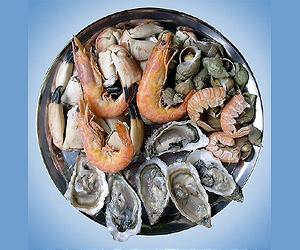
A new model to measure fisheries shows China has overtaken Japan to lead the world in seafood consumption, researchers said.
American and Canadian marine scientists compared the resources needed by different kinds of fish to the total consumption of all seafoods worldwide, finding that China, Japan and the United States were the top three seafood-eating nations.
The report headed by Daniel Pauly, director of the Fisheries Centre at the University of British Columbia here, warned Wednesday however that global fisheries are increasingly unsustainable and their product is unequally consumed by wealthy countries.
Japan was previously considered the top seafood-consuming nation, mainly because China consumes less high-value fish like tuna or salmon, said the study.
But when total resources needed to produce seafood are tallied, the study showed the Asian giant at the top of the ocean food chain.
"Though the average Chinese consumer generally eats smaller fish than the average Japanese consumer does, China's massive population gives it the world's biggest seafood print, 694 million metric tons of primary production," said National Geographic, which co- funded the research.
Pauly's team developed a measuring tool called "SeafoodPrint" modeled on the "ecological footprint" concept that measures the area of land needed to sustain a person depending on their location and lifestyle.
The researchers' model compares fish by the amount of algae it takes to produce them, said study co-author and PhD economics student Wilf Swartz.
"By expressing everything in terms of kilograms of algae… we can measure how much of the ocean's production is being consumed by humans," Swartz told AFP. "A kilogram of herring would be the equivalent of 100 kilograms of algae, and one kilogram of tuna would be equivalent to 1,000 kilograms of algae."
The measurement gives regulators a means to measure the total human impact on the oceans, and the report hopes to encourage consumers to eat species with a less harmful impact.
"Hopefully we can change the demands on fish such as salmon, to less impactful species, like mackerel," said Swartz.
earlier related report
Fears mount of massive Caribbean coral bleaching: US study
Miami (AFP) Sept 22, 2010 –
Above-average temperatures this year could spark massive coral bleaching in the Caribbean basin region, experts with the National Oceanic and Atmospheric Administration (NOAA) warned Wednesday after a major study.
The review found that there is a high risk for bleaching damage to coral in the south and southeastern Caribbean. That could cause a repeat of damage done back in 2005 when 90 percent of coral in the area were damaged and 10 percent were destroyed.
"High temperatures cause corals to force out the symbiotic algae that provide them with food. This makes the corals appear white or bleached' and can increase outbreaks of infectious disease," said Mark Eakin, coordinator of NOAA's Coral Reef Watch.
"Temperatures are high in the Caribbean, and we expect this to continue," Eakin added, so "this season has the potential to be one of the worst bleaching seasons for some reefs."
Bleaching that goes on for even just a week can lead to the death of the coral, and to the loss of marine habitat, experts say.
Emma Hickerson, a sanctuary research coordinator, said that a NOAA survey cruise just returned from the Flower Garden Banks National Marine Sanctuary off the coasts of Texas and Louisiana.
"We saw serious bleaching," she said of the sanctuary. "Several species were bleached and we are concerned we could lose much of the fire corals this year," she warned.
Scientists say corals are vital to marine life because they provide habitats for a vast variety of creatures and absorb large levels of poisonous carbon dioxide.
Share This Article With Planet Earth
