
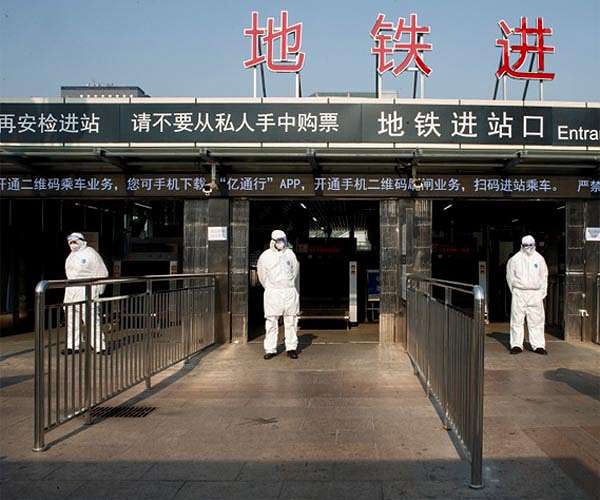
Two Chinese cities south of Beijing further tightened virus restrictions Saturday and issued week-long stay at home orders to residents as authorities race to stamp out a resurgence in infections.
China has largely brought its domestic outbreak under control after the coronavirus first emerged in Wuhan in late 2019 but a spike in Hebei province, bordering Beijing, has sparked fresh lockdowns ahead of the Lunar New Year next month.
Hebei has reported over 130 confirmed Covid-19 cases in the past week, with more than 200 more asymptomatic infections.
Most of the cases were in Shijiazhuang city, which along with its surrounding areas is home to 11 million people. Several other infections were reported in neighbouring Xingtai city, home to 7 million.
Overnight, both cities announced new, week-long stay at home orders for their residents, officials said.
Shijiazhuang also closed its subway from Saturday morning to aid "prevention and control of the outbreak", authorities said, with taxi services also suspended.
Major highways leading into the city, around 300 kilometres (200 miles) south of Beijing, have already been closed and inter-city passenger travel halted.
Supermarkets in Shijiazhuang are now closed to walk-in customers, officials said later Saturday, with purchases limited to online orders and contactless deliveries.
More than 16 million people across the two cities had been tested for the virus since Wednesday, state media reported.
"We haven't seen a clear turning point yet in this outbreak," said Shijiazhuang official Ma Yujun. "The risk of expansion still exists."
The curbs come ahead of the Lunar New Year, when hundreds of millions criss-cross China to visit family and friends, with National Health Commission vice minister Zeng Yixin warning Saturday the festival "will further boost the risk of transmission."
Authorities are racing to roll out vaccines, with more than 9 million doses given so far, Zeng added.
Health authorities recently gave conditional approval to a vaccine candidate by Chinese pharma giant Sinopharm, with emergency use jabs already administered in the later part of 2020.
US logs record virus caseload as millions in Asia enter new lockdowns
Washington (AFP) Jan 9, 2021 –
The United States logged a record new daily virus caseload as Joe Biden slammed the Trump administration's vaccine roll-out as a "travesty" and millions in Asia woke up to new lockdowns.
Almost 1.9 million people have now died from the virus, with new variants sending cases soaring and prompting the re-introduction of curbs on movement even as some countries begin mass inoculation campaigns.
Almost 290,000 new cases were reported in the US within 24 hours Friday according to Johns Hopkins University, a day after the world's worst-hit country recorded a daily record of nearly 4,000 deaths.
"Vaccines give us hope, but the roll-out has been a travesty," Biden told reporters, warning distribution of the vaccine would be "the greatest operational challenge we will ever face as a nation."
On Saturday the streets of the Australian city of Brisbane were quiet as its more than two million residents were ordered back into lockdown after authorities detected a single infection of a new strain from Britain, which is thought to be more infectious.
"Quite surreal, like something from a movie set," local man Scott told AFP in Brisbane's deserted downtown.
"It's necessary. Hopefully we will get through the next few days without any cases, that will allow us just to start to get back to normal."
In China, where the original coronavirus first emerged in late 2019, authorities also tightened restrictions on two cities near Beijing to stamp out a growing cluster.
The new week-long stay at home orders affecting about 18 million people in Shijiazhuang and Xingtai come as cases spike ahead of the Lunar New Year, when hundreds of millions criss-cross the country to visit family and friends.
On Saturday Beijing's National Health Commission said authorities had so far given out more than nine million vaccine doses, but warned the upcoming holiday would "further boost the risk of transmission."
As the race to inoculate heats up, the World Health Organization urged rich countries to stop cutting their own deals with manufacturers to snap up the first wave of vaccines.
"Fifty percent of the high-income countries in the world are vaccinating today," said Bruce Aylward, head of the WHO co-led vaccine procurement and distribution effort.
"Zero percent of the low-income countries are vaccinating. That is not equitable."
The comments came as the European Union said it had agreed an option for a further 300 million jabs from Pfizer/BioNTech, doubling its supply of the vaccine.
China also said Saturday that preparations were still ongoing for a WHO mission to Wuhan to investigate the origins of Covid-19, following a rare rebuke from the UN body over a delay to the long-planned trip.
"As long as these experts complete the procedures and confirm their schedule, we will go to Wuhan together to carry out investigations," National Health Commission vice minister Zeng Yixin told reporters.
– Records keep falling –
Despite nearly a year of intermittent restrictions across the globe, many countries are still recording record coronavirus numbers, including Britain which on Friday announced new highs of 1,325 deaths and 68,053 cases over 24 hours.
Fears have been rising over the new virus variants that emerged in Britain and South Africa, but BioNTech brought some relief on Friday, saying its vaccine was effective against a "key mutation" found in the strains.
In Brazil, which has the second-highest death toll after the US, two vaccine makers — China's Sinovac and AstraZeneca/Oxford — applied for approval for their jabs.
Meanwhile Iran said it was banning the import of any US and British-produced vaccines doses, with Ayatollah Ali Khamenei saying they were "completely untrustworthy".
"It's not unlikely they would want to contaminate other nations," he said.
Africa was spared the worst of the pandemic's first wave, but has seen a sharp surge in recent weeks, with Senegal recording its highest death and infections figures — eight and 296, respectively — on Friday.
At a hospital in Nigerian megacity Lagos, managing director Ngozi Onyia likened the surge in cases there to a "tsunami".
"I'm making tough calls — who to take into the treatment centre, who to put on one of our four ventilators — ethical decisions I've never had to make in 38-plus years," she said.
But there was relief in Spain, where a baby — three-month-old Petru — left the hospital after spending nearly all his short life fighting Covid-19.
