
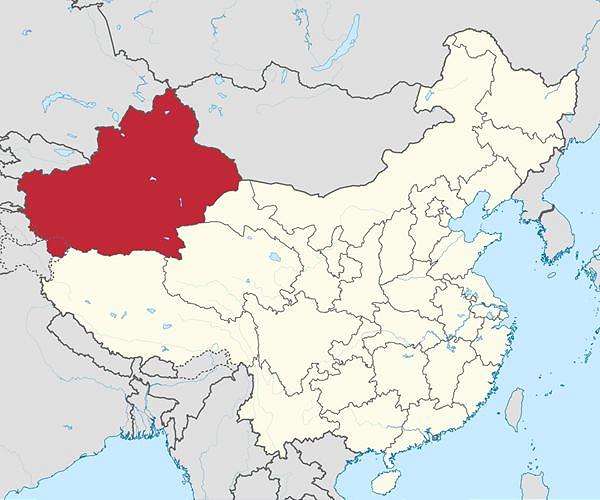
China on Thursday accused the United Nations of becoming a "thug and accomplice of the US and the West" after the global body released a highly anticipated report warning crimes against humanity may have taken place in the Xinjiang region.
The landmark report detailed a string of rights violations including torture and forced labour against Uyghurs and other Muslim minorities in the far-western region, bringing the UN seal to many of the allegations long brought by activist groups, Western nations and the Uyghur community in exile.
However, it stopped short of calling China's actions a genocide — claims made by the United States and several Western lawmakers — leaving some activists "disappointed".
"The extent of arbitrary and discriminatory detention of members of Uyghur and other predominantly Muslim groups… may constitute international crimes, in particular crimes against humanity," the report said.
It said the world must now pay "urgent attention" to the situation in Xinjiang.
Beijing hit back hard against the report — over a year in the making — and maintained its firm opposition to its release, sharing a more-than-100-page document from the Xinjiang provincial government defending its policies.
"The so-called critical report you mentioned is planned and manufactured firsthand by the US and some Western forces, it is wholly illegal and invalid," foreign ministry spokesman Wang Wenbin told a regular briefing Thursday.
"The report is a hodgepodge of misinformation, and it is a political tool which serves as part of the West's strategy of using Xinjiang to control China," he added.
Wang also slammed the UN rights office as having "sunk to becoming the thug and accomplice of the US and the West", but said the report's omission in calling China's actions genocide shows their "lies… have fallen apart".
Michelle Bachelet, the UN human rights chief, said she had decided a full assessment was needed of the situation inside the Xinjiang Uyghur Autonomous Region (XUAR).
Bachelet was determined to release it before her four-year term as the UN High Commissioner for Human Rights expired at the end of August — and did so with 13 minutes to spare at 11:47 pm in Geneva.
"I said that I would publish it before my mandate ended and I have," Bachelet said in an email to AFP Thursday.
"The politicisation of these serious human rights issues by some states did not help."
– 'Serious human rights violations' –
China has been accused for years of detaining more than one million Uyghurs and other Muslims in the region.
Beijing has vehemently rejected the claims, insisting it is running Vocational Education and Training Centres (VETCs), designed to curb extremism.
"Serious human rights violations have been committed in XUAR in the context of the government's application of counter-terrorism and counter-'extremism' strategies," the UN report said.
"Allegations of patterns of torture or ill-treatment, including forced medical treatment and adverse conditions of detention, are credible, as are allegations of individual incidents of sexual and gender-based violence," the report said.
The UN Human Rights Office could not confirm how many people were affected by the VETCs but concluded that the system operated on a "wide scale" across the entire region.
The number in the VETCs, at least between the years 2017 and 2019, "was very significant, comprising a substantial proportion of the Uyghur and other predominantly Muslim minority populations".
Campaigners have accused China of forcibly sterilising women, and the report cited "credible indications of violations of reproductive rights through the coercive enforcement of family planning policies".
– 'A game-changer' –
Campaign groups have said the report should act as a launchpad for further action.
Human Rights Watch's China director Sophie Richardson said the "damning" findings of sweeping rights abuses showed why Beijing "fought tooth and nail" to prevent its publication.
The response from the Uyghur activist community was mixed, with some groups praising its work while others wished it had gone further in its condemnation.
"This is a game-changer for the international response to the Uyghur crisis," said Uyghur Human Rights Project executive director Omer Kanat.
"Despite the Chinese government's strenuous denials, the UN has now officially recognised that horrific crimes are occurring."
And World Uyghur Congress president Dolkun Isa said the report paved the way for "meaningful and tangible action" by countries, businesses and the UN.
But Salih Hudayar, a Uyghur-American who campaigns for Xinjiang independence, told AFP the report was "sadly not as strong as we had hoped".
"Our people have been waiting years for the UN to speak out," said Hudayar.
"Unfortunately, because of Chinese government pressure the UN has long remained silent."
And Elfidar Iltebi, president of the Uyghur American Association, said: "We, as Uyghur community members, are disappointed honestly.
"I was looking for, hoping for, dreaming for the 'g-word' — genocide."
Five key allegations in the UN's Xinjiang report
Geneva (AFP) Sept 1, 2022 –
A UN investigation into China's treatment of Muslim minorities in its vast Xinjiang region has reported torture, sexual abuse and possible crimes against humanity, but stopped short of describing it as genocide.
The report was immediately met by a lengthy rebuttal from China's mission to Geneva.
Here are five main allegations from the UN and China's responses:
– Mass arbitrary detention –
The UN report describes a "pattern of large-scale arbitrary detention" in Xinjiang, in which individuals suspected of terrorism are held in high-security facilities without due process and for indefinite lengths of time.
Everything from having too many children, wearing a veil or beard, or not using one's passport are cited as behaviours that can lead authorities to identify individuals as being at risk of "extremism" and mark them for possible detention.
More recently there have been signs of a shift toward formal jail terms "as the principal means for large-scale imprisonment and deprivation of liberty", according to the report.
Many have been detained without their family members being informed, it also notes.
China has dismissed allegations of mass arbitrary detention as "lies". It insists it has "clearly specified" definitions of terrorism and extremism that have "ruled out arbitrary enforcement due to vague, over-stretching and general legal provisions".
– Torture –
The report says it found "credible" allegations of torture and sexual assault — including rape — at detention centres in Xinjiang.
Former detainees interviewed by the UN describe being beaten while immobilised in "tiger chairs" — used by Chinese police to restrain interrogation subjects — and being forced to receive unexplained medical treatments, as well as instances of rape and "invasive gynaecological examinations".
"The Government's blanket denials of all allegations, as well as its gendered and humiliating attacks on those who have come forward to share their experiences… have added to the indignity and suffering of survivors," the UN report says.
China insists the centres "fully guarantee that trainees' personal dignity is inviolable, and prohibit any insult or abuse of them in any manner".
Beijing has publicly condemned women who made claims of sexual assault in the camps, using their alleged sexual health and relationship statuses in an attempt to discredit them.
– Forced sterilisations and abortions –
The UN says it spoke to women who recounted being "forced to have abortions or forced to have IUDs inserted" — claims it said were believed to be credible.
Noting a sharp decline in Xinjiang's birth rates from 2017, as well as a Beijing white paper linking frequent births and religious extremism, the UN's human rights office says "there are credible indications of violations of reproductive rights through the coercive enforcement of family planning policies".
China dismisses claims of forced sterilisations as "disinformation", saying people in Xinjiang are voluntarily opting to marry later and have fewer children due to improved education and living conditions.
– Suppression of religious freedom –
The UN report says China has "exceptionally broad interpretations of 'extremism'" that criminalise activities "connected to the enjoyment of cultural and religious life".
Activities including wearing hijabs and giving children Muslim names are flagged as signs of "religious extremism", which "can lead to serious consequences for persons so identified", according to the report.
The OHCHR also notes "deeply concerning" reports about the destruction of mosques and cemeteries in Xinjiang.
China insists all "normal religious activities" in Xinjiang are protected by the law, pointing to government-funded renovations of some mosques as well as an expansion of official training institutes for Islamic clerics as evidence.
– Forced labour –
The report says it found indications that employment programmes in Xinjiang could "involve elements of coercion" — echoing long-standing claims by the United States and others that forced labour was taking place in the region.
The report notes government statements that refer to transferring people from vocational centres to factories, raising questions about "the extent to which such programmes can be considered fully voluntary".
China says "trainees" at vocational centres "could freely choose their jobs". and that graduates "are earning wages and living a prosperous life".
