
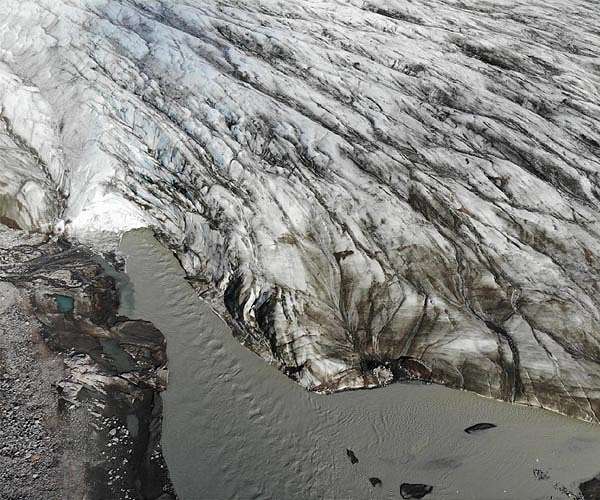
Greenland is becoming darker and warmer due to a weather pattern that is pushing fresh snowfall away from its ice sheet, a study said Monday.
A reduction in the amount of fresh, light-colored snow leaves more old and dark snow exposed on the surface — which in turn causes the ice sheet to absorb more heat and melt faster.
"As snow ages, even over hours to a few days, you get this reduction in reflectivity, and that's why the fresh snow is so important," said Erich Osterberg, an associate professor of earth sciences at Dartmouth College and co-author of the paper in Geophysical Research Letters.
Osterberg and colleagues attributed the decrease in snowfall to a weather phenomenon called "atmospheric blocking" — in which persistent high-pressure systems hover over the ice sheet for weeks at a time.
These systems, which have become more prevalent in the region since the 1990s, hold warmer air over western Greenland, reduce light-blocking cloud cover, and push snowstorms to the north.
The result is a "triple whammy," said Osterberg. "This all contributes to Greenland melting faster and faster."
– Dirty snow –
Some research has linked this phenomenon to human-driven climate change, but Osterberg noted further study is needed on why the blocking is happening.
"Given how important atmospheric blocking is to Greenland melting, I believe this is a critical target for research so we can improve our predictions of future sea level rise," he told AFP in an email.
Co-author Gabriel Lewis added that it's not just less snowfall driving the warming — it's the different kind of snow that is left behind.
"Once it falls and sits on the surface of the ice sheet in the sun, it changes shape and the snow grains become larger over time," he said.
It becomes more rounded and less reflective than newer, crystal-shaped snow.
According to the team's calculations, a one percent change in reflectivity across Greenland's ice sheet could cause an additional 25 gigatons of ice to be lost over three years.
The team trekked 2,700 miles (4,340 kilometers) across Greenland on snowmobiles to carry out two sampling and survey campaigns in the summers of 2016 and 2017, to try to determine the cause of the darkening, which had been observed by satellite imagery over decades.
One hypothesis had been that the snow was becoming dirtier, because of soot from air pollution.
But the researchers found only about one part per billion of impurities, dispelling this hypothesis.
According to research cited in the study, the Greenland ice sheet has warmed about 2.7 degrees Celsius (4.85 degrees Fahrenheit) since 1982, and the continent is experiencing its greatest melt and runoff rates in at least the last 450 years.
Russia warns West against Arctic encroachment ahead of talks
Moscow (AFP) May 17, 2021 –
Russian Foreign Minister Sergei Lavrov on Monday warned Western countries against staking claims in the Arctic, as global warming makes the region more accessible and a site of global competition.
Lavrov's comments came ahead of a ministerial meeting of the Arctic Council that comprises Russia, the United States, Canada, Norway, Denmark, Sweden, Finland and Iceland on Wednesday and Thursday in Reykjavik.
"It has been absolutely clear for everyone for a long time that this is our territory, this is our land," Lavrov said at a press conference in Moscow.
"We are responsible for ensuring our Arctic coast is safe," he said.
As climate change makes the Arctic more accessible, global interest in the region's natural resources, its navigation routes and its strategic position has grown among members of the Arctic Council as well as China.
In a speech last month, US Secretary of State Antony Blinken warned that Russia "is exploiting this change to try to exert control over new space," including through modernising bases, and also pointed to a growing presence of China.
On Monday, he welcomed Denmark's plans to boost its military presence in Greenland and the North Atlantic with $245 million worth of investments into surveillance drones and a radar station on the Faroe Islands.
President Vladimir Putin in recent years has made Russia's Arctic region a strategic priority and ordered investment in military infrastructure and mineral extraction, exacerbating tensions with Arctic Council members.
The United States, for its part, has pushed back against what it considers Russian and Chinese "aggressivity" in the region.
In 2018, the US Navy deployed an aircraft carrier in the Norwegian Sea for the first time since the 1980s.
And in February, Washington sent strategic bombers to train in Norway as part of Western efforts to bolster its military presence in the region.
Lavrov on Monday said he was emphasising "once again — this is our land and our waters".
– Growing military presence –
"When NATO tries to justify its advance into the Arctic, this is probably a slightly different situation and here we have questions for our neighbours like Norway who are trying to justify the need for NATO to come into the Arctic," he said.
The Russian foreign minister said "we will talk about this frankly" at the eight-country ministerial meeting, and suggested resuming a regular dialogue between military chiefs of member countries.
"It would be perfectly logical to re-establish these relations between military officials who understand each other better than politicians," said Russian political analyst Fyodor Lukyanov, editor-in-chief of the journal Russia in Global Affairs.
"Even if this measure would confirm a return to the Cold War, it would still be a step forward in this situation," he told AFP.
The Council is expected to issue a final communique and a common strategic plan for the next decade at the end of the meeting.
As ice cover in the Arctic decreases, Russia is hoping to make use of the Northern Sea Route shipping channel to export oil and gas to overseas markets.
Russia has invested heavily to develop the route, which allows ships to cut the journey to Asian ports by 15 days compared with using the traditional Suez Canal route.
In August 2017, the first vessel travelled along the Northern Sea Route without the use of ice breakers.
Moscow has also beefed up its military presence in the region, reopening and modernising several bases and airfields abandoned since the end of the Soviet era and deploying its state-of-the-art S-400 air defence systems.
On Monday, Igor Churkin, chief of staff of the Russian Northern Fleet's air forces, told journalists that Russia's remote Arctic military base on the Franz Josef Land archipelago could now host Tu-95 strategic bombers after renovations.
In March, Russia launched massive Arctic manoeuvres near the archipelago, with Putin praising the exercises and a retired admiral saying they were to send a "signal to our foreign friends — the Americans".
In Reykjavik this week, Lavrov will also meet with his US counterpart Blinken in a test of Moscow's strained relationship with Washington.
Despite mounting tensions, Russia and the United States during climate negotiations earlier this year noted the Arctic as an area of cooperation.
