
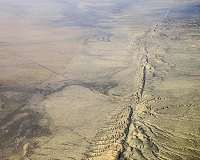
California's three most historically active faults haven't slipped in a century, a hiatus unprecedented over the last 1,000 years, according to a new study.
When researchers at the U.S. Geological Survey studied the paleoseismic records from the San Andreas, San Jacinto and Hayward faults, they failed to find a gap as long as California's current earthquake hiatus.
Scientists calculated the chance of such a long hiatus, given the history of slippage along the three faults, at 0.3 percent.
The new study, published this week in the journal Seismological Research Letters, is bad news for California residents.
"If our work is correct, the next century isn't going to be like the last one, but could be more like the century that ended in 1918," geologist Glenn Biasi said in a news release.
Between 1800 and 1918, slips along the three faults triggered eight major earthquakes, including the infamous 1906 San Francisco earthquake that killed 3,000 people and destroyed 80 percent of the city.
"We know these big faults have to carry most of the [tectonic] motion in California, and sooner or later they have to slip," said Biasi. "The only questions are how they're going to let go and when."
Most of the fault lines running along the Pacific and North American plate boundary belong to the San Andreas, San Jacinto and Hayward faults. Their paleoseismic records suggest the trio should produce at least four magnitude 6.5 or larger earthquakes every century.
Since 1918, the three faults have been quiet.
Through their research, Biasi and his fellow earthquake experts confirmed the silence is not the result of missing data. But the geologists also claim the hiatus isn't a statistical fluke. Biasi and research partner Kate Scharer estimate there is a reason for the dearth of fault slippage over the last 100 years.
"We had the flurry of very large earthquakes from 1800 to 1918," Biasi said. "It's possible that among them they just wrung out — in the sense of wringing out a dishrag — a tremendous amount of energy out the system."
Biasi and Scharer hope their fellow seismologists will accept the century-long hiatus as reality and begin working to explain the eerie silence along California's major fault lines.
Earthquake strikes Iran-Iraq border
Tehran (AFP) April 1, 2019 –
A 5.2-magnitude earthquake Monday struck the western Iranian province of Kermanshah bordering Iraq, authorities said, without reporting damage or casualties.
The quake struck a region already gripped by massive floods that have cut off entire cities and submerged many villages. More than 40 people were reported killed in floods last month across much of Iran.
The national seismological centre said the quake's epicentre was 22 kilometres (14 miles) south of the city of Sumar and at a depth of 10 kilometres.
"Thankfully there have been no reports of damage or casualties till now," Kermanshah's governor-general Houshang Bazvand told state TV.
Iran sits on top of two major tectonic plates and sees frequent seismic activity.
The last massive earthquake struck in November 2017 when a 7.3-magnitude tremor in Kermanshah province killed 620 people.
In 2003, a 6.6-magnitude quake in southeast Iran decimated the ancient mud-brick city of Bam and killed at least 31,000 people.
The deadliest was a 7.4-magnitude quake in 1990 that killed 40,000 people in northern Iran, injured 300,000 and left half a million homeless.
