
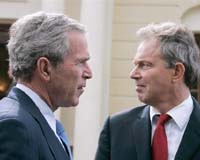
George W. Bush first mentioned a link between Saddam Hussein and Al-Qaeda to Tony Blair days after 9/11, but the British premier advised against pursuing the Iraqi dictator, an aide said Monday.
The then US president spoke to Blair in a telephone conversation on September 14, 2001 and mentioned the possible Iraq link, said David Manning, who was Blair's foreign policy adviser at the time.
In the conversation Bush "said that he thought there might be evidence that there was some connection between Saddam Hussein and Osama bin Laden and Al-Qaeda," Manning told Britain's Iraq war inquiry, which started last week.
"The (British) prime minister's response to this was that the evidence would have to be very compelling indeed to justify taking any action against Iraq," he added.
The inquiry, Britain's third related to the conflict, is looking at its role in Iraq between 2001 and 2009, when its operations ended, and is to report its findings by the end of 2010.
In its first week the probe heard that Britain's ambassador to the United Nations at the time, Jeremy Greenstock, believed the invasion to be "of questionable legitimacy".
Supreme Court rejects bid to publish detainee abuse photos
Washington (AFP) Nov 30, 2009 –
The US Supreme Court on Monday overturned a lower court ruling that would have forced the Pentagon to release scores of photos allegedly showing members of the US military abusing detainees in Iraq and Afghanistan.
The justices vacated a decision taken by the Second Circuit Court earlier this year and sent it back to the court for reconsideration following the passage of a law by Congress last month to keep those photos from public disclosure.
The new law authorizes the administration to withhold publication of "protected documents" — including photos showing "the treatment of individuals engaged, captured, or detained after September 11, 2001 by the armed forces of the United States in operations outside of the United States" — if it believed that releasing the photos could endanger US citizens or troops.
The case dates back to a Freedom of Information Act request filed in 2004.
This spring, the Second Circuit Court granted a request by US rights group the American Civil Liberties Union (ACLU) to have the photographs made public.
According to details included in the brief filed with the Supreme Court, the photographs depict various humiliating and abusive tactics being used against prisoners who are often naked and hooded.
The ACLU says the photos show that detainee torture and abuse were widespread and not carried out by a few "bad apples," as maintained by the administration of former president George W. Bush.
The Bush administration had refused to release the images to the public, arguing that the disclosure would fuel outrage and violate US obligations toward detainees under the Geneva Conventions.
The newest of the nine Supreme Court justices, Sonia Sotomayor, did not take part in Monday's decision to block publication of the photos.
Sotomayor, who was sworn in as a justice in August, was a judge on the Second Circuit Court when it denied review of the same case at an earlier stage, the Supreme Court said.
Share This Article With Planet Earth
