
The new frontier of exploration.
Mars Daily Editorial Team
Editorial Team

Mars Daily Editorial Team

Editorial Team

The Mars Daily Editorial Team produces Mars Daily's coverage of Mars exploration and science. We report on rovers and orbiters, sample-return and human-Mars planning, and the geology, atmosphere and astrobiology of the Red Planet. Articles reflect our team's collective editorial process, source verification, drafting, technical review, and editing, rather than a single writer's work. Mars Daily takes editorial responsibility for content under this byline. For more on how we work, see our editorial policy.

Legacy Reports

Farewell The Aussie Mars Science Team Before Their Expedition To Red Centre

Adelaide - Oct 18, 2001 - Mars Society Australia announced today that the media and general public will be able to meet members of their Project Jarntimarra expedition, before they depart later this month to scout for Mars-like locations in the Australian outback. A highlight will be the rare opportunity to meet high-profile NASA space scientists Dr Carol Stoker and Dr Larry Lemke, both of whom work on Mars-related projects aimed at getting humans to the Red Planet.

Legacy Reports

Mars Odyssey Reaches Its Destination, and an Anxious Moment

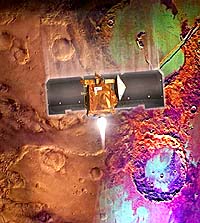
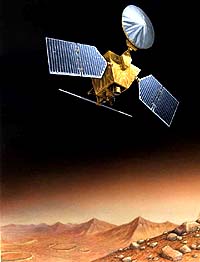
Tempe - Oct 14, 2001 - When NASA's 2001 Mars Odyssey spacecraft reaches Mars on October 23, Arizona State University geologist Philip Christensen will be as nervous as a scientist can be, watching a critical experiment enter a key phase. He has an important instrument aboard the spacecraft which is entering a difficult stage in its journey and all he can do is sit and watch television, waiting for word of success or failure.

Legacy Reports

Top 25 TES Science Results From Mars Global Surveyor

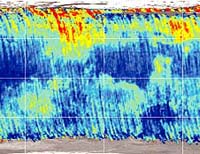
Tempe - Oct 4, 2001 - TES is both an instrument and a technique. The Thermal Emission Spectrometer is a scientific instrument that first flew aboard the Mars Observer spacecraft. Following the loss of that spacecraft, TES was rebuilt and launched along with five of the original seven Mars Observer instruments aboard the new Mars Global Surveyor spacecraft. The purpose of TES is to measure the thermal infrared energy (heat) emitted from Mars. This technique, called thermal emission spectroscopy, can tell us much about the geology and atmosphere of Mars. TES data will provide the first detailed look at the composition of Mars.