Scientists Say Mars Has Liquid Iron Core
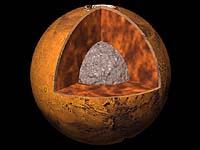
Pasadena - Mar 07, 2003 - New information about what is inside Mars shows the Red Planet has a molten liquid-iron core, confirming the interior of the planet has some similarity to Earth and Venus.
Editorial Team
The Mars Daily Editorial Team produces Mars Daily's coverage of Mars exploration and science. We report on rovers and orbiters, sample-return and human-Mars planning, and the geology, atmosphere and astrobiology of the Red Planet. Articles reflect our team's collective editorial process, source verification, drafting, technical review, and editing, rather than a single writer's work. Mars Daily takes editorial responsibility for content under this byline. For more on how we work, see our editorial policy.

Pasadena - Mar 07, 2003 - New information about what is inside Mars shows the Red Planet has a molten liquid-iron core, confirming the interior of the planet has some similarity to Earth and Venus.

Mar 7, 2003

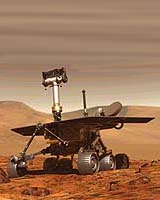
KSC - Feb 26, 2003 - The first of two Mars Exploration Rovers, MER-2 arrived at the Kennedy Space Center today from the Jet Propulsion Laboratory in Pasadena, Calif. The cruise stage, aeroshell and lander for the Mars Exploration Rover-1 mission also arrived today. This same flight hardware for the MER-2 rover arrived January 27, however this rover is scheduled to arrive at KSC around March 10.
Feb 26, 2003

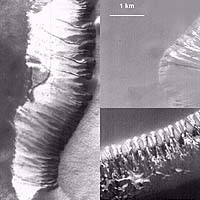
Pasadena - Feb 20, 2003 - Images from the visible light camera on NASA's Mars Odyssey spacecraft, combined with images from NASA's Mars Global Surveyor, suggest melting snow is the likely cause of the numerous eroded gullies first documented on Mars in 2000 by Global Surveyor.
Feb 20, 2003

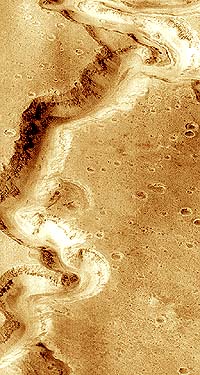
Denver - Feb 17, 2003 - While some researchers believe that only asteroid collisions made Mars warm enough to have running rivers, a Penn State researcher believes the planet had to be continuously warmer to form Mars' deep valleys, but he does not know how the planet warmed up.
Feb 17, 2003

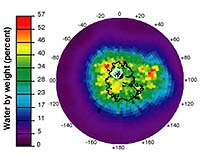
Denver - Feb 17, 2003 - Lurking just beneath the surface of Mars is enough water to cover the entire planet ankle-deep, says Los Alamos National Laboratory scientist Bill Feldman.
Feb 17, 2003

Pasadena - Feb 14, 2003 - For future Martian astronauts, finding a plentiful water supply may be as simple as grabbing an ice pick and getting to work. California Institute of Technology planetary scientists studying new satellite imagery think that the Martian polar ice caps are made almost entirely of water ice-with just a smattering of frozen carbon dioxide, or dry ice, at the surface.
Feb 14, 2003

Moffett Field - Feb 13, 2003 - NASA scientists have discovered how an intricate martian network of streams, rivers and lakes may have carried water across Mars.
Feb 13, 2003

Los Angeles - Jan 30, 2003 - In May and June of this year, NASA will launch two Mars Exploration Rover (MER) spacecraft to the Red Planet. The process of getting these rovers ready for launch involves a complicated series of tests, trials and tribulations - all designed to insure a successful mission.
Jan 30, 2003

Buffalo - Jan 24, 2003 - Research by a University at Buffalo planetary geologist suggests that generally accepted estimates about the geologic age of surfaces on Mars -- which influence theories about its history and whether or not it once sustained life -- could be way off.
Jan 24, 2003

Melbourne - Jan 06, 2003 - An Australian geologist has identified what could be the first ever active flow of fluids through gullies on Mars.
Jan 6, 2003

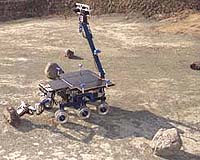
Moffett Field - Dec 20, 2002 - NASA scientists and engineers are testing new technologies using a K9 rover in a newly built 'Marscape' test facility in preparation for future missions to Mars.
Dec 20, 2002

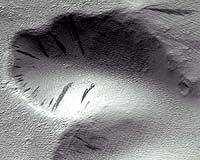
Tucson - Dec 19, 2002 - Salty water driven by hot magma from Mars' deep interior may be forming some of the mysterious dark slope streaks visible near the Red Planet's equator, according to University of Arizona scientists.
Dec 19, 2002

Melbourne - Dec 17, 2002 - Of course, Mars has no reasonable-sized moon to light the night or add romance to a lover's stroll. Its two small companions hasten across the sky like fireflies and the surface below remains dark and cold, but there are degrees of cold, and the THEMIS Infra-Red (IR) Camera on NASA's Mars Odyssey spacecraft is sensitive to the different wavelengths of IR light, from which we can measure the surface temperature both at night and day.
Dec 17, 2002

Paris - Dec 17, 2002 - The hatch to the airlock opens, revealing a human figure encased in a white pressure suit. After a brief glance at the strange surroundings through his bowl-shaped visor, the ambassador from Earth gingerly steps outside and begins to descend the ladder.
Dec 17, 2002

Los Alamos - Dec 17, 2002 - Researchers at the Los Alamos National Laboratory, the University of Arizona Lunar Planetary Laboratory, Tucson, AZ, and Cornell University, Center for Radiophysics and Space Research, Ithaca, NY have discovered further evidence for the possible existence of a changing, and perhaps predictable, Martian climate.
Dec 17, 2002

Pasadena - Dec 12, 2002 - The latest observations from NASA's Mars Odyssey spacecraft, highlighting water ice distribution and infrared images of the Red Planet's surface, are being released this week at the annual meeting of the American Geophysical Union in San Francisco.
Dec 12, 2002