The new frontier of exploration.
Mars Daily Editorial Team
Editorial Team

Mars Daily Editorial Team

Editorial Team

The Mars Daily Editorial Team produces Mars Daily's coverage of Mars exploration and science. We report on rovers and orbiters, sample-return and human-Mars planning, and the geology, atmosphere and astrobiology of the Red Planet. Articles reflect our team's collective editorial process, source verification, drafting, technical review, and editing, rather than a single writer's work. Mars Daily takes editorial responsibility for content under this byline. For more on how we work, see our editorial policy.

Legacy Reports

If At First You Don’t Succeed…

Paris (ESA) Dec 03, 2003 - Seven years ago, Prof. Vittorio Formisano had the worst day of his professional life. A malfunctioning rocket stage sent Russian planetary probe Mars '96 tumbling back down to Earth ¿ and along with it an instrument that he and his team had worked on for almost a decade. Today, Vittorio is Principal Investigator for a new version of the same instrument ¿ the Planetary Fourier Spectrometer (PFS) ¿ now almost at the Red Planet on board ESA's Mars Express.

Legacy Reports

Inflating Mars

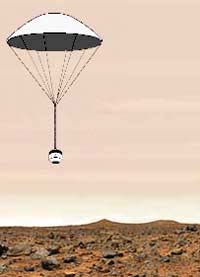
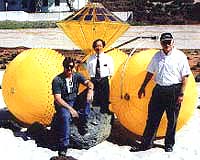
Sydney - Sept. 11. 2001 - All creatures great and small could be an appropriate metaphor for the menagerie of probes that NASA would like to send to Mars. Despite budget shortcomings that could threaten NASA¿s Scout program for small missions, engineers are pressing ahead with plans for a large rover that is tipped to fly in 2007. There could also be other spacecraft of various descriptions in the same time frame, but it¿s difficult to predict their nature with absolute certainty.

Legacy Reports

White Mars: The story of the Red Planet Without Water

Melbourne - Oct. 19, 2000 - A few paradoxes remain about this new Mars. Chief amongst these is the Carbonate Paradox. Basic chemistry requires that if Mars had liquid water at surface for any reasonable period of time, then rapid chemical reactions between the atmospheric CO2 dissolved in the water, and the rocks of Mars, would produce copious quantities of carbonate rock. The process should be so efficient that almost no CO2 should remain, and thick deposits of carbonates should fill all the lake and ocean beds of Mars.

Legacy Reports

Farewell To Earth And Lunar As MarsExpress Looks Back

Paris (ESA) Jul 18, 2003 - A unique view of our home planet and its natural satellite -- the Moon -- is one of the first data sets coming from ESA's Mars Express. It is very good news for the mission, says ESA's Mars Express Project Scientist, Agustin Chicarro. These and other data, such as those recording the major constituents of Earth as seen from space, are the actual proof that the instruments on board Mars Express, launched 2 June 2003, are working perfectly.