Martian Glaciers: Did They Originate From The Atmosphere
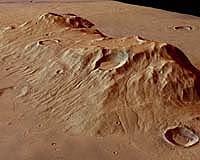
Paris (ESA) Jan 23, 2006 - The spectacular features visible today on the surface of the Red Planet indicate the past existence of Martian glaciers, but where did the ice come from?
Editorial Team
The Mars Daily Editorial Team produces Mars Daily's coverage of Mars exploration and science. We report on rovers and orbiters, sample-return and human-Mars planning, and the geology, atmosphere and astrobiology of the Red Planet. Articles reflect our team's collective editorial process, source verification, drafting, technical review, and editing, rather than a single writer's work. Mars Daily takes editorial responsibility for content under this byline. For more on how we work, see our editorial policy.

Paris (ESA) Jan 23, 2006 - The spectacular features visible today on the surface of the Red Planet indicate the past existence of Martian glaciers, but where did the ice come from?
Jan 23, 2006

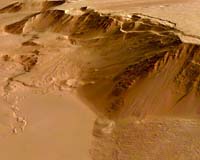
Paris (ESA) Jan 23, 2006 - These images, taken by the High Resolution Stereo Camera (HRSC) on board ESA's Mars Express spacecraft, show the depression of Juventae Chasma, cut into the plains of Lunae Planum on Mars.
Jan 23, 2006

Opportunity has resumed driving after engineers determined an acceptable new way to stow the robotic arm during drives.
Jan 23, 2006

Pasadena CA (JPL) Jan 23, 2006 - NASA's Mars Exploration Rover Spirit spent the Martin Luther King, Jr. holiday weekend analyzing a remarkable exposure of bright, loose material. Spirit discovered the material while driving toward Home Plate along the floor of the basin south of Husband Hill in Gusev Crater.
Jan 23, 2006

Washington DC (SPX) Jan 20, 2006 - Scientists think they have established a link between an ancient collision in the main asteroid belt and a layer of dust particles deposited on Earth from space soon thereafter. The findings could help identify similar events in the geological record and provide more clues about the history of the solar system.
Jan 20, 2006

Snow is the source of glacial deposits found at the base of the majestic volcanoes and mountains dotting the mid-latitude and tropical regions of Mars.
Jan 20, 2006

Pasadena CA (JPL) Jan 19, 2006 - Spirit is healthy and is driving as efficiently as possible toward Home Plate. On the way to Home Plate, Spirit stopped to look at Arad, where scientists encountered a cluster of white, powdery soil. Researchers decided to stop for a few days and use the robotic arm to conduct some measurements on it. Results are expected soon.
Jan 19, 2006

Ithaca NY (SPX) Jan 16, 2006 - Good stuff is happening on both sides of the planet. At Meridiani, the main source of excitement continues to be the festoons. The low-light imaging we've been doing is great for bringing this stuff out, and we've come to realize that it's present in a whole lot of the rocks around us.
Jan 16, 2006

Flagstaff - Jan. 17, 2001 - Some channels visible on the surface of Mars may have been gouged by ice, rather than by catastrophic flooding, as is generally believed.
Jan 9, 2006

Pasadena - Sept. 16, 2000 - Find liquid water on Mars, and life may not be far behind. Many scientists believe that this water can only exist thousands of metres beneath the planet's surface.
Jan 9, 2006

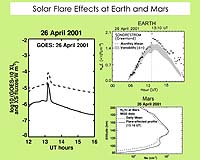
for NASA Science News - Alien planets have alien weather. Take Mars, for example. A morning weather report on the Red Planet might sound like this: Good morning, Martians! It looks like another solar storm heading our way. An X-class solar flare exploded this morning and proton counts have soared 1000-fold. More of the deadly particles are en route, so don't leave shelter today without your radiation suit!
Jan 9, 2006

by Phil BerardelliScience & Technology Editor - The spectacular success of NASA's twin Mars rovers is due obviously to the skills and determination of the scientists and engineers involved in the mission, but luck also contributed to an amazing degree.
Jan 9, 2006

Pasadena CA (JPL) Jan 09, 2006 - Last week Spirit completed robotic-arm work on El Dorado. The rover used all three of its spectrometers plus the microscopic imager for readings over the New Year's weekend.
Jan 9, 2006

Denver - Oct. 31, 2000 - U.S. Geological Survey (USGS) scientists studying Mars have discovered minerals with profound implications for the past history of the planet. The mineral olivine, an iron-magnesium silicate that weathers easily by water, has been found in abundance on Mars. The presence of olivine implies that chemical weathering by water is low on the planet and that Mars has been cold and dry throughout its geologic history.
Jan 9, 2006

KSC - Jan. 5, 2001 - The first major step toward NASA's return of a spacecraft to an orbit around Mars was achieved late Thursday night, Jan. 4, when the Mars Odyssey spacecraft arrived at NASA's Kennedy Space Center in Florida.
Jan 9, 2006

Paris (ESA) Sep 10, 2002 - Of all missions sent to Mars only one, the Viking 26 years ago, has dared to search for life. Its only conclusive result was that finding proof of extraterrestrial life proved to be much harder than expected. Second attempts never followed.
Jan 9, 2006