

Legacy Reports
AMASEing Mars
High in the Arctic, just below Earth's north polar ice cap, a collaboration of nearly two dozen biologists, geologists, and engineers have embarked on an expedition to Mars.

High in the Arctic, just below Earth's north polar ice cap, a collaboration of nearly two dozen biologists, geologists, and engineers have embarked on an expedition to Mars.
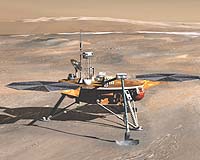
The launch of the Mars Phoenix Lander is just a year away. The spacecraft will be aiming for the martian north pole, and if it lands successfully it will dig in snow and ice in one of the few places on Mars where scientists think life could be preserved.

Pasadena (JPL) Aug 13, 2006 - While Opportunity was collecting images with the panoramic camera on the rover's 902nd Martian day, or sol (Aug. 7, 2006), a spacecraft anomaly at 11:19 a.m. local solar time caused the rover's fault protection software to interrupt operations, place the rover in a safe state, and reboot the flight software.

Moscow (RIA Novosti) Aug 13, 2006 - Over 70 people, including six women and a married couple, from at least 16 countries have applied to take part in a marathon simulated flight to Mars, a Russian scientist said Friday.

Los Angeles CA (SPX) Aug 11, 2006 - The Mars Society is seeking seven volunteers to participate as members of the crew of the Flashline Mars Arctic Research Station (FMARS) during an extended simulation of human Mars exploration operations on Devon Island (May 1 through August 31, 2007).

Greenbelt MD (SPX) Aug 09, 2006 - Scientists and researchers are spending two and a half weeks in Svalbard, an archipelago in the Arctic Ocean north of Norway. The objective of the Arctic Mars Analog Svalbard Expedition (AMASE) is to characterize the geology, geophysical features, biosignatures, and possible life forms of volcanic centers, warm springs, and perennial rivers, settings thought to be analogous to sites on ancient Mars. AMASE targets the Bockfjorden area of the Norwegian island of Svalbard, in hot-spring-deposited carbonate terraces.

Berkeley CA (SPX) Aug 08, 2006 - The planet-wide dust storms that periodically cloak Mars in a mantle of red may be generating a snow of corrosive chemicals, including hydrogen peroxide, that would be toxic to life, according to two new studies published in the most recent issue of the journal Astrobiology.

Pasadena CA (JPL) Aug 08, 2006 - Spirit has finished acquiring images for the McMurdo panorama and began adding some finishing touches around the edges. The rover is healthy and continues to make progress on its winter science campaign of observations on Mars. Plans called for Spirit to complete a winter check-up of all the rover's cameras by calibrating the microscopic imager.

Pasadena CA (JPL) Aug 07, 2006 - After traversing the sandy plains of Meridiani to Beagle Crater, Opportunity investigated a patch of outcrop pavement thought to be representative of the Martian surface beyond the reach of materials excavated by the impacts that dug Beagle and the nearby, much larger Victoria Crater. Opportunity used its rock abrasion tool to grind away the surface of rock for the first time since the rover's 691st sol, or Martian day (Jan. 3, 2006).

Moscow (UPI) Aug 04, 2006 - Russia's space agency is seeking volunteers for a 520-day mock Mars mission. The announcement of the simulation is posted on the Web site of Russia's Federal Space Agency, Space.com reported. The flight will be simulated on the premises of the Russian Academy of Sciences' Institute of Medical and Biological Research in northern Moscow.

Greenbelt, MD (SPX) Aug 04, 2006 - Electricity generated in dust storms on Mars may produce reactive chemicals that build up in the Martian soil, according to NASA-funded research. The chemicals, like hydrogen peroxide (H2O2), may have caused the contradictory results when NASA's Viking landers tested the Martian soil for signs of life, according to the researchers.

Pasadena CA (SPX) Aug 02, 2006 - With only eight Martian days to go before Opportunity joins its twin Spirit in 900-sol territory, the rover has spent its last five sols at a target called Joseph McCoy.

Ann Arbor MI (SPX) Aug 01, 2006 - The question of whether the planet Mars can support life has tantalized scientists for years, but research now suggests that Martian dust devils and storms produce oxidants that would render the planet's surface uninhabitable for life as it exists on Earth.

Fayetteville AR (SPX) Aug 01, 2006 - A recent grant from NASA will enable the Arkansas Center for Space and Planetary Sciences at the University of Arkansas to continue its work creating missions to asteroids and exploring the possibilities and chemistry of water on Mars as part of the nation's space effort.
Pasadena CA (SPX) Jul 31, 2006 - Spirit remains healthy and continues to make progress on computer upgrades and scientific research, despite winter temperatures colder than any yet experienced during the rover's two and a half years on Mars.

Washington DC (SPX) Jul 25, 2006 - In terms of going and going and going, the Energizer Bunny has nothing on NASA's twin Mars Exploration Rovers. Originally designed to operate in the harsh environment of the red planet for 90 sols, or Martian days, Spirit recently passed its 900th sol, and Opportunity will reach that mark within two weeks.