The new frontier of exploration.
Mars Daily Editorial Team
Editorial Team

Mars Daily Editorial Team

Editorial Team

The Mars Daily Editorial Team produces Mars Daily's coverage of Mars exploration and science. We report on rovers and orbiters, sample-return and human-Mars planning, and the geology, atmosphere and astrobiology of the Red Planet. Articles reflect our team's collective editorial process, source verification, drafting, technical review, and editing, rather than a single writer's work. Mars Daily takes editorial responsibility for content under this byline. For more on how we work, see our editorial policy.

Legacy Reports

Spirit Continues Driving While Engineers Check Robotic Arm

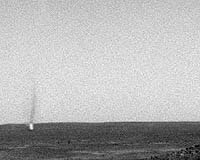
Pasadena CA (JPL) Feb 26, 2007 - Spirit is healthy and making progress on the return trek to Home Plate. Rover handlers have put use of the robotic arm on hold in order to run diagnostic tests of apparent positioning errors in the placement of instruments on the arm. Meanwhile, Spirit continues driving, searching for dust devils and clouds using WATCH computer commands, and acquiring other remote sensing data.

Legacy Reports

APL-Built Mineral Mapper Uncovering Clues Of Martian Surface Composition

Laurel MD (SPX) Feb 21, 2007 - Reaching its first 100 days of operations, the powerful mineral-detector aboard the newest satellite to circle Mars is changing the way scientists view the history of water on the red planet. The Compact Reconnaissance Imaging Spectrometer for Mars (CRISM), designed and built by the Johns Hopkins University Applied Physics Laboratory in Laurel, Md., has teamed with the five other cameras and sensors aboard NASA's Mars Reconnaissance Orbiter (MRO) to provide new clues about where water could have existed on or near the Martian surface.

Legacy Reports

Hunting Martian Fossils Best Bet For Locating Mars Life

San Francisco CA (SPX) Feb 20, 2007 - Hunting for traces of life on Mars calls for two radically different strategies, says Arizona State University professor Jack Farmer. Of the two, he says, with today's exploration technology we can most easily look for evidence for past life, preserved as fossil biosignatures in old rocks. Farmer is a professor of geological sciences in ASU's School of Earth and Space Exploration, where he heads the astrobiology program.

Legacy Reports

Orbiter Provides New Hints Of Past Groundwater Flows On Mars

Pasadena CA (JPL) Feb 16, 2007 - A spacecraft recently arrived at Mars has provided new evidence that fluids, likely including water, once flowed widely through underlying bedrock in a canyon that is part of the great Martian rift valley. The new color images from the HiRISE camera aboard NASA's Mars Reconnaissance Orbiter show an equatorial landscape of hills composed of dozens of alternating layers of dark- and light-toned rocks, and crossed by dark sand dunes.

Legacy Reports

A Wet Past Launches Quest For Life On Red Planet

San Francisco (AFP) Feb 15, 2007 - Growing evidence of water on Mars adds weight to the theory that life once existed and could still exist beneath its surface, said a group of scientists meeting in San Francisco. We have abundant evidence that early Mars was water rich, Houston, Texas, Lunar and Planetary Institute astronomer Stephen Clifford told the annual meeting of the American Association for the Advancement of Science (AAAS).

Legacy Reports

Success For Thales Space Laser Headed To Mars

Paris, France (SPX) Feb 13, 2007 - Thales's space laser programme has achieved a new milestone with the successful completion of shock-resistance tests at over 2,000 g in all three axes. Designed to operate for two years on Mars after a 10-month voyage through space, the Thales laser has already demonstrated impressive performance, including energy delivery of 30 mJ per pulse across a temperature range of -30 to +30oC and the ability to withstand extremely hostile radiation and dust environments.

Legacy Reports

Opportunity Flips 10 Kilometers And Tests New Drive Software

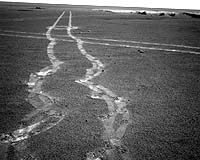
Pasadena CA (JPL) Feb 13, 2007 - Opportunity has completed a remote sensing campaign at Cape Desire and is on the move to the next promontory, called Cabo Corrientes. Opportunity's odometer rolled past 10 kilometers (6.2 miles) during the 50.51-meter (166 feet) drive on sol 1080. By contrast, the NASA Level 1 requirements for the mission called for achieving at least 600 meters (1,969 feet) with one rover, and the mission design requirement was for 1,000 meters (3,281 feet).