The new frontier of exploration.
Mars Daily Editorial Team
Editorial Team

Mars Daily Editorial Team

Editorial Team

The Mars Daily Editorial Team produces Mars Daily's coverage of Mars exploration and science. We report on rovers and orbiters, sample-return and human-Mars planning, and the geology, atmosphere and astrobiology of the Red Planet. Articles reflect our team's collective editorial process, source verification, drafting, technical review, and editing, rather than a single writer's work. Mars Daily takes editorial responsibility for content under this byline. For more on how we work, see our editorial policy.

Del.icio.us

Phoenix Landing Area Viewed By Mars Color Imager

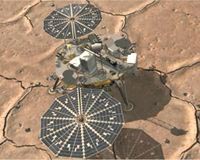
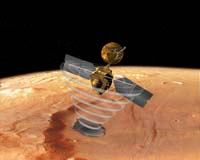
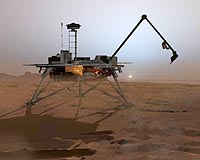
Pasadena CA (SPX) May 13, 2008 - NASA's Phoenix Mars Lander is scheduled to land on the Martian northern plains near 68 degrees north latitude, 127 degrees west longitude on May 25, 2008. In preparation for the landing, NASA's Mars Reconnaissance Orbiter has been monitoring weather in the region around the landing site. On April 20, 2008, the orbiter's Mars Color Imager camera captured this view of a large region of northern Mars that includes the landing target area in the lower right quadrant.

Legacy Reports

Spirit In A Catch-22: Stay Awake Or Sleep

Pasadena CA (SPX) May 06, 2008 - Spirit's Tau measurements of atmospheric dust have remained steady, but solar array input has dropped a bit to 235 watt-hours per sol. Spirit still has enough energy to squeeze in Moessbauer studies of iron-bearing minerals at a time of year when the rover's handlers expected Spirit to be concerned only with survival. At present, the rover's target of scientific interest is a soil exposure nicknamed after Arthur C. Harmon, a former Tuskegee airman.

Legacy Reports

Artificial Intelligence Boosts Science From Mars

Paris, France (ESA) Apr 30, 2008 - Artificial intelligence (AI) being used at the European Space Operations Centre is giving a powerful boost to ESA's Mars Express as it searches for signs of past or present life on the Red Planet. Since January 2005, Mars Express has been using its sophisticated instruments to study the atmosphere, surface and subsurface of Mars, confirming the presence of water and looking for other signatures of life on and below the Red Planet's rocky terrain.