
Mars Polar Cap Mystery Solved
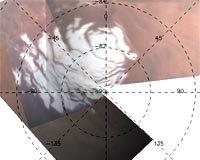
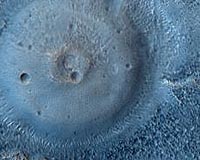
Scientists are now able to better explain why Mars's residual southern ice cap is misplaced, thanks to data from ESA's Mars Express spacecraft - the martian weather system is to blame.
Editorial Team
The Mars Daily Editorial Team produces Mars Daily's coverage of Mars exploration and science. We report on rovers and orbiters, sample-return and human-Mars planning, and the geology, atmosphere and astrobiology of the Red Planet. Articles reflect our team's collective editorial process, source verification, drafting, technical review, and editing, rather than a single writer's work. Mars Daily takes editorial responsibility for content under this byline. For more on how we work, see our editorial policy.

Scientists are now able to better explain why Mars's residual southern ice cap is misplaced, thanks to data from ESA's Mars Express spacecraft - the martian weather system is to blame.
Sep 23, 2008

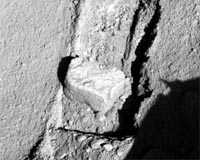
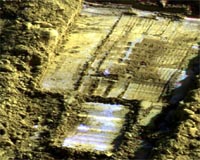
Pasadena CA (SPX) Sep 23, 2008 - This image from the Surface Stereo Imager on NASA's Phoenix Mars Lander shows morning frost inside the Snow White trench dug by the lander, in addition to subsurface ice exposed by use of a rasp on the floor of the trench.
Sep 23, 2008

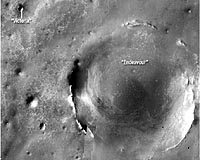
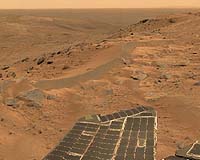
Pasadena CA (SPX) Sep 23, 2008 - NASA's Mars Rover Opportunity is setting its sights on a crater more than 20 times larger than its home for the past two years.
Sep 23, 2008

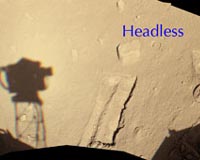
Tucson AZ (SPX) Sep 23, 2008 - If the robotic arm on NASA's Phoenix Mars Lander can nudge a rock aside, scientists on the Phoenix team would like to see what's underneath.
Sep 23, 2008

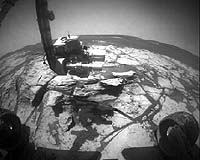
Pasadena CA (SPX) Sep 22, 2008 - During the past week, Opportunity performed several tests of the robotic arm to learn how to use it with a disabled shoulder joint. Having successfully completed those tests, Opportunity is moving on to investigate some bright patches of dust. Scientists hope to ascertain if the patches contain material not thoroughly analyzed in the past.
Sep 22, 2008

Tucson AZ (SPX) Sep 19, 2008 - The High Resolution Imaging Science Experiment aboard NASA's Mars Reconnaissance Orbiter, has returned more than 8,214 gigapixel-size images of the Martian surface since the start of the science phase of the mission in November 2006.
Sep 19, 2008

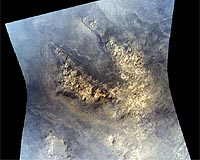
Tucson AZ (SPX) Sep 18, 2008 - Water may have played a role in shaping parts of the Martian landscape a billion years longer than previous studies have shown, according to a research team led by Catherine Weitz, a senior scientist with the Planetary Science Institute.
Sep 18, 2008

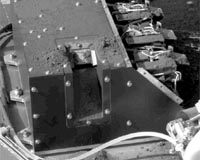
Pasadena CA (SPX) Sep 17, 2008 - This image, taken by NASA's Phoenix Mars Lander's Surface Stereo Imager, documents the delivery of a soil sample from the Snow White trench to the Wet Chemistry Laboratory. A small pile of soil is visible on the lower edge of the second cell from the top.
Sep 17, 2008

Boulder CO (SPX) Sep 17, 2008 - In the largest research contract ever awarded to the University of Colorado at Boulder, the Laboratory for Atmospheric and Space Physics has been selected by NASA to lead a $485 million orbiting space mission slated to launch in 2013 to probe the past climate of Mars, including its potential for harboring life over the ages.
Sep 17, 2008

Washington DC (SPX) Sep 16, 2008 - NASA has selected a Mars robotic mission that will provide information about the Red Planet's atmosphere, climate history and potential habitability in greater detail than ever before. Called the Mars Atmosphere and Volatile EvolutioN (MAVEN) spacecraft, the $485 million mission is scheduled for launch in late 2013.
Sep 16, 2008

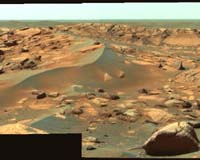
Pasadena CA (SPX) Sep 16, 2008 - Opportunity has completed one of the most fantastic scientific campaigns of the Mars Exploration Rover mission -- the interior investigation of Victoria Crater. After spending more than 340 Martian days, known as sols -- almost one Earth year -- inside the crater, Opportunity climbed back out on sol 1634 (Aug. 28, 2008).
Sep 16, 2008

Moffett Filed CA (SPX) Sep 12, 2008 - On the surface, Pavilion Lake, nestled among the peaks of Canada's Marble Range, looks like a thousand other mountain lakes. It's not unusually large or deep. It's not especially acidic, or alkaline; it's not overly salty; nor are there high concentrations of minerals dissolved in its water. Locals come here to fish, to boat, to swim, and to watch the summer clouds drift by.
Sep 12, 2008

Tucson AZ (SPX) Sep 12, 2008 - NASA's Phoenix Mars Lander has photographed several dust devils dancing across the arctic plain this week and sensed a dip in air pressure as one passed near the lander. These dust-lofting whirlwinds had been expected in the area, but none had been detected in earlier Phoenix images.
Sep 12, 2008

Tucson AZ (SPX) Sep 11, 2008 - The next soil sample that NASA's Phoenix Mars Lander will deliver to its deck instruments will go to the fourth of the four cells of Phoenix's wet chemistry laboratory, according to the Phoenix team's current plans.
Sep 11, 2008

Pasadena CA (SPX) Sep 10, 2008 - The Robotic Arm Camera on NASA's Phoenix Mars Lander took this image on Sept. 1, 2008, at about 4 a.m. local solar time during the 97th Martian day, or sol, since landing. The view underneath the lander shows growth of the clumps adhering to leg strut (upper left) compared with what was present when a similar image was taken about three months earlier.
Sep 10, 2008

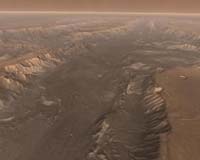
Santa Cruz CA (SPX) Sep 09, 2008 - A new study suggests that ancient features on the surface of Mars called valley networks were carved by recurrent floods during a long period when the martian climate may have been much like that of some arid or semi-arid regions on Earth.
Sep 9, 2008