The Sun Is Setting On Phoenix
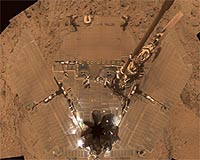
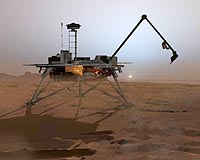
Moffett Field CA (SPX) Oct 14, 2008 - As fall approaches Mars' northern plains, NASA's Phoenix Lander continues to dig into the red planet's soil and deliver samples to its onboard science instruments for analysis.
Editorial Team
The Mars Daily Editorial Team produces Mars Daily's coverage of Mars exploration and science. We report on rovers and orbiters, sample-return and human-Mars planning, and the geology, atmosphere and astrobiology of the Red Planet. Articles reflect our team's collective editorial process, source verification, drafting, technical review, and editing, rather than a single writer's work. Mars Daily takes editorial responsibility for content under this byline. For more on how we work, see our editorial policy.

Moffett Field CA (SPX) Oct 14, 2008 - As fall approaches Mars' northern plains, NASA's Phoenix Lander continues to dig into the red planet's soil and deliver samples to its onboard science instruments for analysis.
Oct 14, 2008

Moscow (RIA Novosti) Oct 13, 2008 - Deep space exploration is becoming an ever bigger part of national space programs. Currently, missions to the Moon and Mars are considered feasible. The U.S. has announced preparation for another space probe launch to collect data from the Martian atmosphere, scheduled for 2013.
Oct 13, 2008

Tucson AZ (SPX) Oct 13, 2008 - The crater-counting system that scientists have used since the 1970s to determine the age of large geologic features on Mars will also allow them to date small features, such as riverbeds and lava flows, according to William K. Hartmann, a senior scientist at the Tucson-based Planetary Science Institute.
Oct 13, 2008

Tempe AZ (SPX) Oct 13, 2008 - A six-minute rocket firing on September 30 has put NASA's Mars Odyssey spacecraft on track for a new orbit around the Red Planet. The change, part of a two-year extension for the mission, will give an ASU-operated instrument carried on Odyssey greater sensitivity for mapping Martian minerals.
Oct 13, 2008

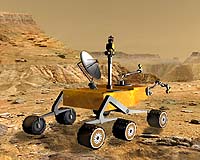
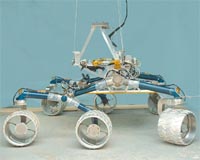
Washington (UPI) Oct 10, 2008 - NASA plans to launch a new exploration rover to Mars next fall, despite budget and technical concerns, a NASA official said Friday.
Oct 10, 2008

Pasadena CA (SPX) Oct 10, 2008 - As fall approaches Mars' northern plains, NASA's Phoenix Lander is busy digging into the Red Planet's soil and scooping it into its onboard science laboratories for analysis.
Oct 10, 2008

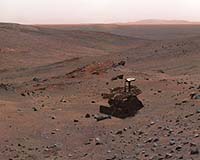
Pasadena CA Oct 04, 2008 - Opportunity has embarked on the next great challenge -- a journey of 12 kilometers (7.5 miles) southeast to a huge hole in the ground nicknamed Endeavour Crater. Measuring 22 kilometers (14 miles) from rim to rim and plunging 300 meters (1,000 feet) below the surface, Endeavour Crater is significantly larger than Victoria Crater, which is 730 meters (almost half a mile) wide and 70 meters (200 feet) deep. Because it is so much deeper, Endeavour promises to expose even more rock layers going further back in time.
Oct 4, 2008

Moffett Field CA (SPX) Oct 01, 2008 - Volcanic eruptions were commonplace on ancient Mars, when vents and fissures spewed out gases like water vapor, carbon dioxide, sulfur dioxide, and hydrogen sulfide. Such locales were very hot and very acidic - characteristics that would seem to be inhospitable to life. But in recent years researchers have discovered a vast array of primitive organisms living in analogous environments on Earth.
Oct 1, 2008

Pasadena CA (SPX) Sep 30, 2008 - NASA's Phoenix Mars Lander has detected snow falling from Martian clouds. Spacecraft soil experiments also have provided evidence of past interaction between minerals and liquid water, processes that occur on Earth.
Sep 30, 2008

Bonn, Germany (SPX) Sep 29, 2008 - About four billion years ago, there were lakes on Mars which may have been fed by short-lived rivers that were, in turn, fed by precipitation. These lakes filled craters that were formed by the impact of meteorites. Water accumulated in places where rivers broke through the crater rims.
Sep 29, 2008

Pasadena CA (JPL) Sep 29, 2008 - NASA's Mars Reconnaissance Orbiter has revealed hundreds of small fractures exposed on the Martian surface that billions of years ago directed flows of water through underground Martian sandstone.
Sep 29, 2008

Pasadena CA (SPX) Sep 29, 2008 - NASA's Mars Rover Opportunity is setting its sights on a crater more than 20 times larger than its home for the past two years. To reach the crater the rover team calls Endeavour, Opportunity would need to drive approximately 12 kilometers (7 miles) to the southeast, matching the total distance it has traveled since landing on Mars in early 2004. The rover climbed out of Victoria Crater earlier this month.
Sep 29, 2008

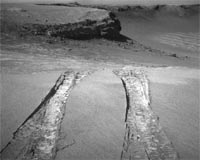
Pasadena CA (JPL) Sep 29, 2008 - During the past week, Opportunity has been trying to reach a patch of dust between two crests of the ridge surrounding Victoria Crater. The rover approached the ridge from the west, driving on flat ground, on Martian days, or sols, 1648 and 1650 (Sept. 12 and Sept. 14, 2008).
Sep 29, 2008

Pasadena CA (SPX) Sep 25, 2008 - The robotic arm on NASA's Phoenix Mars Lander slid a rock out of the way during the mission's 117th Martian day (Sept. 22, 2008) to gain access to soil that had been underneath the rock.
Sep 25, 2008

Pasadena CA (SPX) Sep 25, 2008 - With Martian winter on the wane, Spirit is using significantly less energy to stay warm. During the winter solstice, Spirit needed 90 watt-hours to run the heater. Now, the rover uses between 30 and 40 watt-hours.
Sep 25, 2008

Boston MA (SPX) Sep 23, 2008 - Boston University's Center for Space Physics (CSP) has announced that it will participate in NASA's next mission to Mars to study the planets atmosphere and climate history - particularly the history of water on the planet.
Sep 23, 2008