The new frontier of exploration.
Mars Daily Editorial Team
Editorial Team

Mars Daily Editorial Team

Editorial Team

The Mars Daily Editorial Team produces Mars Daily's coverage of Mars exploration and science. We report on rovers and orbiters, sample-return and human-Mars planning, and the geology, atmosphere and astrobiology of the Red Planet. Articles reflect our team's collective editorial process, source verification, drafting, technical review, and editing, rather than a single writer's work. Mars Daily takes editorial responsibility for content under this byline. For more on how we work, see our editorial policy.

Del.icio.us

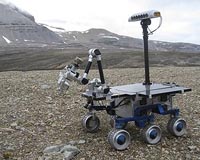
AMASE 2009 Expedition Takes Off In The Arctic

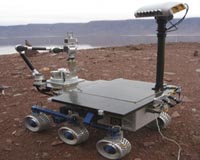
Washington DC (SPX) Aug 12, 2009 - From August 1 to 24, 2009 AMASE (the Arctic Mars Analog Svalbard Expedition) will be taking place in Svalbard (Norway, 76-81 degrees N). This expedition involves different researchers from the Carnegie Institution of Washington, NASA/JPL, ESA, Cornell University, the Earth and Planetary Exploration Services (Norway), DLR (Germany), the University of Valladolid (Spain) and the University of Leeds (UK).

Del.icio.us

JPL Mars Sandbox Testing Continues For Spirit Extraction

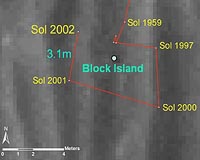
Pasadena CA (JPL) Jul 27, 2009 - Mars rover team members have begun a new phase of testing at JPL - using longer-duration experiments - in their preparations for driving Spirit again on Mars. They have completed assessments of individual maneuvers, using the test rover in a box of sloped, soft soil that simulates conditions at the patch of Martian ground called Troy, where Spirit's wheels have dug themselves hub-deep.

Del.icio.us

Australia Selected To Support Research For Future Mars Mission

Sydney, Australia (SPX) Jul 23, 2009 - Volunteers from the Mars Society Australia's Sydney chapter have been selected to support this year's Flashline Mars Arctic Research Station (FMARS) expedition by running the Pacific-based Mission Support Centre. FMARS is an annual research expedition conducted at a research station located at Devon Island near the North Pole. The peer reviewed research conducted at Devon Island, a Mars-like 'analogue' environment, is geared towards learning how humans will live and work on Mars, and has been visited by scientists and engineers from around the world since it was first constructed in 2000. Australia's contribution to this expedition follows in the tradition of assisting international space-related projects and makes this valuable research possible.