
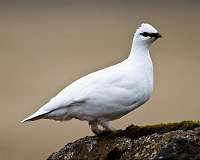
To survive the Arctic's frigid temperatures, animals must use their energy efficiently. According to a new study, one Arctic bird species, the Svalbard rock ptarmigan, utilizes a previously unknown energy-saving method.
No bird lives closer to the North Pole than the the Svalbard rock ptarmigan. To better understand how the bird species survives the extreme conditions, researchers analyzed changes in the bird's immune system during the winter and late spring.
"We have discovered that the birds reduce how much they spend on keeping their own immune defense system up and running during the five months of the year when it is dark around the clock, probably to save energy," Andreas Nord, researcher at Lund University in Sweden, said in a news release.
"Instead, they use those resources on keeping warm and looking for food. When daylight returns, their immune response is strengthened again."
When birds become ill in the middle of winter, scientists found, their energy levels drop compared to when they are healthy. The opposite occurs when the birds get sick during the spring.
"A weaker immune system is probably a part of all the adaptations that Arctic animals use to save energy in winter," Nord said. "The risk of being infected by various diseases so far north is less in winter than when it becomes warmer towards summer."
The novel energy-saving strategy — described this week in the journal of Experimental Biology — is surprisingly risky. The bird doesn't have much an immune system to sacrifice. Scientists suspect the a strong immune system is less useful in the Arctic, where the Svalbard rock ptarmigan evolved.
"This may have negative consequences when the climate changes and migratory birds arrive earlier in the Arctic and leave later," Nord said.
"More and more tourists also come ashore in places where people have not set foot before. Such a scenario paves the way for an increased risk of disease and may be a threat to animals that have evolved in the Arctic where a strong immune defense system might not have been needed."
Seal behavior helps scientists predict changes in Antarctic krill distribution
Washington DC (UPI) Apr 28, 2020 –
By analyzing the feeding patterns of crabeater seals, scientists have designed new models to predict the effects of environmental changes on Antarctic krill distribution.
"We're using the feeding behavior of this one predator as an indicator of the habitat for their prey and how that could change," Luis Huckstadt, researcher with the Institute of Marine Sciences at the University of California, Santa Cruz, said in a news release.
For the last several years, Daniel Costa, professor of ecology and evolutionary biology and director of the IMS, has been using electronic tags to track the movements and behavior of crabeater seals, as well as collect environmental data related to their habitat preferences.
Because crabeater seals stay close to the ocean surface when traveling and only dive when feedings, tracking data can be used to determine the location of large Antarctic krill populations.
Scientists were able to use the the environmental data collected by Costa and his colleagues to estimate the kinds of marine conditions preferred by the tiny crustaceans.
Researchers used the data to build a model capable of simulating the effects of climate change on the krill distribution along the western Antarctic Peninsula. The published the results of their modeling efforts this week in the journal Nature Climate Change.
As the climate warms, krill numbers are likely to decline along the northern portions of the peninsula. As water temperatures rise and currents shift, the crustaceans will move farther offshore.
Along the southern part of the peninsula, south of Alexander Island and in the Bellinghausen Sea, krill distribution is likely to expand. Both seals and the many other predators that rely on krill will have to adapt their foraging patterns and follow the krill southward — or find new sources of food.
"The shift in krill habitat away from coastal waters in the north has big implications for species like penguins and fur seals, which can't make long foraging trips because they have to come back to land to feed their offspring," Huckstadt said.
Because crabeater seals spend all year in Antarctica and don't live in small, flexible groups instead of massive colonies, scientists expect the marine mammals will be better able to adapt. Other marine species that migrate to the region each summer, like humpback and minke whales, will have to make longer treks to find food.
"It will be challenging for a lot of species," Huckstadt said. "Things are changing so fast in Antarctica, the changes we're seeing in our model might be coming sooner than we expected."
Marine mammals are the only animals that hunt krill. Humans use krill for aquaculture feed and fish bait, and the Antarctica Peninsula is home to largest krill fishery in the world.
"We don't really have a good grasp on how fishing pressure will change in the future, and that's one reason so many marine protected areas have been proposed for the western Antarctic Peninsula," Huckstadt said.
"The peninsula is critical habitat for krill, which is the most abundant and important prey species in this region. Everything depends on krill, so any changes will cascade through the ecosystem."
