
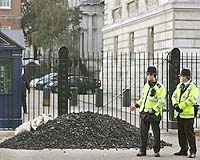
British activists said Friday they dumped a ton of coal on the government's steps in an act of protest as world leaders sit to sign the Paris climate deal.
"No-one likes a view of dirty coal outside their door, so we've dumped this pile of coal to remind ministers to do the right thing and leave coal in the ground," Guy Shrubsole, an activist with the British Friends of the Earth campaign, said in a statement.
Activists dumped a ton of coal at the doorstep of the British Department of Energy and Climate Change to protest ongoing mining operations in the country. The campaign group said it was frustrated with permits for new open-cast mining operations that have emerged since the government made pledges in November to phase out coal.
British Energy and Climate Change Secretary Amber Rudd in November said the government would start restricting the reliance on coal-fired power by 2023 and close all coal-fired power stations by 2025. Nevertheless, while the British economy was relying more on renewable energy resources, coal provided more electricity in 2014 than it did in 1999.
Provisional data from 2015 published by the government in March show coal production declined by 27 percent from the previous year as mines approached their end of their operational life. Oil and gas production, meanwhile, increased by 13.4 percent and 7.8 percent, respectively, as new fields open up.
For Europe as a whole, meanwhile, data from 2014, the last full year for which metrics are available, show the share of energy from renewable resources was 16 percent, about 89 percent above 2004 levels, the first year it started keeping records on renewables.
The British protest comes as world leaders gather at the U.N. headquarters to start signing off on last year's Paris Climate Agreement, one of the most comprehensive pieces of climate legislation even opened for signature.
The agreement called for all parties to make strides to reduce greenhouse gas emissions to a level necessary to curb global warming to less than 2 degrees Celsius by the end of the century
John Knox, a U.N. special envoy on human rights and the environment, said in a statement earlier this week the commitments pledged by governments to date "are insufficient."
