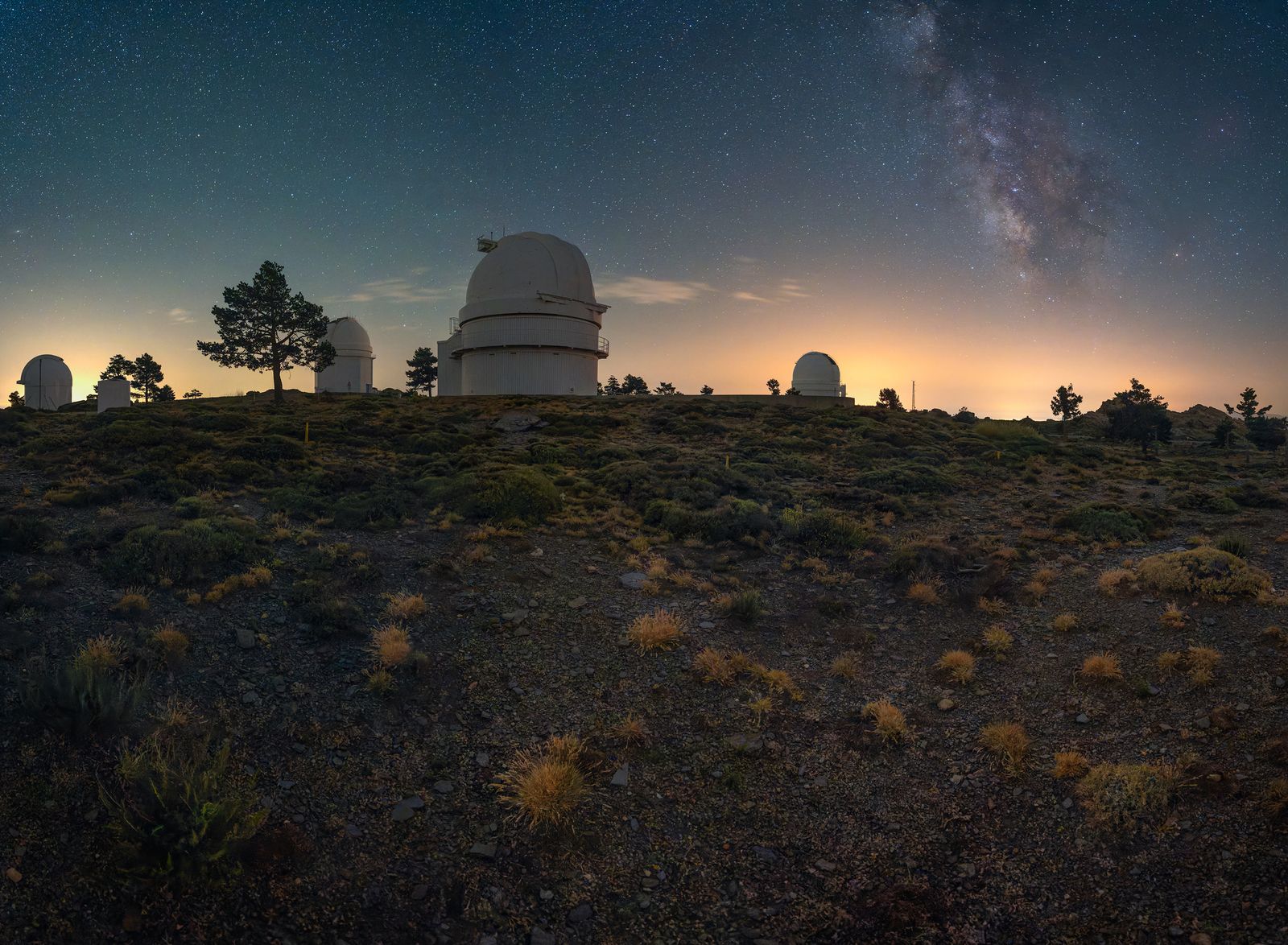
On 14 April 2026, just before dawn over the Sonoran Desert, a 4-metre telescope on Kitt Peak swung its 5,000 fibre-optic eyes toward a patch of sky near the Little Dipper and, in about 20 minutes, gathered the last photons needed to finish the largest high-resolution 3D map of the universe ever assembled. The instrument, called the Dark Energy Spectroscopic Instrument, or DESI, had been chasing that milestone for five years. When the sun rose over Arizona, the survey it was built for was done.
The map traces the pull of dark energy across 11 billion years of cosmic history.
That is roughly 80 percent of the age of the universe, compressed into a single searchable atlas of more than 47 million galaxies and quasars and 20 million stars. Each dot on the map is a real object with a measured distance, a measured velocity, and a measured chemical fingerprint. Earth sits at the centre of the wedge, and everything outside it is the past, arranged by how long its light has been travelling.
What actually happened on 14 April
The final night looked like any other night at Kitt Peak National Observatory. The Nicholas U. Mayall 4-metre Telescope tilted toward a pre-planned tile of sky. Inside its prime-focus cage, 5,000 robotic positioners shuffled into place. Each carried an optical fibre. Each had to line up on a specific galaxy or quasar to a tolerance of 10 microns, thinner than a human hair.
Then the shutters opened. For about 20 minutes, photons that had been travelling since before the Earth existed poured into the fibres. Ten spectrographs in a temperature-controlled room split that light into its component colours, teasing out redshift, velocity and composition for thousands of objects at once. Around 80 gigabytes of data streamed off the mountain that night through the Department of Energy’s ESnet network to supercomputers at Berkeley Lab.
When the last tile in the original survey plan was checked off, the collaboration marked completion. According to Carnegie Mellon University, which contributed key researchers to the project, DESI has now measured cosmological data for six times as many galaxies and quasars as all previous surveys combined.
Why 5,000 fibres and not one big camera
A camera photographs a patch of sky. A spectrograph does something harder. It measures the exact wavelength of the light coming from an object, which reveals how much that light has been stretched by the expansion of the universe. Stretched light means the object is far away and moving away from Earth. That stretch, the redshift, is how astronomers turn a flat picture of the sky into a 3D map.
Doing this one galaxy at a time would take centuries. DESI does it 5,000 at a time. The robotic positioners rearrange themselves between exposures, choreographed by software so the fibres never collide, then lock on to a new set of targets. The instrument is essentially a factory floor for spectra, and it runs almost every clear night the telescope is open.
The design allowed the collaboration to plan for 34 million galaxies and quasars over five years. It captured more than 47 million, plus 20 million stars, and finished ahead of schedule.
What dark energy is, and why the map matters
Dark energy is the name astronomers give to whatever is pushing the universe apart at an accelerating rate. It makes up about 70 percent of everything. Nobody knows what it is. For decades, the working assumption has been that it is a cosmological constant, an unchanging pressure baked into the fabric of space itself, first proposed and then rejected by Einstein before observations of distant supernovae in 1998 revived the idea.
The DESI map lets researchers test that assumption directly. By comparing how galaxies clumped together at different points in cosmic history, from about 11 billion years ago to today, they can watch dark energy’s grip on matter tighten or loosen over time. If it has stayed constant, the standard model of cosmology holds. If it has changed, the model breaks.
Early results from the first three years of DESI data hinted at the second option. As the international collaboration reported, dark energy may be evolving, weakening slightly over the last few billion years. That would be one of the largest revisions to physics since the discovery of cosmic acceleration itself. The full five-year dataset is what will confirm or kill the hint. First results from the complete survey are expected in 2027.
The 900-person, 70-institution machine behind it
DESI is run by the U.S. Department of Energy’s Lawrence Berkeley National Laboratory, but the collaboration behind it stretches across more than 70 institutions and involves over 900 researchers, including 300 PhD students. The telescope belongs to the U.S. National Science Foundation and sits on Tohono O’odham land at Kitt Peak, a mountain the nation calls I’oligam Du’ag.
The survey was not a straight run. In 2020, final testing of the instrument was halted by the COVID-19 pandemic. Operations were also disrupted by wildfire and subsequent damage to observatory infrastructure.
According to statements released with the survey completion, researchers described DESI as a complex but reliable system that has performed well despite challenges. Researchers noted that after five years of operation, they have developed deep familiarity with the instrument’s characteristics and performance.
DESI director Michael Levi described the five-year survey as highly successful, noting that the instrument exceeded expectations.
What 47 million galaxies actually look like
Try to picture it. The moon covers about 0.2 square degrees of sky. The full sky holds more than 41,000 square degrees. DESI’s original map covers 14,000 of them, roughly a third of everything visible from Earth, and the extension now underway will push it to 17,000 by 2028.
Inside that volume, each galaxy in the map is placed in three dimensions by its redshift. The deepest objects are quasars, whose light left them when the universe was less than 3 billion years old. The nearest are galaxies just a few hundred million light-years away, close enough that their light is comparatively fresh. Slice the wedge at any depth and you are looking at a snapshot of the cosmos at a specific age.
The pattern that emerges is not random. Galaxies cluster along filaments and sheets separated by immense voids, a structure cosmologists call the cosmic web. Baryon acoustic oscillations, faint ripples in the density of matter frozen in place when the universe cooled enough for atoms to form, leave a preferred distance of about 490 million light-years between clusters. That fossil ruler is what DESI measures to track expansion. According to coverage of the completed survey, the density of the DESI map means those ripples can be resolved across cosmic time with unprecedented precision.
The dark matter question sitting alongside it
Dark energy is only one of the two things that dominate the universe and nobody understands. The other is dark matter, the invisible substance that accounts for about 85 percent of all mass. DESI is helping there too, by mapping stellar streams and dwarf galaxies whose motions trace the gravitational pull of dark matter around the Milky Way.
Between observational efforts like DESI and underground detection experiments, researchers are attacking the 95 percent of the universe that visible matter cannot account for. One approach watches how the invisible stuff shapes structure across billions of light-years. The other waits for particle interactions in shielded detectors deep underground.
What comes next, and what comes after that
DESI is not done observing. The collaboration will keep taking data through 2028, extending the map by about 20 percent into regions closer to the plane of the Milky Way and further south, where Earth’s atmosphere is thicker and observations are harder. The extension will also revisit already-mapped patches to catalogue fainter, more distant luminous red galaxies, adding density to the existing map.
Then comes DESI-II, planned to begin in 2029, which will push further into transient astronomy, watching supernovae, kilonovae and other short-lived events flare across the sky. A version of that work is already underway using unused fibres during the main survey, capturing what the collaboration calls serendipitous discoveries at no extra cost.
The wider field is only getting more crowded. The Vera C. Rubin Observatory in Chile officially began its Legacy Survey of Space and Time in June 2026, and is now producing the most detailed timelapse of the sky ever made. The Nancy Grace Roman Space Telescope launched from Kennedy Space Center in late August 2026 and is now on its way to a stable orbit beyond the Moon, where it will map roughly a billion galaxies. And LISA, the Laser Interferometer Space Antenna, is planned for the mid-2030s to detect low-frequency gravitational waves from merging supermassive black holes.
All of these are chasing pieces of the same puzzle DESI is helping to define. What is pushing the universe apart, what is holding galaxies together, and whether the standard model of cosmology, so successful for so long, is about to need rewriting.
The view from a mountain in Arizona
The Mayall telescope was dedicated in the early 1970s, the year Pink Floyd released The Dark Side of the Moon. For most of its life it was a general-purpose optical instrument. In 2019 it was retrofitted with DESI, and in May 2021 it began the survey that finished this April.
Every clear night for five years, the same choreography played out. Robotic positioners clicked into place. Fibres locked onto galaxies whose light had left them before the solar system existed. Spectrographs sliced that light into colour. Data streamed down the mountain. And a little more of the invisible skeleton of the universe was made visible.
The map does not answer the question of what dark energy is. It sharpens the question. If the hint from the first three years survives the full dataset, the universe is stranger than the standard model allows. If it dissolves, Einstein’s cosmological constant, resurrected once already, will have held up against the most detailed cosmic census ever taken.
Either way, the answer will come from a night in April when the last tile was checked off, the sun rose over the Sonoran Desert, and a machine built to measure the dark handed its five-year archive over to the humans trying to read it.