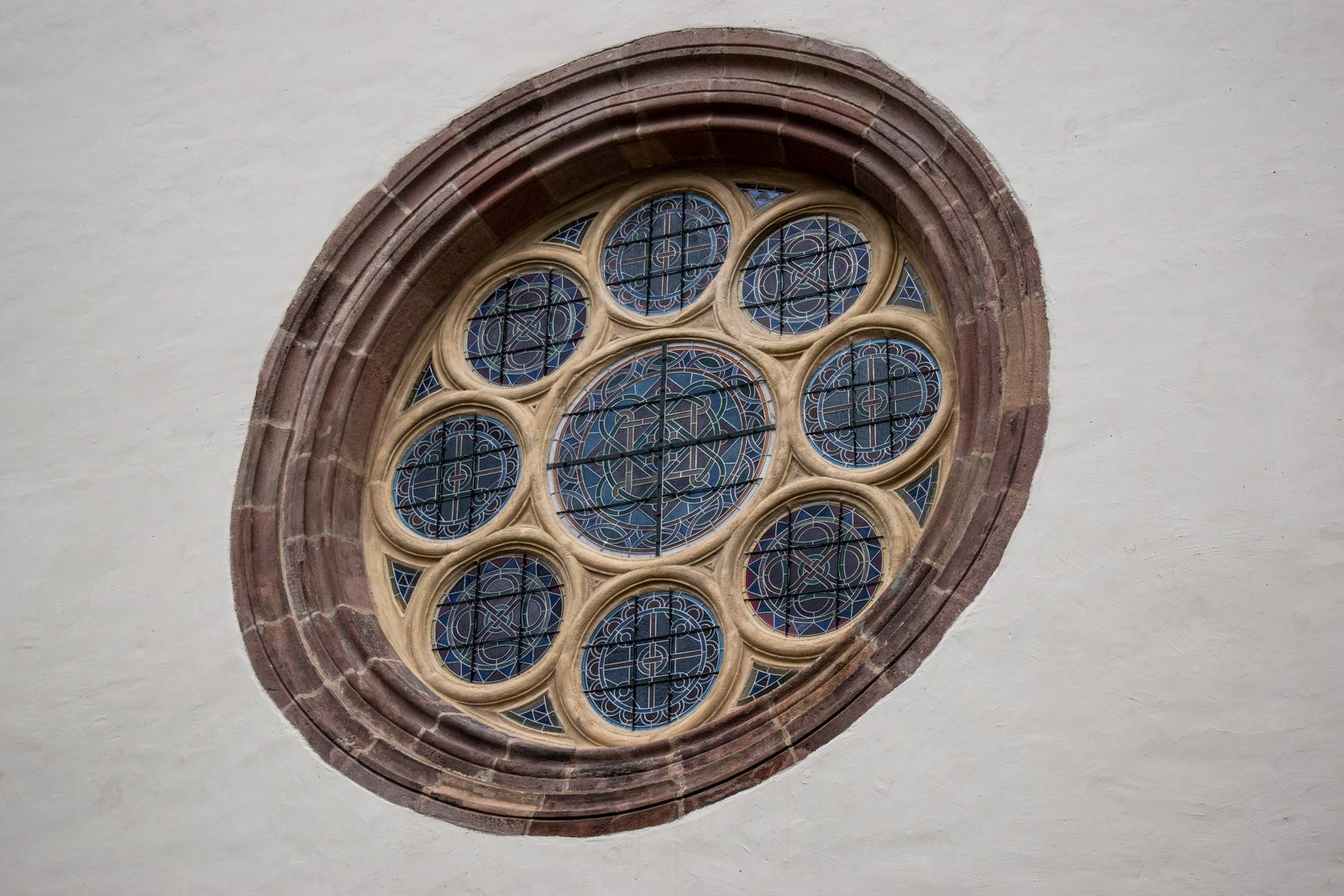
Walk into Chartres or Canterbury and look closely at a stained-glass panel that has occupied its frame for centuries. Some panes are visibly thicker at the bottom than at the top. For generations, tour guides and science teachers offered a tidy explanation: glass is an extraordinarily slow liquid, and gravity has gradually pulled it downward. The idea is memorable, but it does not fit the evidence.
The unevenness is principally a record of how early window glass was made and installed. Glass can undergo structural relaxation, but at ordinary temperatures its deformation is so slight that eight centuries are nowhere near enough to produce the thickness differences seen in cathedral windows.
The myth that refused to shatter
The story remains one of popular science’s most durable misconceptions. It appears alongside familiar claims about using only 10 percent of the brain and lightning never striking twice in roundups of common scientific myths. It feels persuasive because glass lacks the regular atomic lattice of a crystal and old panes really can be uneven.
The faulty step is treating atomic disorder as proof that a material must flow like an ordinary liquid. At room temperature, window glass responds mechanically as a solid. Its structure can relax over sufficiently long periods, but that is not equivalent to a cathedral pane visibly sagging during the life of the building.
How historic glaziers made uneven panes
Before the modern float-glass process, sheet glass was made by hand. The resulting panes were rarely uniform, and the Corning Museum of Glass attributes their varying thickness to the way the sheets were produced, not to centuries of flow.
In the crown method, a gather of molten glass was attached to a rod and spun into a disc. The disc was thinner near its outer edge and thicker toward the centre, especially around the point where the rod had been attached. Rectangular or diamond-shaped panes cut from different parts of that disc therefore had naturally thicker and thinner edges.
Another process involved blowing a cylinder, cutting it lengthwise, reheating it and flattening it into a sheet. This method also left variations in thickness and surface texture. Neither technique produced the flat, consistently thick sheets familiar from modern buildings.
A glazier could place the heavier edge at the bottom because that orientation appeared more stable, although surviving panes also occur with their thicker edge elsewhere. The manufacturing variation explains the observation without requiring the glass to have crept downward. If gravity had produced the unevenness, orientation would be much more consistent across old windows.
What glass actually is
Glass is a non-crystalline material whose atoms lack the long-range repeating order found in a crystal. That description does not make it an ordinary liquid. At room temperature, the configurational movement needed for substantial viscous flow is effectively frozen on human timescales.
Researchers still investigate how glasses relax, how the glass transition should be described and whether a single definition can capture every glass-forming material. Those are genuine scientific questions. They do not revive the claim that the lower edge of a medieval window formed by flowing during the past eight centuries.
What the pitch-drop experiment really demonstrates
Pitch provides a striking comparison because it feels solid and can shatter when struck, yet it flows slowly enough to form drops. Physicist Thomas Parnell created the University of Queensland experiment in 1927, poured heated pitch into a sealed funnel and allowed it to settle for three years before cutting the stem in 1930.
The first drop fell in 1938. University records say nine drops had fallen by April 2014, but no custodian had directly witnessed one detach because of absences, camera failures and other interruptions. John Mainstone cared for the experiment for 52 years and died in 2013 without seeing a drop fall.
The university describes the pitch as approximately 100 billion times more viscous than water. That makes it an excellent demonstration of a material flowing far more slowly than everyday liquids. It does not provide a reliable shortcut for calculating the behaviour of window glass, whose room-temperature viscosity is vastly greater.
Why room-temperature glass does not visibly flow
A peer-reviewed study by Özgür Gülbiten, John C. Mauro, Xiaoju Guo and Olus N. Boratav examined a medieval glass composition associated with Westminster Abbey. The researchers calculated a room-temperature viscosity of roughly 1024 to 1025 pascal-seconds, depending on the glass’s thermal history.
That value is not merely one million times greater than the viscosity of the Queensland pitch. It is approximately 10 quadrillion to 100 quadrillion times greater. The comparison explains why multiplying the pitch experiment’s decade-long intervals by one million produces a profoundly misleading estimate.
The study’s most useful result is its calculated deformation rate. Under the researchers’ model, the medieval glass would move by no more than approximately one nanometre in one billion years. A simple linear extrapolation puts one micrometre of movement at roughly one trillion years and one millimetre at roughly one quadrillion years.
The universe is approximately 13.8 billion years old. Even a micrometre of deformation at the study’s maximum rate would therefore require more than 70 current ages of the universe. A visibly sagging edge would require vastly longer, assuming the pane and its surroundings somehow remained unchanged for that entire period.
The complication of medieval composition
Medieval glass is chemically different from modern soda-lime window glass. Its proportions of silica, potash, lime and other components vary, and impurities can affect its viscosity. The Westminster Abbey composition studied by Gülbiten and colleagues was estimated to be about 16 orders of magnitude less viscous than an earlier estimate for modern soda-lime-silicate glass.
That difference is scientifically important, but it does not rescue the cathedral-sag story. Even this relatively less viscous medieval formulation was calculated to deform by only about one nanometre per billion years. Eight hundred years would produce a change far below anything visible or responsible for a noticeably thick lower edge.
Glass-like materials beyond cathedral windows
The physics of ordered and disordered solids now reaches far beyond historic glazing. In 2025, researchers described meteoritic tridymite with structural and thermal properties between those of a crystal and a glass. The silica mineral was studied in a sample from the Steinbach meteorite, which fell in Germany in 1724, and tridymite has also been identified on Mars.
The material’s thermal conductivity remained approximately constant across the tested temperature range, unlike the more familiar temperature responses of crystals and glasses. The result offers researchers another way to examine how partial structural disorder changes heat transport in planetary and industrial materials.
Researchers reported another unusual glass-forming process in 2026. After laboratory exposure equivalent to approximately 8.7 days of atmospheric ultraviolet light, particles produced by smouldering pine wood developed a highly viscous, glassy outer phase. The finding concerns the behaviour of biomass-burning aerosols, including their atmospheric lifetime and chemistry, rather than conventional silica window glass.
Why the myth persists
The cathedral story survives because it turns three true observations into one false conclusion. Glass has a disordered structure, some materials can appear solid while flowing slowly, and old panes often have uneven thickness. None of those facts demonstrates that gravity reshaped a cathedral window over eight centuries.
Materials scientists have been correcting the misconception for decades. The American Ceramic Society’s account of the Westminster Abbey calculations reports the same upper limit of approximately one nanometre of movement per billion years and identifies manufacturing inconsistency as the source of the uneven panes.
Even after 100 billion years at that maximum rate, the model implies movement of only about 100 nanometres, roughly one ten-thousandth of a millimetre. It does not predict a visible puddle or a drop beginning to fall on that timescale.
The real history is more tangible than the myth. A thick edge in a cathedral window records the spinning, blowing, cutting and placement of glass by an early craftsperson. The pane is not visibly sliding through its lead frame; it is preserving the uneven geometry it carried out of the workshop centuries ago.