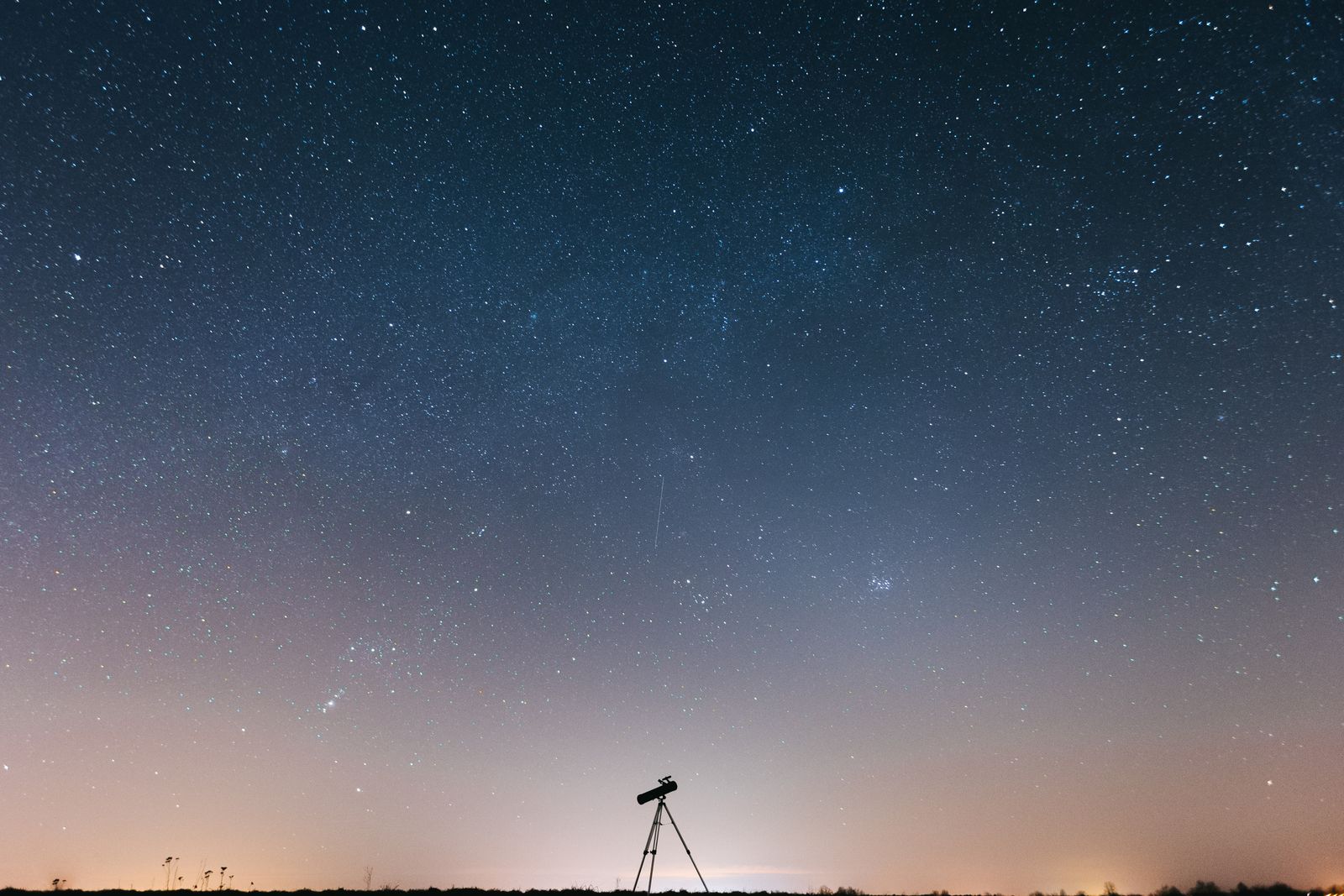
On the night of January 7, 1610, a Paduan mathematics professor pointed a nine-foot wooden tube capped with two hand-ground lenses at the brightest object in the winter sky and saw something no human had ever seen: three tiny stars strung in a neat line beside Jupiter. Within days a fourth joined them. By mid-January, Galileo Galilei had understood he was not looking at stars at all. He was watching moons — worlds circling another world — and the crystalline spheres that Aristotle had bolted around the Earth for nearly two thousand years cracked open in a Padua garden.
The telescope Galileo used that week magnified roughly twenty times. A modern pair of birdwatching binoculars would do the same job. What made the observation revolutionary was not the instrument. It was the sketch he kept, night after night, of four points of light rearranging themselves in a straight line beside a planet that he initially took to be distant stars.
Four dots that would not stay still
The first entry in Galileo’s notebook that January shows Jupiter as a small circle with three asterisks arranged in a row to its east and west. The second night, the pattern had shifted. The third night, shifted again. One of the stars had vanished behind the planet. Then it reappeared on the other side.
Stars do not do this. Stars are fixed. Whatever these were, they were bound to Jupiter and moving around it on schedules of their own — one fast, one slow, two in between. By the end of the week Galileo had counted four, and he had the outline of the argument that would eventually get him convicted of heresy.
The names Io, Europa, Ganymede, and Callisto came later, suggested by the astronomer Simon Marius. Galileo himself proposed calling them the Medicean Stars, a flattering nod to his Florentine patrons. The Medicis got a book dedication. The moons kept the Greek names.
Why Jupiter’s moons broke the sky open
To understand the size of what Galileo had done, you have to sit for a moment inside the model he was demolishing. The Aristotelian universe, absorbed and formalized by the Catholic Church over more than a millennium, placed Earth at the dead center of a nested set of crystal spheres. The Sun, Moon, planets, and fixed stars were embedded in these shells and carried around by their rotation. Everything, without exception, orbited Earth.
Ptolemy had refined the machinery around 150 CE with epicycles and eccentrics — mathematical patches that let the model roughly predict where planets would appear in the sky. Copernicus, publishing in 1543, moved the Sun to the center but kept the perfect circles, so his predictions were no more accurate than Ptolemy’s. The heliocentric idea had drifted for nearly seventy years without a killing piece of evidence.
Then four dots beside Jupiter rearranged themselves on a Paduan winter night, and the killing evidence arrived. If moons could orbit Jupiter, then not everything orbited Earth. And if not everything orbited Earth, the geocentric model was not a slightly wrong description of reality. It was broken at the foundation.
The instrument in Galileo’s hands
The telescope was Dutch in origin — an instrument the spectacle-maker Hans Lippershey sought a patent for in 1608, magnifying about three times. Dutch authorities ultimately refused the patent, since rival claimants had built similar devices and the design was judged too easy to copy. Galileo heard rumors of the device in 1609, worked out the optics himself, and within months had built an instrument several times more powerful than anything the Dutch were selling. By January 1610 he had pushed his design to roughly 20x magnification, enough to resolve Jupiter as a small disk and pick out points of light that hugged tight to its edges.
His lenses were ground by hand, in his workshop, from Venetian glass. The tube was leather-wrapped wood. The eyepiece was a bead of glass smaller than a fingernail. Focus was set by sliding one section of tube inside another. The whole apparatus was, by modern standards, an amateur’s build — and it opened the outer solar system.
Those observations were published in March 1610 in a slim Latin pamphlet called Sidereus Nuncius — Starry Messenger — a book that rewired European astronomy in a season.
What those four dots actually are
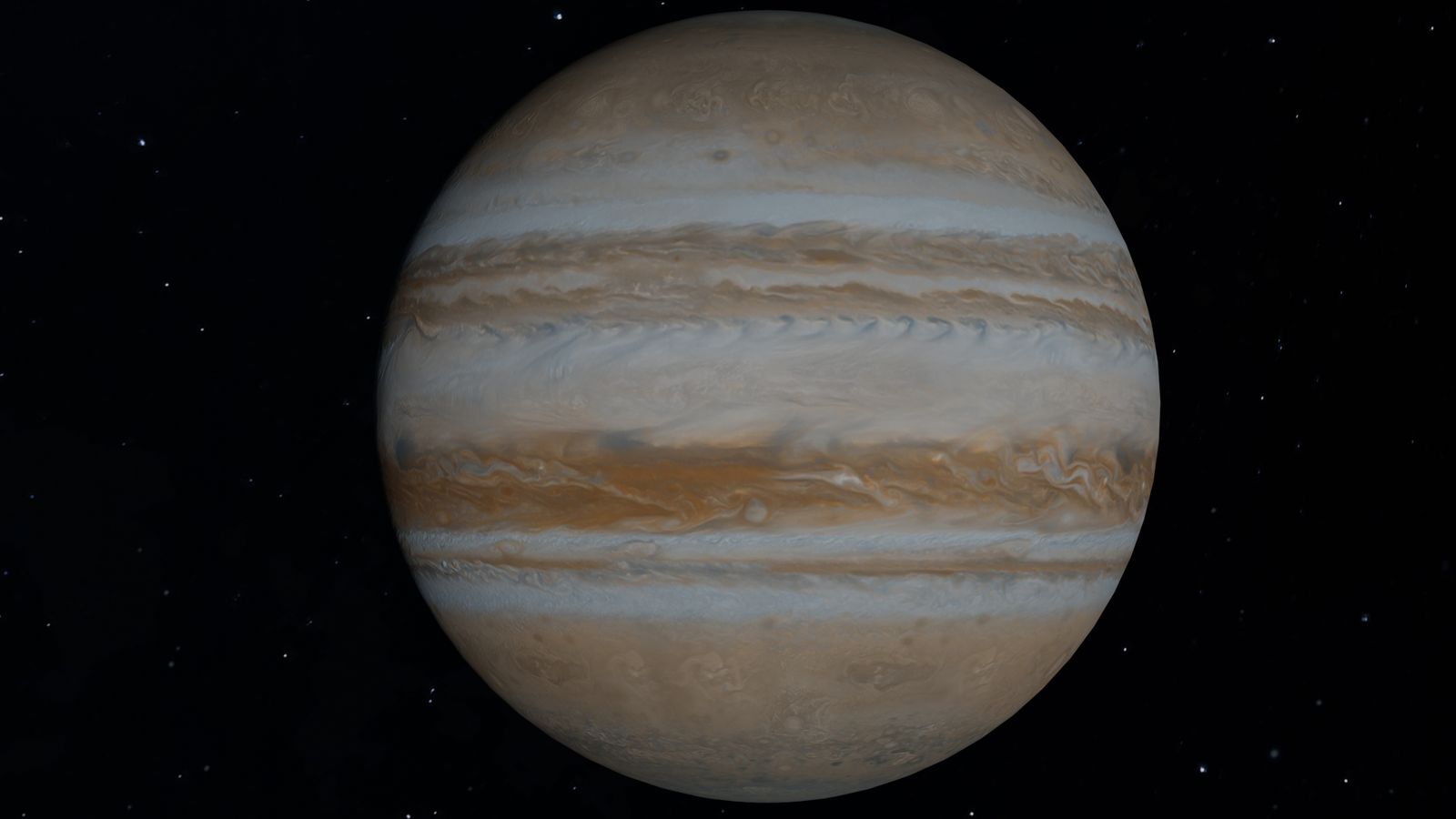
The Galilean moons are worlds in their own right. Ganymede is larger than the planet Mercury — the biggest moon in the solar system, at 3,270 miles across. Callisto is nearly as large and heavily cratered. Io is the most volcanically active body known, its surface repaved constantly by hundreds of eruptions, and a recent re-analysis of NASA Juno spacecraft data suggests the moon may emit hundreds of times more heat than scientists had previously estimated. And Europa, the smallest of the four, hides a saltwater ocean beneath a shell of ice — an ocean that may contain more than twice the liquid water of every ocean on Earth combined.
None of this was knowable in 1610. Galileo saw four points of light. What he understood — correctly — was that they were solid bodies orbiting a planet other than his own, and that this single fact was fatal to the Aristotelian cosmos.
Venus finished the job
The moons of Jupiter were the opening blow. The killing stroke came later that year, when Galileo turned his telescope on Venus and watched it move through a full sequence of phases — crescent, half, gibbous, full — exactly as the Moon does.
In the Ptolemaic system, Venus was locked between Earth and the Sun and could never show a full disk. It should have appeared as a permanent thin crescent. Galileo saw it swell to a fat gibbous phase and shrink again. The only geometry that explained the sequence was one in which Venus orbited the Sun, not Earth. Between Jupiter’s moons and Venus’s phases, the geocentric model was finished as a physical description of reality — though it would take the Church another two centuries to formally concede the point.
The trial that followed
The Catholic Church did not receive the news well. In 1616 the Inquisition declared heliocentrism “foolish and absurd in philosophy” and “formally heretical.” Galileo was warned personally by Cardinal Bellarmine not to hold or teach the Copernican view. He held it and taught it anyway.
In 1632 he published Dialogue Concerning the Two Chief World Systems, a book that presented the heliocentric argument as a conversation between three characters — one of whom, the defender of geocentrism, he named Simplicio. The name gestured at an Aristotelian commentator but also carried, in Italian, the ring of “simpleton.” The pope, Urban VIII, who had personally requested that his own arguments be represented in the book, saw them delivered by Simplicio. He was not amused.
Galileo was tried in 1633, forced to renounce heliocentrism, and sentenced to house arrest. He spent the last nine years of his life confined to his villa outside Florence, going blind, working on a final book on the physics of motion that would feed directly into Newton’s laws a generation later.
The moons are still teaching
Four centuries on, the Galilean moons remain the most-studied worlds beyond Mars. NASA’s Galileo orbiter spent years in the Jovian system from 1995 to 2003. The Juno spacecraft has flown close to Io’s volcanoes. The Europa Clipper, which launched in October 2024, is cruising toward a 2030 arrival that will place it in a looping orbit designed to fly through the plumes of water vapor Europa vents into space.
The idea that a moon could tell you about the planet it circles has become foundational to how planetary science works. Mars Daily has looked at how the surface of Phobos may hold clues to the Martian past — the same logic Galileo stumbled into, that satellites carry the fingerprints of the world they orbit.
And the discovery does not stop. In August 2025, a team led by the Southwest Research Institute used the James Webb Space Telescope to identify a previously unknown moon of Uranus, a six-mile rock that Voyager 2 missed during its 1986 flyby. The discovery brought Uranus’s total known moons to 29.
The sketch in the notebook
The original pages from January 1610 survive. Held in the manuscript collection of the Biblioteca Nazionale Centrale in Florence, they show Jupiter as a small open circle and the moons as ink dots, some to the east, some to the west, spaced by tiny measurements Galileo recorded in units of Jovian diameter. The handwriting is dense and hurried. He was working night by night, running the observations back to himself, checking the pattern.
On January 11, he wrote a marginal note in Latin that translates, roughly, that these bodies were not stars but planets moving around Jupiter. Four days of watching. That was all it took for a mathematics professor with a homemade telescope to overturn a cosmology that had held for two thousand years.
The four moons are still there tonight. A cheap pair of 10×50 binoculars, held steady against a fence post, will show them as pinpricks strung along Jupiter’s belt — the same points of light Galileo saw, in the same configuration, obeying the same orbits he was the first person to plot. Io swings around Jupiter every 42 hours. Europa takes three and a half days. Ganymede seven. Callisto sixteen and a half. If you sketched them on Monday and again on Thursday, the pattern would have shifted, exactly as it shifted for a bearded Italian in a Paduan garden on a cold January night four hundred and sixteen years ago.