
On the night of 23 September 1846, German astronomer Johann Gottfried Galle pointed the nine-inch refractor of the Berlin Observatory toward a patch of sky in Aquarius. Working with the young astronomer Heinrich Louis d’Arrest and comparing the telescope view with a detailed star chart, they identified an eighth-magnitude object that was not on the map in less than an hour. It lay within one degree of coordinates calculated by a French mathematician in Paris, as the Leibniz Institute for Astrophysics Potsdam’s account of the discovery records.
The prediction came from Urbain Le Verrier, who had never seen the planet through a telescope. He had extracted its position from columns of observations showing that Uranus was not moving quite as expected. Neptune had effectively been found on paper before it was identified in the sky.
A planet that would not stay on its track
William Herschel discovered Uranus in 1781, extending the known solar system for the first time in recorded history. As astronomers accumulated observations, however, its measured positions did not always agree with tables calculated from Newtonian gravity and the effects of the known planets.
In 1821, French astronomer Alexis Bouvard published new tables of Uranus’s motion. He considered several possible reasons for the discrepancies, including observational error and the gravitational pull of an unknown body beyond Uranus.
The deviations were small on the scale of the solar system, but systematic enough to demand an explanation. The possibility of another planet was therefore familiar well before Le Verrier began his calculation, although turning that possibility into a usable position in the sky was an entirely different problem.
The arithmetic nobody wanted
The calculation was formidable. An astronomer had to assume the presence of an unseen planet, estimate its distance and orbit, calculate how its gravity would perturb Uranus across decades of observations, and repeatedly adjust the proposed orbit until the remaining discrepancies became acceptably small.
In England, Cambridge mathematician John Couch Adams independently tackled the same problem and produced proposed positions during 1845 and 1846. The familiar story that Astronomer Royal George Airy simply filed his work away is too neat: according to the American Physical Society’s history of the episode, Airy asked Adams for technical clarification, but Adams did not reply.
A Cambridge search eventually began after Le Verrier’s published work attracted attention. Astronomer James Challis unknowingly recorded Neptune on 8 and 12 August 1846 but failed to identify it because his comparison process and star charts did not reveal that the object had moved.
Le Verrier began later but published his results systematically. Trained first in chemistry before moving into celestial mechanics, he presented three increasingly specific analyses between November 1845 and August 1846, with the final paper giving observers a practical location at which to search.
The letter to Berlin
Le Verrier’s final prediction placed the unseen world in Aquarius at a great distance from the Sun. French observers showed little urgency, so on 18 September 1846 he wrote to Galle, with whom he had previously corresponded, and asked him to examine the predicted region.
The letter reached Berlin on 23 September. Galle obtained permission from observatory director Johann Franz Encke to use the Fraunhofer refractor that evening, while d’Arrest proposed comparing the view with the recently printed Hora XXI sheet from the Berlin Academy’s star-chart project.
The chart had been completed in 1844 and printed in 1845. Galle called out the stars visible through the telescope while d’Arrest checked them against the sheet, allowing the pair to isolate an object that the chart did not contain.
The object displayed a measurable disc rather than remaining a point like an ordinary star. Observations over the following nights confirmed its movement, and Galle’s letter announcing that Le Verrier’s planet existed was dated 25 September 1846.
Why the prediction worked at all
Le Verrier’s result was not a perfect description of Neptune’s true orbit. His estimates of the planet’s distance and orbital period were inaccurate, but his predicted longitude for September 1846 was close enough to guide a telescope directly to the correct region.
The achievement was therefore narrower and more impressive than the idea that every property of Neptune had been calculated in advance. Mathematics had reduced an enormous sky to a searchable patch and supplied observers with a position precise enough for a recently printed chart to expose the unfamiliar object.
Neptune became the first planet located through mathematical prediction rather than an ordinary survey of the sky. The broader reasoning remains familiar in modern astronomy: when visible objects move in unexplained ways, astronomers test whether unseen mass could be responsible.
The analogy also appears in debates over dark matter. As The Wire Science’s discussion of dark matter and modified gravity explains, scientists can infer an unseen component from gravitational effects while continuing to debate whether matter or a revised theory provides the better explanation.
The credit war
The Berlin discovery quickly became entangled in national rivalry. British astronomers announced that Adams had independently worked on the problem before Le Verrier’s final prediction, and Airy and Challis faced criticism for failing to turn Adams’s private calculations into a successful discovery.
Adams himself acknowledged that Le Verrier’s published research had led directly to the planet’s identification. Later historical assessments have treated the traditional equal-credit formula more cautiously because Adams supplied several changing solutions, published none before the discovery, and played no direct role in directing Galle to Neptune.
The observational result is clearer. Le Verrier sent the coordinates, while Galle and d’Arrest found and identified the planet in Berlin on the first night they searched.
Galileo had recorded Neptune much earlier, during observations in 1612 and 1613, but marked it as a fixed star. He noticed possible movement in one notebook entry but did not establish that the object was a planet, and Neptune returned to anonymity for more than two centuries.
What Le Verrier could not have known
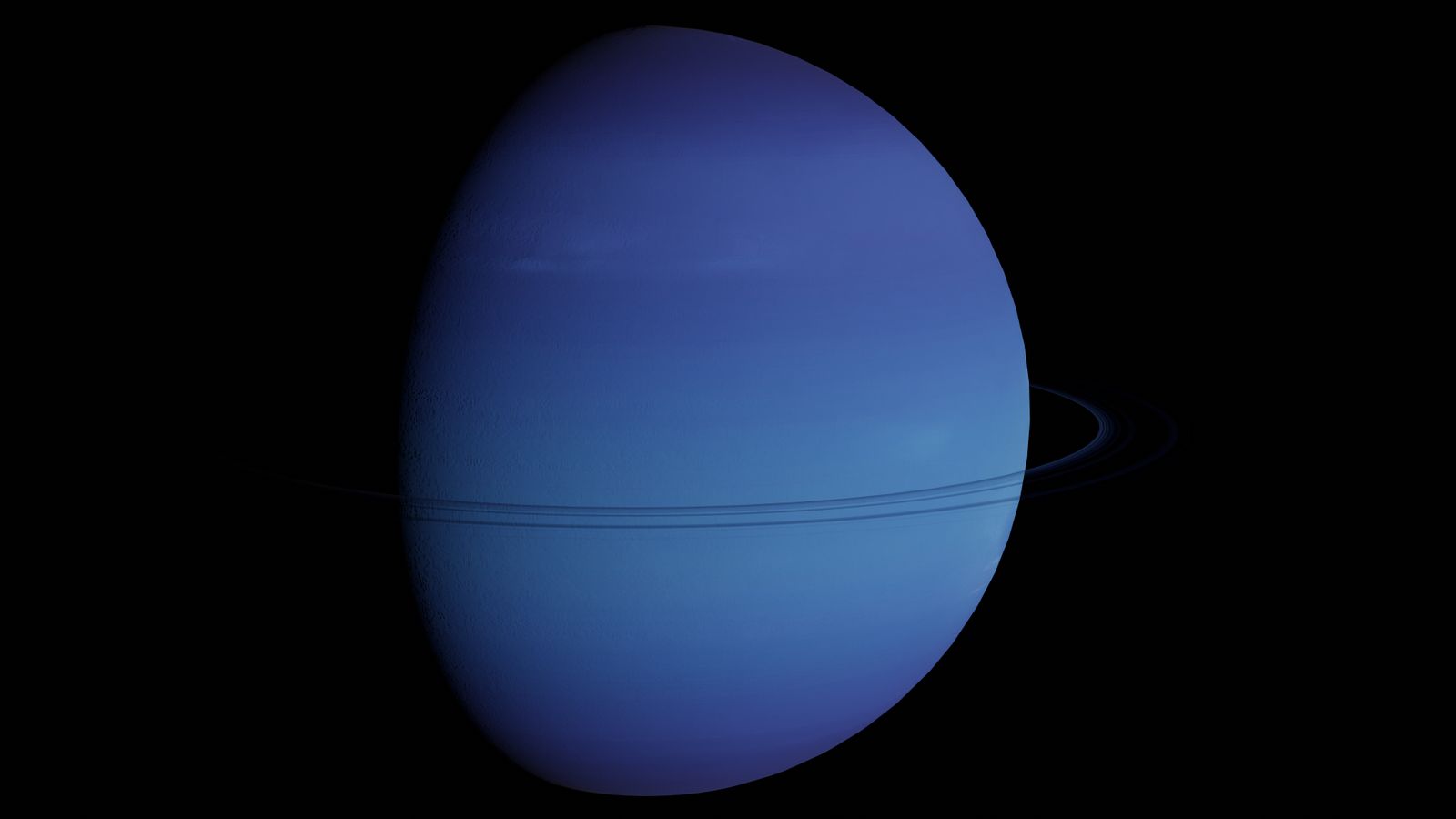
According to NASA’s Neptune overview, the planet orbits at an average distance of about 4.5 billion kilometres from the Sun, or roughly 30 astronomical units. One Neptunian year lasts about 165 Earth years, and the planet completed its first full orbit since the 1846 discovery in July 2011.
An ABC News report marking that milestone featured Macquarie University planetary scientist Craig O’Neill and described how much about the distant planet remained uncertain. Everyone who had known of Neptune before July 2011 had lived within the same Neptunian year.
Sunlight at Neptune is roughly 900 times fainter than it is at Earth, making high noon resemble dim twilight rather than total darkness. Despite receiving so little solar energy, Neptune supports some of the fastest sustained winds measured anywhere in the solar system.
The source of that violent weather is still being studied. One proposed process involves methane breaking down under extreme pressure deep inside the planet, allowing carbon-rich material to form diamonds and sink, but the connection between such processes and Neptune’s atmospheric energy remains hypothetical.
Uranus has a broadly similar size and composition yet releases much less internal heat and displays less extreme weather. Explaining why the two ice giants behave so differently remains one of the major unanswered questions of outer-planet science.
The instruments that have visited
Almost everything measured at close range came from one encounter. On 25 August 1989, Voyager 2 flew about 4,800 kilometres above Neptune’s cloud tops, becoming the first and so far only spacecraft to visit the planet.
The spacecraft discovered six new moons and four rings, measured winds exceeding 1,000 kilometres per hour, and returned the first detailed images of Neptune’s storms. It also photographed Triton, the large moon that follows a retrograde orbit and has a surface temperature near minus 235 degrees Celsius.
Voyager’s images revealed dark streaks associated with geyser-like plumes on Triton. The finding showed that even at the edge of the planetary system, an intensely cold moon could remain geologically active.
Since the flyby, observations have come from telescopes operating at enormous distances. The Hubble Space Telescope has repeatedly watched dark atmospheric vortices form, move, fade, and disappear, but no spacecraft has entered orbit around Neptune and no lander has touched Triton.
A method that keeps finding worlds
Le Verrier’s method still echoes through searches at the edge of the solar system. In 2016, Caltech astronomers Konstantin Batygin and Mike Brown proposed that the clustered orbits of several distant Kuiper Belt objects could be explained by the gravity of a large, unseen planet.
The Atlantic’s account of the Planet Nine proposal drew the direct comparison with Neptune: both arguments begin with unexplained patterns in known orbits and attempt to reconstruct the properties of an unseen object that could produce them.
The comparison does not mean Planet Nine has been discovered. NASA’s current Planet Nine overview states that the proposed world remains theoretical and that astronomers continue to debate whether the observed orbital clustering requires a planet at all.
The distinction is the same one that separated Le Verrier’s papers from the Berlin observation. Mathematical evidence can tell astronomers where an object might be and what effects it should produce, but a prediction becomes a discovered planet only when observation confirms it.
Mars Daily has covered other moments when a missed detail, or a detail caught in time, changed the outcome of a scientific effort, from the disputed transcription error associated with Mariner 1 to the diffraction evidence that helped reveal DNA’s structure. The Berlin night of 23 September 1846 belongs in that tradition because the calculation, the letter, the telescope, and the correct chart all had to meet at the right moment.
The night itself
The instrument used that night still survives. The Deutsches Museum identifies the nine-inch Fraunhofer refractor in its Academy Collection as the telescope Galle used to discover Neptune in Berlin.
The Hora XXI chart survives as part of the story too. Work on it had begun in 1826, but the sheet was not completed until 1844 and was printed in 1845, ready by chance for the evening when d’Arrest needed an accurate inventory of the surrounding stars.
After additional measurements confirmed that the unfamiliar object had moved, Galle wrote to Le Verrier on 25 September. Only a week separated Le Verrier’s decision to send his request and the written confirmation that the predicted planet was real.
Neptune completed its first post-discovery orbit in 2011 and should complete its second around 2176. The people who calculated, observed, and argued over its discovery are gone, but the planet continues through the same distant sky where mathematics first told astronomers to look.