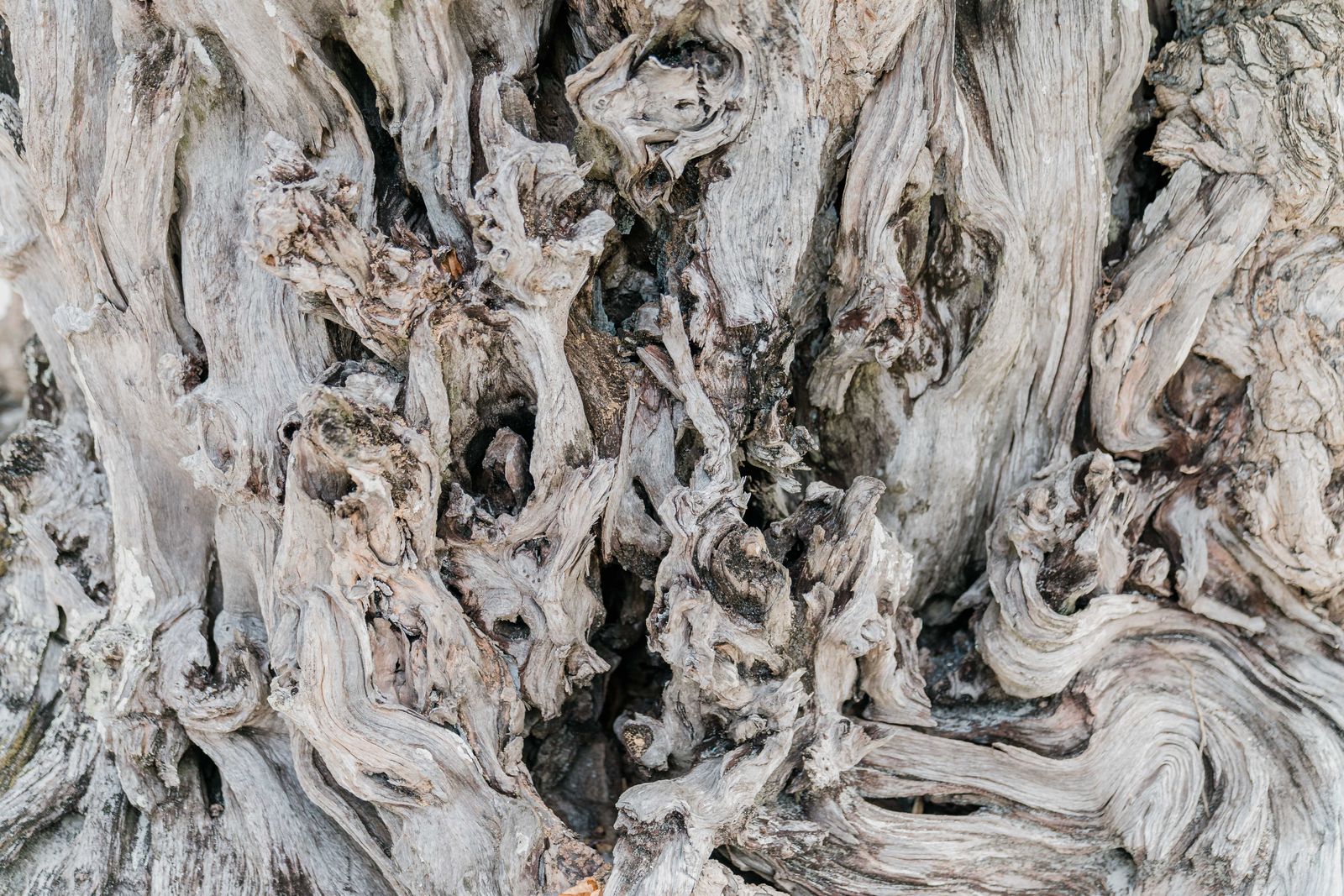
On a wind-scoured ridge in the White Mountains of eastern California, at high elevation, there is a Great Basin bristlecone pine that germinated close to 4,800 years ago. Its seed cracked open in soil older than writing. By the time Egyptian laborers began setting casing stones on the Great Pyramid of Giza, this tree — now known as Methuselah — was already a sapling with roughly two centuries of growth rings inside it.
It is still alive today.
The pyramid workers are 45 centuries gone. The pharaohs they built for are dust in museum cases. The tree is out there right now, holding onto needles it grew in the 1980s, adding a sliver of new wood so thin you could stack a hundred of its recent rings inside a centimetre.
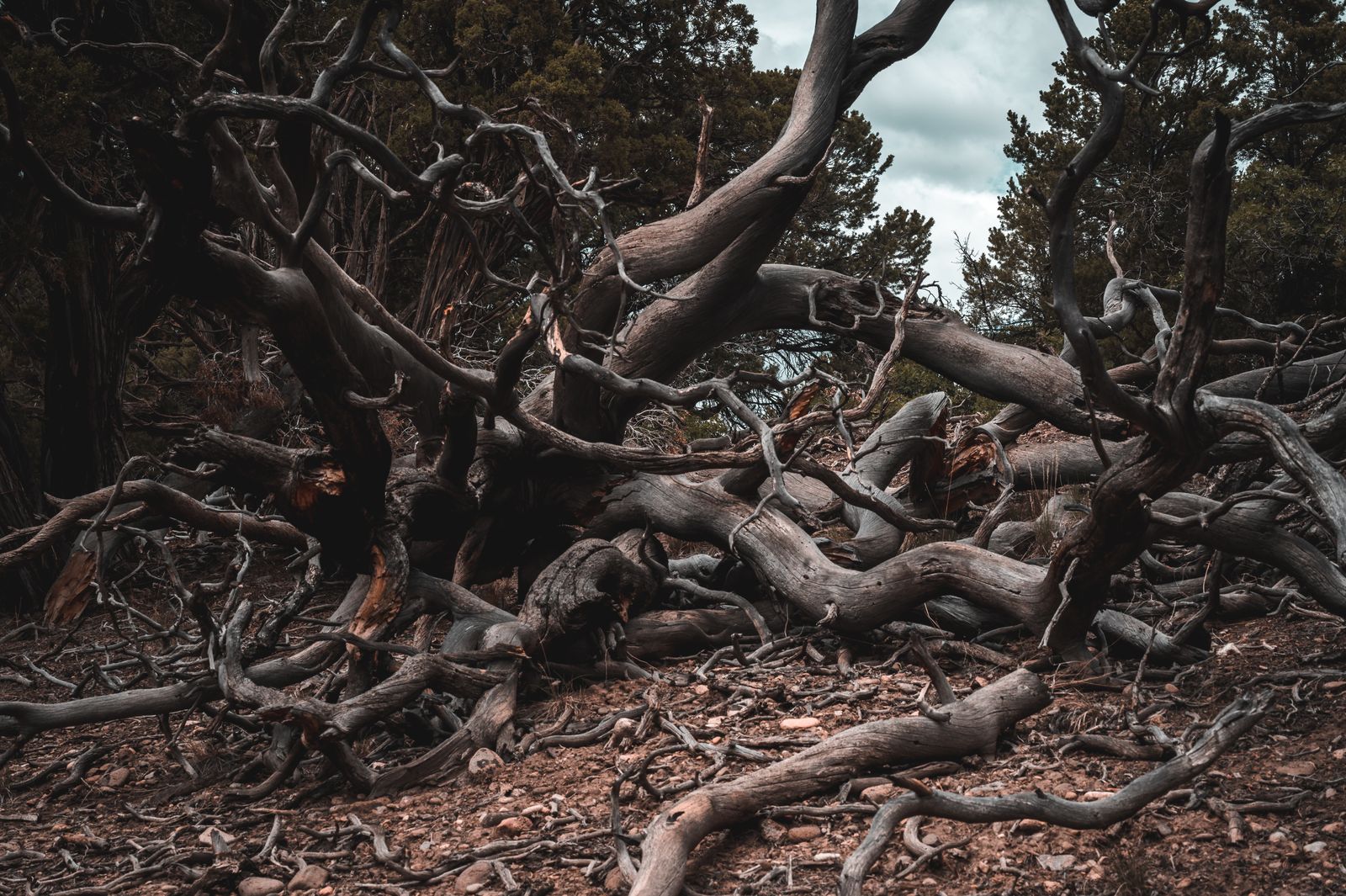
A tree older than the pyramids, still adding rings
The number matters, so it is worth being precise. Methuselah’s age was established by the dendrochronologist Edmund Schulman, who pushed an increment borer into the trunk and pulled out a pencil-thin core of wood. The rings inside told him the tree was at least 4,800 years old.
Do the arithmetic against Giza. The Great Pyramid’s construction dates to roughly 2560 BCE. Methuselah’s germination sits close to 2833 BCE. When the first polished casing block was levered into place at the base of the pyramid, this pine had been photosynthesising on a California ridge for something like 270 years.
It was already old when Stonehenge’s sarsen ring went up. It was middle-aged when the Trojan War, if it happened, would have happened. It was about 2,800 years old when Julius Caesar was stabbed.
Why this particular tree, on this particular ridge
Bristlecones do not live this long because the mountain is kind to them. They live this long because it is not.
The Ancient Bristlecone Pine Forest sits inside California’s Inyo National Forest, at high elevations. The soil is dolomite — pale, alkaline, low in nutrients, and inhospitable to most competing plants. Winters are brutal. Summers are short. The growing season is exceptionally brief.
Under those conditions, a bristlecone pine grows almost imperceptibly. Some of its annual rings measure only a fraction of a millimetre across. That slow accumulation produces wood so dense and so saturated with resin that fungi struggle to rot it and beetles struggle to bore it. The tree essentially armours itself in its own tar.
Its needles are part of the strategy too. Where most pines shed needles every two to four years, a Great Basin bristlecone holds onto some needle clusters for decades — a record among conifers. That means less energy spent regrowing photosynthetic tissue every spring — a critical savings in a place where the sun-hours are short and the calories are thin.
The strip-bark trick
Walk up to an ancient bristlecone and the first thing you notice is that most of it looks dead. Bleached, twisted wood spirals up out of the ground like driftwood standing on end. Only a narrow ribbon of bark — sometimes just a few centimetres wide — runs from a single root up to a handful of living branches.
This is called strip-bark growth. As sections of the root system die from drought or lightning or wind exposure, the corresponding strips of cambium above them also die. The tree does not fight to keep the whole trunk alive. It concentrates its living tissue into whatever thin corridor still has a working water supply, and lets the rest of the trunk stand as dead scaffolding.
That dead scaffolding is not wasted. The dense, resinous heartwood shields what remains of the living tree from wind abrasion and from the fires that occasionally sweep the lower slopes. Much of a 4,800-year-old bristlecone is, technically, no longer alive. What is alive is enough.
The genome inside the wood
In early 2026, a team coordinated by the University of California, Davis, and Johns Hopkins University sequenced the full genome of Pinus longaeva. The results were unusual. The bristlecone genome runs to about 24 billion base pairs — roughly eight times the size of the human genome — but codes for only 21,364 proteins, barely more than a person.
The rest is repetitive DNA, what the researchers described as millions of repetitive sequences that appear to do no harm to the organism.
Two findings from the sequencing project stand out. The tree carries an unusually large complement of disease-resistance genes. And its telomeres — the protective caps on the ends of its chromosomes — are longer than those of comparable conifers. In most organisms, telomere length correlates with cellular longevity. Cells with longer telomeres can divide more times before their genetic machinery frays.
The researchers were careful about extrapolating, noting in the project release that sequencing one tree does not give clear insights as to the genetic basis of longevity, but that having a reference genome sequence is a necessary reagent in modern biology.
A tree that may not age
One of the more startling ideas to come out of bristlecone research is that these trees may not senesce at all. Senescence is the biological process by which cells lose the ability to divide and repair — the mechanism that, in humans, sets the ceiling on lifespan even when disease is held off.
Bristlecones do not appear to show that ceiling. Old individuals produce viable pollen and seeds. Their meristems — the growing tissue at the tips of branches and roots — divide at rates comparable to those of young trees. Their deaths, when they come, are almost always caused by something external: a fire, a lightning strike, an unusually severe drought, an axe.
The bristlecone pine may be fundamentally unique in its longevity.
The cautionary tale of Prometheus
Methuselah is not the oldest bristlecone ever documented. That title belongs to a tree that no longer exists.
In 1964, a graduate student named Donald Currey was studying the glacial history of Wheeler Peak in Nevada. He had permission to core a bristlecone he had labelled WPN-114. His borer got stuck. With Forest Service approval, the tree was cut down.
Only after the trunk was on the ground and the rings could be counted directly did anyone realise what had been felled. The tree, later nicknamed Prometheus, was at least 4,862 years old, and possibly older — the innermost rings were too eroded to read with certainty.
Prometheus is the reason the Forest Service refuses to confirm which tree in the Methuselah Grove is Methuselah. Photographs that appeared to identify it leaked online, and the agency still declines to comment on which trunk it is. Visitors walk the 4.5-mile loop trail past the ancient grove without knowing that the tree beside them may have been alive when the wheel was invented.
Contenders in Patagonia
Methuselah’s status as the oldest verified non-clonal tree faces one serious challenger: a Fitzroya cupressoides in Chile called Gran Abuelo, or Great-Grandfather. Climate scientist Jonathan Barichivich has estimated its age at around 5,484 years, using a partial core combined with statistical modelling of ring-width patterns.
The full core needed to settle the question has not been extracted. Decay at the tree’s centre makes drilling all the way through difficult, and cutting it down for a definitive count is unthinkable after Prometheus. So Gran Abuelo sits in a peculiar limbo — probably older than Methuselah, not yet provable.
Other ancient trees around the world round out the picture. The Sarv-e Abarqu cypress in Iran has stood for more than 4,000 years. The Llangernyw Yew in Wales may be between 4,000 and 5,000. Japan’s Jomon Sugi cedar has been estimated at anywhere from 2,000 to 7,200 years old, depending on which method you trust.
What Indigenous knowledge already knew
The Paiute entered the White Mountains around 4,000 years ago — when Methuselah was already older than the pyramids are now. They knew the bristlecones intimately. The wood was hard to burn, so it was used for shelter rather than fuel. The Shoshone warmed bristlecone resin and applied it to wounds and skin sores, treating it as a substance associated with endurance and healing.
That older observation lined up with what modern chemistry would later find: bristlecone resin is loaded with terpenes and phenolic compounds that resist microbial growth. The same molecules that protect the tree from fungal invasion also make it useful as a topical antiseptic.
The threat now
The very traits that let bristlecones survive 4,800 years may not be enough for the next 100. The White Mountains are warming. Bark beetles that were once excluded by cold winters are now finding the high groves reachable. The recent drought across the American Southwest — the worst in 1,200 years — has killed pines at lower elevations that were previously considered safe.
Constance Millar, an ecologist with the USDA Forest Service’s Pacific Southwest Research Station and a coauthor on the genome paper, has pointed out that the White Mountains population has weathered climate extremes before. Research suggests that bristlecone pine populations in the White Mountains have demonstrated remarkable resilience, persisting through climate extremes for thousands of years since the last ice age.
Whether the current pace of change stays inside that historical envelope is an open question. Tree-ring data itself has been used to reconstruct long-term drought records — the same bristlecone chronologies that dated Methuselah are the ones that dated the megadrought.
What a 4,800-year ring count actually looks like
Imagine a core sample the diameter of a pencil, pulled from the trunk of a living tree. Under a microscope, the rings appear as alternating light and dark bands, each pair representing a single year of growth. In a bristlecone, they are packed so tightly that a millennium of rings can occupy less than a centimetre of wood.
Somewhere near the outer edge of Methuselah’s core, there is a ring that formed in 1969, the year humans walked on the Moon. A few millimetres inward, a ring from 1492. Further in, rings from the fall of Rome, the founding of Buddhism, the reign of Hammurabi. And near the pith, the tree’s earliest wood, laid down while the Sahara was still partially green and the first cities of Mesopotamia were just organising themselves into kingdoms.
The core does not lie. Each of those years is a physical band of cellulose, still measurable, still there.
Standing on the ridge
The Methuselah Trail is open to the public. It winds through the grove at high elevation, past hundreds of ancient trees any one of which could be the tree. The Forest Service will not say which. Hikers pass twisted, silver-grey trunks that look more like sculpture than lumber, and photograph them, and move on.
Somewhere on that ridge, a needle cluster that first opened in 1981 is still doing photosynthesis. A cambium layer only millimetres thick is laying down a new ring this summer — the 4,858th, give or take. When the ring closes at the end of the growing season, it will sit against a ring formed the year the pyramid workers at Giza were fitting the final casing stones into place.
The tree does not know that. It is just holding on, slowly, the way it has held on for the entire span of recorded human civilization, and the way, if the beetles and the drought and the fires stay away, it may hold on for a while longer.