In the predawn hours of July 22, 1962, an Atlas-Agena rocket rose from Cape Canaveral carrying Mariner 1, the first American spacecraft launched toward Venus. The mission lasted less than five minutes. After the rocket began veering away from its planned corridor, the Range Safety Officer sent the command that destroyed the vehicle before its upper stage and spacecraft could separate.
NASA records the destruct command at approximately T+294.5 seconds. The failure was not caused by a literal missing hyphen, despite the phrase that entered popular history. Investigators traced it to a missing overbar in a guidance equation, combined with a separate problem in the Atlas guidance system.
The mission had cost an estimated $18.5 million in 1962. Science-fiction writer Arthur C. Clarke later helped immortalise the accident with the description “the most expensive hyphen in history”, even though the mark involved was technically something else.
A probe built to return data from another planet
Mariner 1 was derived from spacecraft developed for NASA’s Ranger lunar programme. Engineers had to redesign the mission quickly after delays to the more powerful Centaur upper stage forced NASA and the Jet Propulsion Laboratory to use the smaller Atlas-Agena combination.
The spacecraft carried no camera. Its instruments included microwave and infrared radiometers, a magnetometer, a cosmic-dust detector, particle detectors and a solar-plasma spectrometer. Together, they were intended to measure Venus’s temperature and atmosphere while examining magnetic fields, radiation and charged particles in interplanetary space.
Mariner 1 was not humanity’s first object to travel into interplanetary space. The Soviet Venera 1 probe had probably passed Venus in 1961 after communications were lost. What Mariner 1 was attempting was something no mission had yet achieved: a successful planetary encounter that returned useful scientific measurements to Earth.
A hardware fault met a bad equation
The Atlas launch vehicle was guided during ascent using information exchanged with equipment on the ground. During the Mariner 1 flight, an Atlas guidance antenna temporarily lost its lock with the ground. This was a known type of fault, and the vehicle was expected to continue along a programmed path until reliable guidance information returned.
A second problem was waiting inside the guidance logic. An overbar had been omitted when a handwritten equation was translated into the computer instructions used for the launch. The overbar indicated that a changing value should be smoothed rather than treated as an immediate, unfiltered measurement.
When the guidance connection faltered, the incorrect equation allowed noisy data to be interpreted as genuine movement. The computer responded by issuing steering commands to correct deviations that were not actually happening. The Atlas followed those commands, turning a recoverable guidance interruption into an increasingly erratic flight.
That distinction matters. Mariner 1 was not destroyed because one piece of punctuation independently seized control of a rocket. The failure emerged because an error in the guidance equation and a separate hardware problem occurred together.
Why range safety destroyed the rocket
As the Atlas departed its assigned corridor, controllers had to consider where it might fall. An uncontrolled launch vehicle could threaten Atlantic shipping routes or populated areas near the range. The Range Safety Officer therefore had only a narrow period in which the rocket could still be destroyed safely.
Contemporary retellings place the destruct command at roughly 293 seconds after launch. NASA’s current mission record gives 294.5 seconds, a difference caused largely by rounding and the precise event used as the endpoint.
The command came only seconds before the Agena upper stage was scheduled to separate. After separation, the remaining vehicle would no longer have been within the same destruct capability.
The explosion ended the mission, but the spacecraft did not necessarily disintegrate immediately. NASA’s historical account says Mariner 1 continued transmitting for more than a minute while falling toward the Atlantic.
How an overbar became a hyphen
The missing mark was an overbar placed above a mathematical symbol. In this context, it told the guidance system to work with a smoothed value. Without it, the program could react to short-lived fluctuations as though they represented real changes in the rocket’s motion.
Early newspaper coverage described the mark as a hyphen, an easier symbol to explain to a general audience. Clarke’s memorable phrase then gave the mistake a life far beyond the technical investigation. The “missing hyphen” became the version repeated in articles, lectures and software folklore.
Calling it a hyphen is understandable as shorthand, but it obscures the engineering lesson. The problem was not ordinary punctuation accidentally deleted from a sentence of computer code. It was a mathematical instruction lost while a guidance equation was being transferred from its written specification into an operational program.
The reported $18.5 million loss was enormous for 1962. More important than the price alone was the launch window that had nearly been lost. Venus and Earth align favourably for low-energy missions only at intervals, so NASA could not simply wait a few weeks and build another spacecraft from scratch.
Five weeks later, Mariner 2 tried again
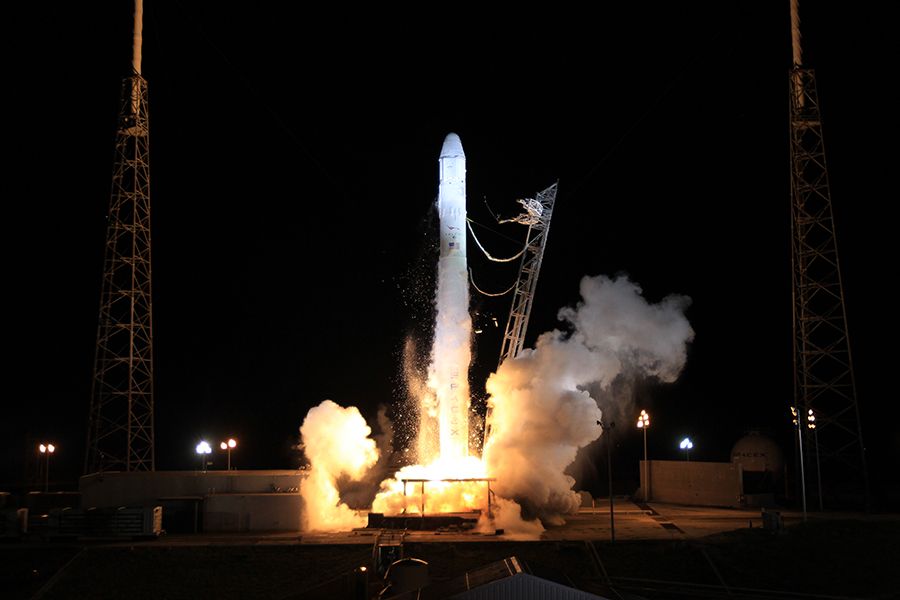
NASA had prepared a second spacecraft as part of the same Venus effort. Engineers corrected the guidance problem and reviewed the launch system before Mariner 2 lifted off on August 27, 1962, only a little more than a month after Mariner 1 was lost.
This time the spacecraft escaped Earth successfully. On December 14, Mariner 2 became the first successful mission to another planet when it flew past Venus and transmitted scientific data home.
Its measurements helped establish that Venus was intensely hot rather than a mild, ocean-covered version of Earth. The spacecraft also measured charged particles streaming from the Sun, making the first direct planetary mission one that advanced understanding of interplanetary space as well as Venus.
Mariner 2 did not succeed because early spaceflight had suddenly become reliable. It survived a series of alarming technical problems during its journey, including trouble with a solar panel and rising spacecraft temperatures. Its success showed why NASA prepared spacecraft in pairs during an era when launch failures were common.
What the failure actually teaches
Mariner 1 has become an enduring example of how a small error can remain hidden until another part of a system fails. The incorrect equation had not immediately exposed itself under ordinary conditions. It became catastrophic only when the guidance hardware stopped behaving as expected.
That makes the incident more instructive than the simplified story of a careless typist destroying a spacecraft. Complex machines depend on layers of assumptions. Software assumes that sensors and communications will behave in certain ways, while backup systems assume that the instructions they receive are correct.
Modern aerospace software is developed under far more formal review, testing, documentation and verification requirements than the programs used in 1962. It would be too strong, however, to claim that Mariner 1 alone created those practices or that individual modern missions can be traced directly to one failed Atlas launch.
The defensible lesson is narrower. Specifications must survive translation into working systems without losing meaning, and redundancy offers little protection when separate layers share an unnoticed flaw. Mariner 1 remains useful because the accident demonstrates both problems in a single flight.
The worlds the Mariner programme revealed
Mariner 1 never reached Venus, but its twin began a programme that transformed planetary science. Later Mariner spacecraft flew past Mars, returned close views of its cratered terrain and eventually placed the first spacecraft into orbit around another planet.
Mariner 4’s 1965 flyby produced the first close-up images of the Martian surface. The pictures arrived line by line and showed a heavily cratered landscape, challenging more optimistic ideas about a warm or Earth-like Mars.
Mariner 9 reached Mars in 1971 during a planet-wide dust storm. Once the atmosphere cleared, it revealed volcanoes, canyons, dried channels and a world far more geologically varied than the earlier flyby photographs had suggested. Other Mariner missions explored Venus and Mercury.
The programme’s record remained mixed. Mariner 1, Mariner 3 and Mariner 8 were lost during launch, while their paired spacecraft succeeded. That pattern reflected the reality of early planetary exploration, when preparing a backup was often the only practical defence against unreliable rockets.
A symbol, a rocket and a narrow decision window
Mariner 1 survived for less than five minutes as a mission, but the story has lasted for more than six decades. Its reputation rests partly on the irresistible image of a spacecraft lost because of a mark no wider than a few pen strokes.
The reality was more complicated and more valuable. A guidance antenna lost contact, an equation handled the resulting information incorrectly, the rocket began following false corrections and a range officer had seconds to prevent a potentially dangerous vehicle from continuing beyond his control.
Five weeks later, the corrected twin left the same launch site and completed the journey. Mariner 1’s trajectory ended over the Atlantic, but the programme continued toward Venus, Mars and Mercury. What remains is not simply a warning to check every character. It is a reminder that in a tightly connected machine, the smallest instruction can become decisive when everything around it starts to fail.