Voyager 1 is still talking to Earth on roughly 22 watts of radiated radio power — less than the bulb burning in most hallway fixtures — from a distance so vast that a simple two-word message takes about 23 hours to arrive. The spacecraft, launched on September 5, 1977, is now hurtling away at 61,100 kilometres per hour and sits more than 24 billion kilometres from home, closing in on the milestone of one full light-day from Earth in November 2026, according to NASA figures reported by ScienceAlert.
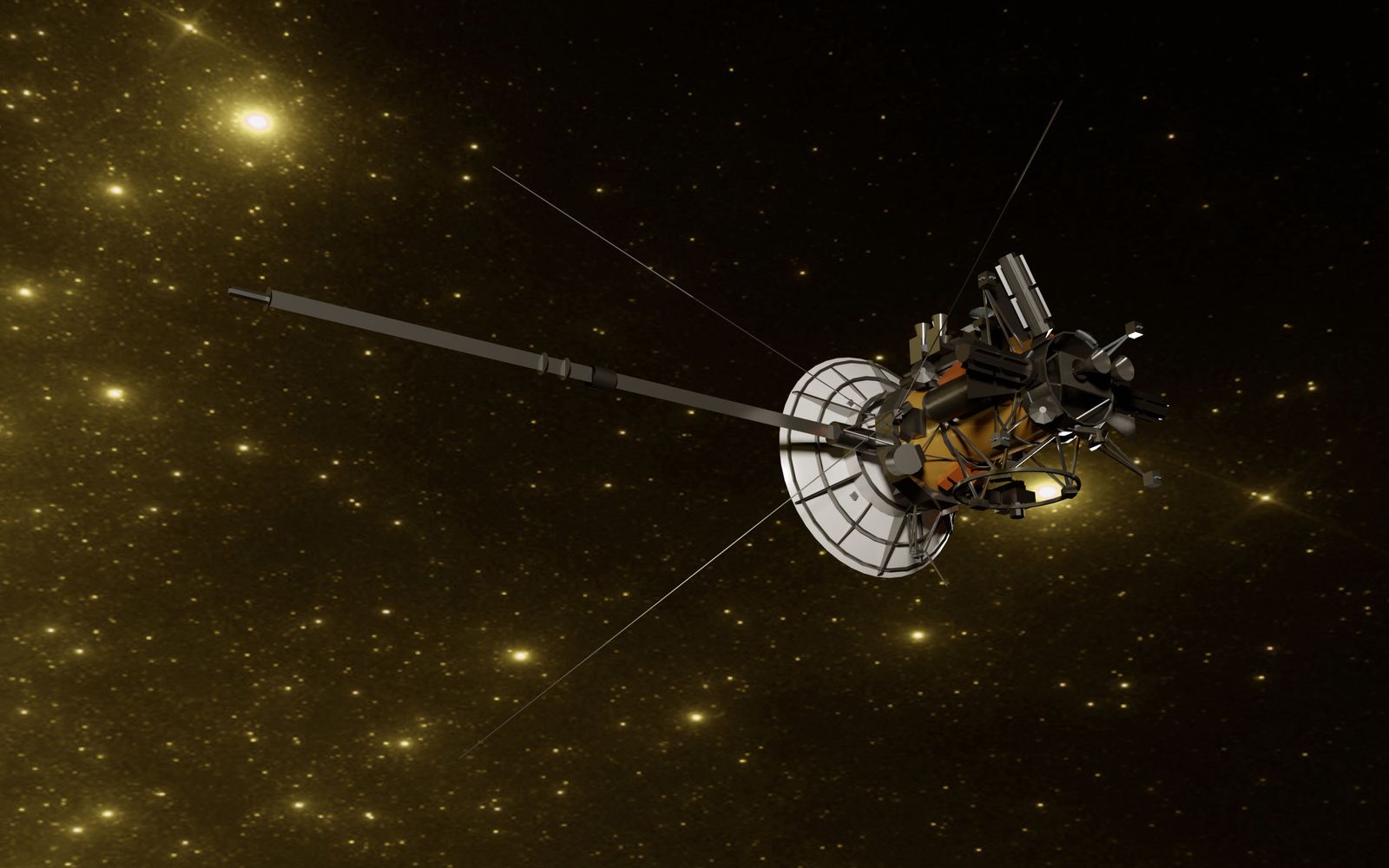
The answer to how a nearly 50-year-old machine still whispers back across that abyss is a stack of specific, unglamorous engineering choices: three plutonium-238 radioisotope thermoelectric generators, a 3.7-metre high-gain dish antenna aimed with the precision of a laser pointer at a coin ten kilometres away, a receiver network of 70-metre dishes on three continents, and a data rate slowed to a trickle of about 160 bits per second. That is the mechanism. Everything else is consequence.
The plutonium heart
Voyager 1 has no solar panels. Out beyond Neptune, sunlight is roughly 0.001 percent of what it is at Earth, so photovoltaics would be useless. Instead, tucked on a boom that keeps its radiation away from the science instruments, sit three General Purpose Heat Source radioisotope thermoelectric generators — RTGs — each originally packed with pellets of plutonium-238 dioxide.
Plutonium-238 does something quietly useful: it decays by alpha emission with a half-life of 87.7 years, and in doing so it gets hot. Not warm — hot enough to glow dull red in a dark room. The RTGs surround those pellets with thermocouples, junctions of two different metals that produce a small voltage when one end is hotter than the other. No moving parts. No fuel to burn. Just heat leaking outward through metal, converted directly to electricity.
At launch in 1977, the three RTGs together produced about 470 watts of electrical power. The plutonium is now roughly 40 percent decayed and, worse, the thermocouples themselves have degraded from the constant thermal load. Available power has dropped by around four watts every year. What remains today is enough to run the transmitter, a computer built when the Apple II was the newest thing in home electronics, heaters that keep the hydrazine thrusters from freezing solid, and two surviving science instruments — the magnetometer and the plasma wave subsystem, the latter still sampling the faint electromagnetic hum of interstellar space.
Why a hallway bulb is enough
The transmitter itself radiates about 22 watts through the 3.7-metre high-gain antenna. On the face of it, that seems absurd. A cellphone tower pushes hundreds of watts and struggles to reach the next suburb. How does 22 watts cross 24 billion kilometres?
Three things do the work.
The first is the antenna. A dish concentrates radio energy the way a flashlight reflector concentrates light. Voyager’s high-gain antenna focuses that 22 watts into a beam only a fraction of a degree wide, pointed with obsessive accuracy back at Earth. The effective radiated power in that narrow cone is enormously larger than the raw transmitter output.
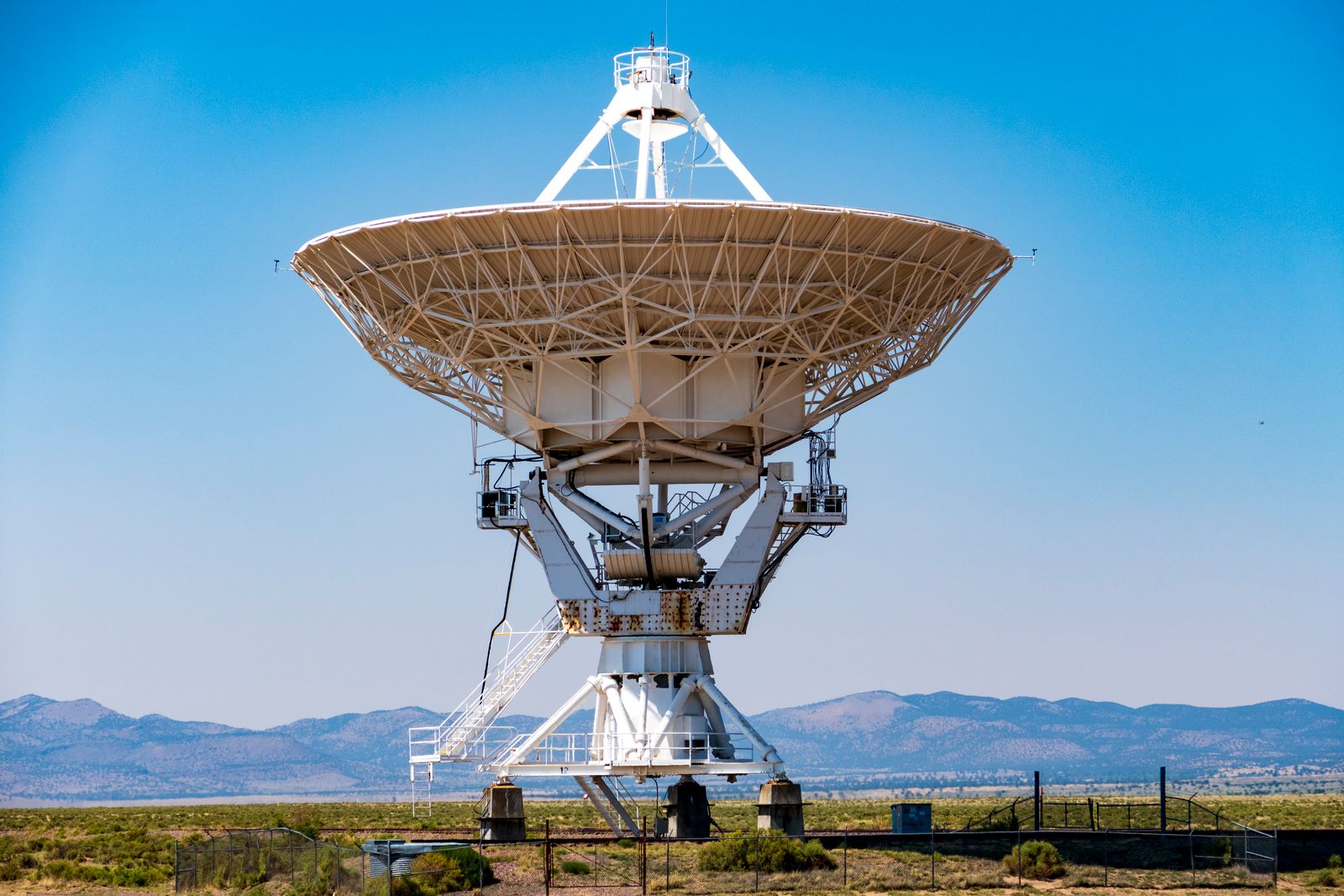
The second is what happens on the receiving end. NASA’s Deep Space Network operates three complexes — Goldstone in California, Madrid in Spain, and Canberra in Australia — each with 70-metre dishes the size of a football pitch and cryogenically cooled receivers chilled to a few degrees above absolute zero to suppress thermal noise. By the time Voyager’s signal arrives, it has spread out and weakened to somewhere around 10⁻¹⁸ watts per square metre. That is a billion-billionth of a watt. The DSN dishes gather that whisper for hours at a time and integrate it into a coherent signal.
The third is patience. The data rate is glacial — around 160 bits per second for science data, slower than a 1980s dial-up modem by orders of magnitude. Slow bit rates mean each bit is transmitted for longer, which means more energy per bit, which means signals that can be teased out of noise. Speed is traded for reach.
23 hours each way
Distance turns every conversation into a monologue. A command takes a little over 23 hours to travel at lightspeed from Earth to the spacecraft; the reply takes another 23 hours to return.
That two-day round trip is why last year’s technical fault on Voyager 1 took weeks to debug. As Popular Science noted, engineers send a diagnostic, wait a day, read the reply, think, send the next diagnostic, wait another day. Fixing a computer bug becomes an act of correspondence conducted over months.
In November 2026, Voyager 1 will officially be one light-day away — 25.9 billion kilometres, or 16.1 billion miles. It will be the first human-made object to reach that distance, as BGR reported. From that point on, every exchange with Earth is measured in days, not hours.
The instruments still awake
Voyager 1 launched carrying eleven scientific instruments. Most were switched off decades ago once they had served their purpose at Jupiter, Saturn, and the outer boundary of the heliosphere. Over the past year, NASA has been powering down instruments one by one to stretch the shrinking energy budget.
What remains active is small but historically remarkable: the magnetometer, which measures the direction and strength of the magnetic fields surrounding the spacecraft, and the plasma wave subsystem, which listens to the density and oscillations of ionised gas in the space between stars. The plasma wave data confirmed in 2013 that Voyager 1 had crossed the heliopause — the boundary where the Sun’s magnetic bubble gives way to the galaxy proper. It is still the only spacecraft, along with its twin Voyager 2, ever to have operated in true interstellar space.
Every year, another few watts vanish. Engineers face the same grim arithmetic that mission planners run for older spacecraft, watching consumable reserves to squeeze out extra years of science. Voyager’s constraint is not fuel but decay itself, ticking downward on a physics clock that cannot be paused.
The computer that runs it
The brains onboard Voyager 1 are three pairs of computers with a combined memory of about 69 kilobytes — less than a single low-resolution photograph on a modern phone. The command and control system was designed in the early 1970s using integrated circuits that are now essentially museum pieces. The flight data system was among the first spacecraft computers to use CMOS technology, chosen for its low power draw.
That the software still works is partly luck and partly the discipline of building for known constants. The commands are simple. The instrument list is short. The environment, once past the planets, is featureless. When bugs do appear — as happened in late 2023, when a stuck bit in the flight data subsystem started returning gibberish — the small team of engineers still fluent in the machine’s assembly language has to write patches and beam them across the light-day gap. Several of the original Voyager engineers came out of retirement to help.
How long the whisper lasts
The end is not dramatic. Voyager 1 will not crash into anything. Its trajectory carries it, over the next 40,000 years, toward the general direction of the star Gliese 445 in the constellation Camelopardalis, which it will pass at a distance of 1.6 light-years. Long before that, sometime in the early 2030s, the RTGs will drop below the minimum threshold needed to power the transmitter, and the signal will simply stop.
The spacecraft will keep flying. It will keep carrying its Golden Record — the gold-plated copper disc etched with 55 languages of greetings, the sound of surf and rain, Beethoven’s Fifth and Chuck Berry’s Johnny B. Goode, and the pulsar map showing where the Solar System sits. The record cover carries an electroplated sample of ultrapure uranium-238, a radioactive element with a 4.46-billion-year half-life. Any civilisation that finds the probe can measure how much uranium is left and calculate, roughly, how long ago it was made.
Voyager 1’s ability to communicate depends on Earth’s own patience — on the DSN scheduling receive windows across three continents, on engineers reading the same trickle of bits every day, on knowing which frequency to point at. Once the transmitter falls silent, the probe becomes an artefact rather than a spacecraft. As Gigazine noted, Apollo 10 remains the fastest crewed vehicle ever built at 39,897 km/h, but Voyager 1’s steady 61,100 km/h has been accumulating for nearly half a century — an object still gaining distance from us at 3.5 astronomical units every year.
A comparison scale
To put 22 watts in domestic terms: a modern LED hallway bulb draws around 8 to 12 watts. An incandescent nightlight is about 7 watts. A microwave oven pulls roughly 1,000 watts. A car headlight is around 55 watts. Voyager’s transmitter sits neatly between the nightlight and the headlight, and yet the signal it produces is being resolved at the far side of the Solar System.
Distance-wise, 24 billion kilometres is difficult to picture. Light from the Sun reaches Earth in 8 minutes and 20 seconds. It reaches Pluto in about 5 hours. It takes over 22 hours to reach Voyager 1 today. If the Solar System were shrunk so that Earth’s orbit was the size of a dinner plate, Voyager 1 would be somewhere down the street.
The economics are equally strange. Voyager 1 and 2 together cost about $865 million to build and launch — roughly $4.3 billion in 2026 dollars. The operating cost today is a rounding error against that: a small team at JPL, telemetry passes on the DSN, and the electricity to run a few consoles. The machine long ago outran its scientific mandate, which was Jupiter and Saturn. Everything since — Uranus and Neptune imagery from Voyager 2, the crossing of the termination shock, the heliopause detection, the interstellar plasma measurements — has been a bonus.
What silence will sound like
Sometime in the early 2030s, on a scheduled DSN pass over Canberra or Madrid or Goldstone, the tone will not arrive. The last bit will already have been transmitted a day earlier, from the far side of the light-day threshold. Engineers will wait through the pass, then the next one, then a few more, and eventually mark the mission complete.
Voyager 1 will keep flying at 17 kilometres per second in the general direction of the constellation Ophiuchus, radio dark, its plutonium still warm but no longer producing enough electricity to speak. The Golden Record will keep its uranium-238 clock ticking on the cover. The magnetometer boom will keep its geometry. The 3.7-metre dish will keep pointing roughly at where Earth used to be, drifting slowly out of alignment as the years pass.
The bulb, eventually, goes out. The probe does not.