
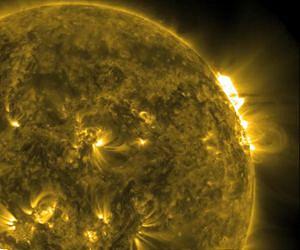
The sun unleashed an X1.8 class flare that began at 1:12 PM ET on January 27, 2012 and peaked at 1:37. The flare immediately caused a strong radio blackout at low-latitudes, which was rated an R3 on NOAA's scale from R1-5.
The blackout soon subsided to a minor R1 storm. Models from NASA's Goddard Space Weather Center predict that the CME is traveling at over 1500 miles per second. It does not initially appear to be Earth-directed, but Earth may get a glancing blow.
Initial movies from NASA's Solar Dynamics Observatory (SDO) look as though there was an eruption and coronal mass ejection (CME) associated with the event, and NOAA's GOES satellite also detected a solar energetic particle (SEP) event a half hour after the flare peak.
How these CMEs and SEPs form and evolve, as well as their association with the flare event itself will be studied in the coming hours and days as more data and movies from NASA's SDO, STEREO and SOHO instruments become available.
Mars-Bound Instrument Detects Solar Burst's Effects
Pasadena CA (JPL) – The largest solar particle event since 2005 has been detected by the radiation-monitoring instrument aboard the Mars Science Laboratory spacecraft, on its way from Earth to Mars.
The Radiation Assessment Detector, inside the mission's Curiosity rover tucked inside the spacecraft, is measuring the radiation exposure that could affect a human astronaut on a potential Mars mission.
It has measured an increase resulting from a Jan. 22 solar storm observed by other NASA spacecraft. No harmful effects to the Mars Science Laboratory have been detected from this solar event.
