
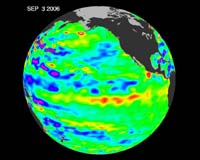
The climatic phenomenon El Nino should gather weak to moderate intensity, leading to a warming of the Pacific Ocean, the World Meteorological Organization said Tuesday. "Climate patterns across the equatorial Pacific over the last one-two months have developed a notable tendency toward El Nino conditions," the WMO said in a statement.
"There is general agreement that 'the development of a weak to moderate basin-wide El Nino is now likely and that such an event would persist into early 2007," it added.
The organization, whose calculations were based on observations made over the last two months, offered no assessment of the possible consequences of trend — and even suggested it may dissipate.
Spanish for "the boy", El Nino's last appearance in 1997-1998 helped trigger severe fires, rainfall and cyclones across America, Africa, Asia and Australia that killed 22,000 people. The price tag of those catastrophes was estimated at 34 billion dollars (26.8 billion euros).
On Tuesday, WMO said surface water temperature in the Pacific's equatorial center may warm by one degree, and trade winds would weaken as is characteristic of El Nino. But it also left open chances the phenomenon might go away.
"Expert opinion does recognize that, at this early stage 'there is a possibility that the event could actually dissipate in the next couple of months,'" the WMO said.
The organization also described as "highly unlikely" that the opposite La Nina ("the girl") effect will take place, chilling sea-surface temperatures. The last La Nina stretched from 1998 to early 2001.
Source: Agence France-Presse
