
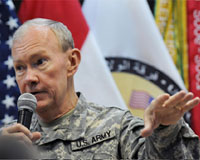
The US military's top officer on Thursday called for deploying American advisers to Iraq's Anbar province to counter Islamic State jihadists, but said the Baghdad government must first arm local Sunni tribes.
General Martin Dempsey's comments marked the first time the American military openly endorsed sending advisers to the restive western province, where Iraqi government troops have suffered a string of setbacks at the hands of the IS group.
Due to recent IS gains, "we need to expand the train, advise and assist mission into al-Anbar province, but the precondition for that is that the government of Iraq is willing to arm the tribes," Dempsey told a news conference.
"By the way, we have positive indications that they (Iraqi government) are. But we haven't begun to do it yet."
The US military has sent about 600 advisers to Baghdad and Arbil in the north to assist Iraqi and Kurdish forces and coordinate US-led air raids against IS.
The advisers are not heading into combat with Iraqi or Kurdish units but working with senior officers in Baghdad and Arbil.
Dempsey made the remark after he was asked about recent US airdrops of aid to a Sunni tribe near al-Asad air base that was forced to flee their homes in Heet in the face of advancing IS militants.
"The Iraqi security forces in al-Anbar province are in defensive positions and would be unlikely to be able to respond to a request for assistance from the Abu Nimer tribe," he said.
US to check troops for chemical exposure in Iraq
Washington (AFP) Oct 30, 2014 –
The US military will launch new medical examinations for troops and veterans exposed to chemical weapons in Iraq, and review claims they were ordered to stay silent about such contact, officials said Thursday.
Defense Secretary Chuck Hagel has asked the US Army and Navy secretaries to ensure troops affected by chemical munitions "are receiving the care and the support they require," spokesman Rear Admiral John Kirby said.
As a result, army and navy leaders plan to offer fresh medical examinations and to monitor the health of soldiers exposed to chemical agents in Iraq, defense officials said, confirming a New York Times report.
Hagel is "also troubled by suggestions that some of these same troops might have been ordered not to discuss their potential exposure and would like a fuller accounting of the veracity of those claims," Kirby said in a statement.
The medical exams and broader review came in response to a New York Times report this month that found at least 17 soldiers had been exposed to nerve or mustard agents in Iraq during the American occupation of Iraq and had been told not to discuss their handling of the chemicals.
Before the 2003 US invasion of Iraq, president George W. Bush insisted Baghdad was hiding an active weapons of mass destruction program.
Although US forces never found evidence of an active program, they did find remnants of an aging chemical arsenal and often they were not trained nor equipped to handle it, according to the Times report, which cited officials, veterans and government documents.
Following the invasion that toppled dictator Saddam Hussein, American forces uncovered 5,000 warheads, shells and bombs filled with chemical agents, but their findings were kept secret, according to the Times report.
Some veterans who handled the weapons also have questioned why they did not receive Purple Hearts, the award given to troops injured in battle.
Officials said a separate review of all combat awards and decorations would examine the decision not to award Purple Hearts to some veterans exposed and injured by chemical agents.
