
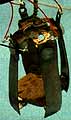
Artificial muscles that should give space robots animal-like flexibility and manipulation ability will get their first test on a small NASA rover destined to explore an asteroid.
Under development by Dr. Yoseph Bar-Cohen of NASA's Jet
Propulsion Laboratory, Pasadena, CA, the artificial muscles are
based on a simple, lightweight strip of highly flexible plastic
that bends and functions similarly to human fingers when
electrical voltage is applied to it.
Bar-Cohen and a small team of scientists and engineers are
working to turn these strips into grippers and strings which can
grab and lift loads, among many other potential uses. These
strips and strings, known as artificial muscles or electroactive
polymers (EAPs), have the potential to greatly simplify robotic
spacecraft tasks. The technology could lead in the future to the
development of insect-like robots that emulate biological
creatures.
Years from now, these devices could also conceivably replace
damaged human muscles, leading to partially "bionic men" and
"bionic women" of the future, according to Bar-Cohen and his
fellow researchers. "My hope is someday to see a handicapped
person jogging to the grocery store using this technology," said
Bar-Cohen, leader of JPL's Nondestructive Evaluation and Advanced
Actuator Technologies unit, although such "blue sky" medical
applications, even if proven feasible, may be decades away.
In the near-term, two EAP actuators are planned for use as
miniature wipers to clear dust off the viewing windows of optical
and infrared science instruments on the Mu Space Engineering
Spacecraft (MUSES-CN) nanorover. This mission, led by the
Japanese space agency ISAS, is designed to land the palm-sized
rover on an asteroid following its 2002 launch, and return a
sample of the asteroid to Earth.
"That's just the tip of the iceberg when it comes to space
applications," Bar-Cohen added. "Electroactive polymers are
changing the paradigm about the complexity of robots. In the
future, we see the potential to emulate the resilience and
fracture tolerance of biological muscles, enabling us to build
simple robots that dig and operate cooperatively like ants, soft-
land like cats or traverse long distances like a grasshopper."
Unlike human hands, which move by contracting and relaxing
muscles, typical robotic arms utilize gears, hydraulics and other
expensive, heavy, power-hungry parts. In future planetary
exploration missions, where robots will need to perform tasks like
collecting and manipulating samples of soil or ice, such mass and
complexity becomes a problem. To meet these challenges, Bar-Cohen
and his team have developed two types of artificial muscles that
respond quickly to small amounts of electricity by lengthening or
bending.
The first is a flexible polymer ribbon constructed from
chains of carbon, fluorine and oxygen molecules. When an electric
charge flows through the ribbon, charged particles in the polymer
get pushed or pulled on the ribbon's two sides, depending on the
polarity. The net result: The ribbon bends. Using four such
ribbons, Bar-Cohen has fashioned a gripper that can pick up a
rock.
The second consists of thin sheets wrapped into cigar-like
cylinders that stretch when one side of a sheet is given a
positive charge and the other a negative charge. These charges
cause the wrapped sheet to contract toward the center of the
cylinder, and this constriction forces the cylinder to expand
lengthwise. When the power supply is turned off, the cylinder
relaxes, enabling it to lift or drop loads.
Society of Photo-Optical Instrumentation Engineers' (SPIE) Symposium
Eight individual researchers or groups from around the world
will demonstrate their work on artificial muscles as part of the
Society of Photo-Optical Instrumentation Engineers' (SPIE) 6th
Annual International Symposium on Smart Structures and Materials
in Newport Beach, CA, in early March, with a media session planned
for the evening of March 2. Contact Pat Wright of the SPIE
(360/676-3290, x609) for further information on this event.
Muses-C Mission Links
