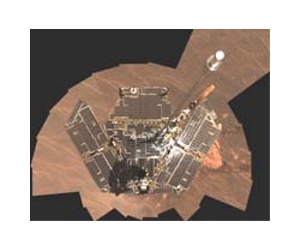
With the winter solstice just passed, Opportunity is constrained by power and must recharge between drives. The rover had an extended stay on the north facing site, referred to as a Lily Pad that it reached on Sol 2240 (May 13, 2010). The favorable northerly tilt provided an increase in power for extra remote science and a MarsQuake experiment.
The MarsQuake experiment conducted on Sol 2242 (May 15, 2010), is designed to use the accelerometers in Opportunity's inertial measurement unit (IMU) as a seismometer.
This is only possible when the rover is not in motion, as normal vehicle acceleration will mask any acceleration due to seismic activity. To date no MarsQuakes have been detected during the experiments.
On Sol 2245 (May 18, 2010), Opportunity was commanded to drive 55.5 meters (182 feet) south in search of another north facing Lily Pad. The only identifiable Lily Pads to the south were just five and 12 meters (16 to 39 feet) away.
Opportunity was commanded to check if she had reached a favorable northerly tilt during the last half of the drive and stop there.
Opportunity did not reach the required northerly and drove instead the full commanded distance. This driving strategy balances progress towards Endeavour Crater with the need to maximize solar array power output during the depth winter.
As of Sol 2245 (May 18, 2010), solar array energy production was 232 watt-hours, atmospheric opacity (Tau) was 0.421 and the solar panel dust factor was 0.461.
Total odometry is 20,754.39 meters (20.75 kilometers, or 12.90 miles).
Share This Article With Planet Earth