
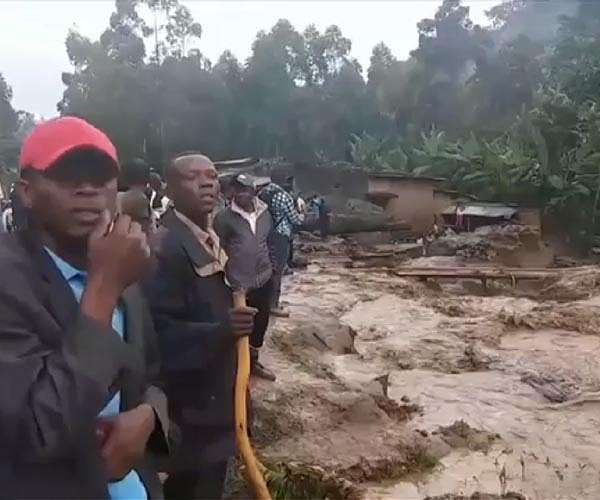
Nine people have lost their lives and many more are feared dead in flooding in the eastern Ugandan city of Mbale after two rivers burst their banks, leaving a trail of destruction, officials said Sunday.
Police and the military have been called in to help in search and rescue operations in Mbale, where stranded residents could only watch helplessly as their belongings were washed away by the floodwaters.
Mbale City resident commissioner Ahamada Waashaki told AFP that nine bodies had been recovered so far, including one of a soldier.
"Many more people are missing and feared dead," he said.
"There is a lot of destruction, roads cut off, buildings submerged as a result of heavy rain that started last night until this morning."
He said the situation became worse when the Nabuyonga and Namatala rivers burst their banks, causing flooding across most parts of the city.
Prime Minister Robinah Nabbanja visited Mbale, which lies on flat land about 300 kilometres (180 miles) east of the capital Kampala.
"Police and military marine forces will be coming to help in the rescue and search for dead bodies as we provide relief to the affected population," her office said.
Two local reporters told AFP they had seen bodies floating in the muddy brown floodwaters before being removed by police.
Several cars were also washed away, along with household goods and personal items as residents moved to higher ground for safety.
"In the past we experienced flooding but not the level of lives lost and destruction of property seen this time," Waashaki said.
Death toll from week-long Iran flooding tops 80
Tehran (AFP) July 30, 2022 –
At least 80 people have been killed and 30 others are missing in floods that have wreaked havoc across Iran for more than a week, state media reported Saturday.
Since the start of the Iranian month of Mordad on July 23, "59 people died and 30 are still missing in the incidents caused by recent floods," Yaghoub Soleimani, secretary-general of the Red Crescent Society, was quoted as saying by state news agency IRNA.
That is in addition to flash floods caused by heavy rains in the normally dry southern province of Fars that left at least 22 people dead just before the start of Mordad.
Many of those victims were spending the day by a riverside.
Soleimani noted that 60 cities, 140 towns and more than 500 villages across the country of around 83 million people have been affected by the inundations.
Tehran province is the hardest-hit with 35 deaths. Nearby Mazandaran province has the highest number of missing people at 20, a list published by the Red Crescent showed.
Supreme leader Ayatollah Ali Khamenei, in a letter published on his website Saturday, expressed condolences to the families and called on authorities to take necessary measures to repair the damage.
President Ebrahim Raisi visited flood-ravaged areas in Firouzkouh region east of the capital, his office said.
Severe damage occurred there primarily because of a mountain landslide late Thursday which claimed 14 lives, according to state media.
Videos and pictures posted by Iranian media and on social media showed houses and cars surrounded by grey mud, and people trying to recover their belongings.
Initial estimates point to more than 60 trillion rials (about $200 million) in damages to the agricultural sector, Agriculture Minister Javad Sadatinejad said, according to state broadcaster IRIB.
Iran's meteorological centre on Saturday warned of more rains in the southern and northern provinces in the coming days.
Scientists say climate change amplifies extreme weather, including droughts as well as the potential for the increased intensity of rain storms.
Like other regional countries, Iran has endured repeated droughts over the past decade, but also regular floods, a phenomenon made worse when torrential rain falls on sun-baked earth.
In 2019, heavy rains in Iran's south left at least 76 people dead and caused damage estimated at more than $2 billion.
Unseasonable rains leave seven dead in UAE
Dubai (AFP) July 29, 2022 –
At least seven people have been killed in the United Arab Emirates after unseasonable downpours triggered flash flooding in eastern districts of the normally parched Gulf state, authorities said.
"We regret to announce that six people of Asian nationalities have been found dead as a result of the floods," the interior ministry's chief of central operations, Ali al-Tunaiji, said.
The ministry later announced the death of a seventh Asian migrant.
July temperatures in the UAE regularly hit 40 degrees Celsius (104 degrees Fahrenheit) but its east coast can also be affected by the Indian Ocean monsoon.
When torrential rain falls on sun-baked earth, it can lead to flash flooding.
The emergency services said they had answered hundreds of calls for help over the past two days as the floodwaters swamped the streets of the port city of Fujairah and other eastern districts.
