
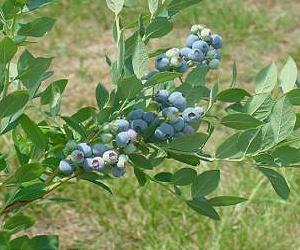
Blueberry aficionados will soon have a tasty, colorful new variety for their backyard gardens. Blueberry experts D. Scott NeSmith and Mark K. Ehlenfeldt introduced 'Blue Suede' in a recent issue of HortScience.
The new southern highbush blueberry (Vaccinium hybrid) was released by the University of Georgia's College of Agricultural and Environmental Sciences, the University of Georgia Agricultural Experiment Station, and the U.S. Department of Agriculture-Agricultural Research Service. 'Blue Suede' is targeted for sales to the home gardener market.
According to NeSmith and Ehlenfeldt, 'Blue Suede' produces an abundance of attractive, light-blue fruit, with large, flavorful berries. The plant of 'Blue Suede' is vigorous and features attractive deep-red fall foliage. The researchers anticipate that the plant should perform well in USDA hardiness zones 6a through 9a.
"When compared with the popular southern highbush variety 'O'Neal', 'Blue Suede' had larger berry size, more pronounced light-blue color, increased plant vigor, and considerably later flowering time, " noted NeSmith. 'O'Neal' typically blooms too early for most homeowners, subjecting it to spring freeze damage during flowering; 'Blue Suede' flowers 10 to 14 days later than 'O'Neal'.
'Blue Suede' also tends to have a protracted ripening period, a desirable trait that allows home gardeners to harvest berries over a longer period of time. The longer ripening period is less advantageous for most commercial operations, the researchers noted.
The cultivar has been exclusively licensed to McCorkle Nursery, which plans to sell the new release under the trade name 'Blue Suede'. Consumers should see the new cultivar introduced as part of McCorkle's Gardener's Confidence Collection in late 2010 or early 2011. Propagation rights for 'Blue Suede' are controlled by University of Georgia Research Foundation, Technology Commercialization Office in
related report
'Wyldewood,' first release from Elderberry Improvement Project
The American elderberry is showing promise as a profitable commercial fruit crop. Traditionally used for making jelly, juice, and wine, elderberry is becoming increasing important in North America's burgeoning "nutraceutical" industry. Historically, elderberries have mostly been harvested from the wild; researchers have made recently made efforts to select or develop improved cultivars.
Increased interest and emerging markets are encouraging scientists to develop improved elderberry cultivars that yield consistent, superior production. Scientists from the University of Missouri have introduced a new variety named 'Wyldewood', a tall, vigorous elderberry plant that consistently produces heavy yields, is efficient to harvest, and produces fruit well-suited for processing.
The Elderberry Improvement Project was initiated at Missouri State University and the University of Missouri in 1997 with the goal of developing American elderberry cultivars adapted to Midwestern environments. 'Wyldewood' is the first cultivar released from the program. Originally described and tested as 'Brush Hills 1' and 'Wyldewood 1', the new release was identified and collected from the wild by Jack Millican in 1995 near the community of Brush Hill, Oklahoma.
The cultivar was named in honor of Wyldewood Cellars Winery of Mulvane, Kansas, a leading promoter of elderberry production in the Midwest and a supporter of the Elderberry Improvement Project. 'Wyldewood' was tested and observed beginning in 1998 at two locations in southern Missouri.
According to corresponding author Patrick L. Byers of the University of Missouri Cooperative Extension Service in Springfield, 'Wyldewood' outperformed the standard 'Adams II' elderberry in yield potential and berry size; 'Wyldewood berry weights ranged from a low of 52 mg to a high of 111 mg. The harvest season for 'Wyldewood' is generally 14 to 26 days later than the standard 'Adams II', with harvest usually beginning in late July in Missouri.
A limited number of unrooted cuttings of 'Wyldewood' are available for test purposes to federal and state experiment stations from University of Missouri and Missouri State University by contacting the authors.
Share This Article With Planet Earth
