
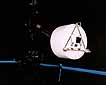
Washington, DC Nov. 14, 1997 – For the first time in U.S. space history, a system for automated rendezvous and docking without human intervention will be tested in space. Aboard this month's STS-87 Columbia Space Shuttle mission, the space agency will test the Automated Rendezvous and Capture Video Guidance Sensor- which serves, in essence, as the "eyes" of a prototype system.
Such a system would allow linking in space of unmanned upper stages or
rocket units that require boosters to reach higher orbits, or automated
logistics carriers eventually bound for the International Space Station.
The test unit uses onboard sensors, computers, and navigation signals along
with video cameras to bring together a research spacecraft with the
Shuttle. Sensors mounted in the Shuttle cargo bay and on the free-flying
Spartan satellite will track reflected laser beams, bounced off of
reflectors mounted on the Spartan's exterior. Tracking data will be
gathered during testing when the unit is both floating through space
nearby as well as stationary, hovering above the bay. The Shuttle robot arm
will also be used to hold the Spartan satellite in 16 different positions
while the laser reflectors test bouncing the beams back to the collectors.
Tests will also be made of the laser system under varying lighting
conditions.
Eventually, such tests as those planned for the Shuttle flight may lead to
an operational laser docking system for the Space Station. Unlike the
Russian space program, all dockings conducted by the U.S. since 1966 have
been under astronaut control. The Russians have routinely docked spacecraft
by using automated systems. In fact, Russian Cosmonauts have less
accumulated time in rendezvous and docking than their robot systems in the
history of the Russian space programs.
