
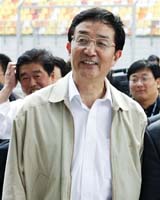
More heads are set to roll in the corruption scandal that led to the sacking of Shanghai's Communist Party chief, a top Chinese disciplinary official said Tuesday. The dismissal, the highest-level sacking of a government official in more than a decade, centers on the apparent misuse of up to 400 million dollars from Shanghai's 1.2-billion-dollar pension fund.
"This case is still under investigation … as the investigation deepens more people are likely to be implicated," Gan Yisheng, vice head of the party's Central Commission for Discipline Inspection, told reporters in Beijing.
"We will investigate thoroughly and severely punish any party member who violates party discipline, no matter how high or how low his position."
The government announced Monday that Shanghai party chief Chen Liangyu had been dismissed from his post and kicked out of the 24-member politburo, China's top political organ, over major corruption charges.
The politburo accused Chen of "violating regulations" in using the money, while also seeking to enrich friends and relatives inappropriately, according to a dispatch from the official Xinhua news agency.
Several other Shanghai officials, including Chen's former secretary, had already been removed from their posts for their roles in the scandal.
With around 100 investigators sent from Beijing to Shanghai to probe the affair, and warnings from Gan of more heads to roll, the city was awash with speuclatino that tough measures were being employed to stop anyone fleeing.
Hong Kong newspapers reported extra police had been deployed at Shanghai's airports and ports to prevent officials from leaving the city.
The passports of senior Shanghai officials were also confiscated, along with their travel permits to Hong Kong and Macau, according to the Ta Kung Daily, which did not cite any sources.
Hong Kong's Sing Tao newspaper and the Hong Kong Economic Times gave similar accounts of the extra security measures, also without citing sources.
A Shanghai government spokesman as well as municipal police at Pudong and Hongqiao aiports told AFP they were unaware of the extra security measures.
Meanwhile the political implications of Chen's sacking continued to be the subject of much interest.
Chen's sacking has been widely seen as a power play by President Hu Jintao to weaken the political stronghold of his predecessor, Jiang Zemin, and shore up his own position.
Before retiring in 2003, Jiang, who also once served as Shanghai's top party official, named many of his allies into positions of leadership.
Chen was one such ally. Others include Vice Premier Huang Ju, parliamentary head Wu Bangguo and Vice President Zeng Qinghong.
The so-called "Shanghai clique" has been seen as a challenge to Hu's rule, with the president determined to solidify his own position ahead of an important five-yearly Communist Party Congress late next year.
Gan, however, denied such infighting in the top echelons of power.
"The top Chinese leadership are extremely united in placing great importance on fighting corruption and building an honest government," he said.
He refused to be drawn on speculation that the case could implicate Huang, the vice premier who also once served as Shanghai's top Communist Party official and was Chen's political mentor.
"Whether or not the Chen Liangyu case is linked to other people, you cannot listen to unofficial channels. Do not listen to what others are saying and believe it. You must (get information) through formal channels," Gan said.
At a briefing on Tuesday, China's foreign ministry did not want to comment on the specifics of the Chen case but defended the government's motives for cracking down on corruption.
"The anti-corruption move of the Chinese government is aimed at improving the (economic) opening and reform policy," ministry spokesman Qin Gang said.
Source: Agence France-Presse
