
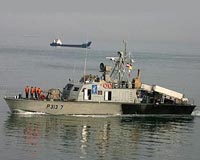
Tehran and Washington Saturday accused each other's naval forces of provocative maneuvers in the Gulf that culminated in a US helicopter firing warning flares at Iranian vessels, the latest close encounter between the countries in recent months.
The US Navy said it had reacted to unresponsive vessels belonging to the Revolutionary Guards closing in on American ships at high speed, a charge denied by Iran, which described the American move as unprovoked.
"At 4 pm (1130 GMT) on Friday, the supercarrier USS Nimitz and its accompanying warship, while being monitored by the Guards' frigates, flew a helicopter near the Resalat oil and gas platform and approached the force's ships," the Guards said.
"The Americans in a provocative and unprofessional move, sent a warning message to the frigates and fired flares."
The Guards "ignored the unconventional move by the US ships and continued their mission, after which the supercarrier and its warship left the area," the statement added.
The US Navy said in a statement its ships were on a routine patrol when an American helicopter "observed several Islamic Revolutionary Guard Corps naval vessels approaching US naval forces at a high rate of speed."
It added: "US naval forces attempted to establish communications, with no response from the Iranian vessels. Shortly thereafter, at a safe distance, the US helicopter deployed flares, after which the Iranian vessels halted their approach."
The latest incident came days after a US Navy patrol ship fired warning shots at a Guards boat in similar circumstances, with each side blaming the other.
In January, the destroyer USS Mahan fired warning shots at four Iranian Revolutionary Guard vessels that approached at high speed in the Strait of Hormuz, which connects it to the Indian Ocean.
The Revolutionary Guards are a paramilitary force that answers directly to Iran's supreme leader Ayatollah Ali Khamenei.
The force's boats periodically approach US warships in international waters and the Strait of Hormuz, ignoring US radio messages and giving little indication of their intentions.
In January 2016, the Iranians briefly captured the crew of two small US patrol boats that strayed into Iranian waters.
The 10 US sailors were released 24 hours later.
The latest incident comes after the US Congress approved new sanctions against Iran.
Iran's tech sector blooms under shield of sanctions
The names may be unfamiliar but the services are immediately recognisable: Snapp is Iran's answer to Uber, Digikala is its Amazon, and Pintapin its Booking.com.
US sanctions have protected the Islamic republic's tech sector, barring Silicon Valley from profiting from one of the world's most promising emerging markets, and giving a free run to domestic start-ups to recreate their services. … read more
