
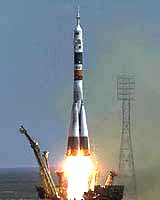
This months successful maiden flight of an improved Soyuz vehicle marked an important milestone in the program to bring this Russian workhorse vehicle into Arianespace's commercial launcher family.
The Soyuz 2-1a version lifted off from Russia's Plesetsk Cosmodrome on November 8, and carried a test payload. It used a digital flight control system with a high-speed onboard computer.
This new control system provides additional mission flexibility, and also will enable Soyuz to be equipped with a larger payload fairing for its future use in commercial Arianespace missions from the Spaceport in French Guiana.
Arianespace Chief Executive Jean-Yves Le Gall congratulated the Russian Space Agency, the Samara Space Center (which develops and produces Soyuz) and all engineers and technicians who participated in the Soyuz 2-1a mission.
The Soyuz 2-1a maiden launch will be followed by the validation of further improvements to the Soyuz launcher, including a more powerful third stage that increases overall launch vehicle performance and provides the capability to carry heavier payloads.
The flight of this Soyuz configuration – designated Soyuz 2-1b – is planned in 2006 from Baikonur Cosmodrome in Russia.
Both new Soyuz versions will become part of Arianespace's expanded commercial launcher family operating from French Guiana – with an inaugural flight of the improved vehicle planned in 2007 from a new launch pad that currently is under construction at the Spaceport.
The Soyuz at French Guiana will become Arianespace's medium-class launch vehicle for commercial and governmental flights. By adding Soyuz to its family of launchers, Arianespace will be able to cost-effectively perform a full range of missions, meeting the company's goal of offering the capability to launch "any mass, to any orbit, any time."
Soyuz will join the heavy-lift Ariane 5 and the lightweight Vega launcher (which is scheduled to begin service in 2007).
