
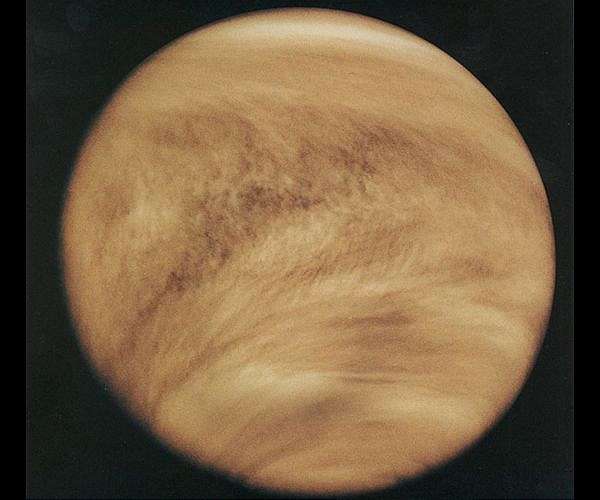
The largest ever quest for atmospheric wave patterns on the night side of Venus, and a new window onto vertical winds, are the two recent major insights into the super rotating cloud level of the planet, made by researchers of the Instituto de Astrofisica e Ciencias do Espaco (IA).
13th May 2021 – On a slow rotating planet such as Venus, but with constant winds beyond the most devastating hurricanes on Earth, any light breeze might be part of the key to the puzzling "super-rotation"1 of its atmosphere.
Now, two studies led by researchers of the Instituto de Astrofisica e Ciencias do Espaco (IA) contribute to the ongoing endeavour to understand what makes Venus' airy shell spin so fast.
A study led by Jose Silva, of IA and Faculdade de Ciencias da Universidade de Lisboa (Ciencias ULisboa), published in Astronomy and Astrophysics, searched for wave patterns in the lower clouds, at around an altitude of 47 kilometres, in more than 5500 images from the archives of two space missions to the planet.
It is the largest ever quest for atmospheric waves on the night side of Venus, and is now a database that may hint at what is creating them.
