
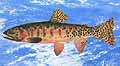
A team of experts in fisheries biology, remote sensing, aerospace technology and the environment has committed its expertise and resources to carry out an important restoration project for the westslope cutthroat trout on a tributary of Montana's famous fly-fishing stream, the Madison River.
Larry Vance, founder and chairman of Earth Search Sciences, Inc. said the company's project to carry out remote sensing along an approximately 50 miles of stream within the unique Cherry Creek drainage will contribute to a new level of understanding about this critical game fish habitat. Nearly the entire Cherry Creek drainage lies on Turner Enterprises' Flying D Ranch.
"We have established the value of our Probe-1 remote sensing
system for mineral exploration, and this project provides an excellent
opportunity to demonstrate the environmental applications of this
technology," Vance said. "The depth of qualitative information that
will come from Probe-1's flights over this important drainage will
help drive decisions that can give this imperiled native trout a new
lease on life in these waters."
Earth Search's partners in the project are Montana Fish, Wildlife
and Parks, Turner Enterprises and NASA-MSU TechLink.
"The Turner biodiversity team is excited to play a small part in
this critical initiative on behalf of one of Montana's prized native
fishes," said Mike Phillips, coordinator of biodiversity divisions of
Turner Enterprises. "The Flying D ranch will be a useful field
laboratory in an undertaking that could ultimately contribute mightily
to the recovery of Montana's state fish."
Concern over the disappearance of the westslope cutthroat trout
has led to a petition that the species be listed as threatened by the
U.S. Fish & Wildlife Service. Restoring the fish and preventing the
listing, with its associated impacts across the economy, moved Montana
Governor Marc Racicot to convene the Westslope Cutthroat Trout
Steering Committee, a working group of environmentalists, scientists,
sportsmen, Indian tribes, industry representatives and resource
managers to develop a plan to address the situation.
Non-native species of trout such as rainbow, brook and brown
trout have been introduced in waters that historically were the domain
of Montana's native fish such as the cutthroat. The non-natives are
more adaptable to varying habitat, and resulting interbreeding and
competition have not only affected the purity of the westslope
cutthroat's gene pool but have led to a takeover of the westslope
cutthroat's historic range on the east and west slopes of the
Continental Divide.
The pilot project grew out of the working group's recommendations
to address the decline in the westslope cutthroat's population.
Biologists believe that the Turner Enterprises' Flying D Ranch,
through which 50 miles of Cherry Creek flows, provides a rare
opportunity to remove non-native stocks, re-seed the waters with
genetically pure westslope cutthroat, and restore the population to
this important Madison tributary. The reason the Flying D is so
critical is that a 30-foot waterfall in the lower part of the
watershed isolates the upper reach of the stream from immigration by
non-native fish.
"There couldn't be a better field laboratory for us to undertake
this important project," Montana Fish, Wildlife and Parks Project
Manager Pat Clancey said of the Cherry Creek drainage. "This unique
collaboration will play a huge role in allowing us to make informed
decisions about the restoration of this native Montana fish."
A project memorandum of understanding calls for ESSI to gather,
analyze, and interpret image data from the Cherry Creek drainage to
identify its key features and to make data available to Montana Fish,
Wildlife and Parks and to Turner Enterprises. Remote sensing data from
Probe-1 overflights will establish critical riparian and stream
biological content information, enabling biologists to make precision
decisions. One of the applications of the remote sensing data will be
to help determine the minimum possible use of an EPA- registered fish
toxicant to be employed to remove non-native stocks from the study
area.
NASA-MSU TechLink helped to broker this partnership and is
providing support through its "TechLaunch" Program to assist in the
commercialization of ESSI's hyperspectral imaging information by
demonstrating its utility in this first-of-its kind watershed study.
"We're very excited about seeing this hyperspectral technology
being used to solve critical natural resource problems," said Will
Swearingen, project manager at NASA-MSU TechLink.
Work for private clients in 1998 has been carried out over targets in the United States, Australia, Canada and Mexico.
Remote sensing, or "hyperspectral imaging," creates ultra high-resolution images of the earth's surface. Analysis of these images can determine the presence of target minerals in geologic formations or evidence of minerals from vegetal "signatures."
Earth Search officials believe Probe-1's capabilities can deliver authoritative information to clients across the mineral, environmental, defense, agriculture and many other industries. The cost of data from Probe-1 and its fixed-wing platform is far below that of existing satellite technology.
If you're looking for cutthroat troat try altavista – there's plenty left there
