
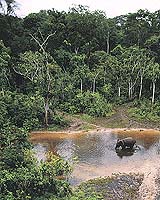
Depleting forests and coal reserves, compounded by the environmental cost of traditional energy sources, are forcing Africa to seriously consider going nuclear, experts say. "For the sake of humanity and the environment we should accept nature's gift," South African energy analyst Andrew Kenny told a conference in Cape Town of scientists, businessmen, energy watchdogs and African government officials.
But some warn that a lack of financing, a regulatory void and a dearth of specialist skills could impede Africa's participation in the "nuclear renaissance".
"There are good reasons for certain African countries to be considering nuclear energy, but this does not mean they will be able to do it overnight," Alan McDonald from the Vienna-based International Atomic Energy Agency told AFP.
Franklin Osaisai, director-general of Nigeria's atomic energy commission, said Africa simply had to find the money for nuclear energy.
"It is not affordable not to invest in energy. We found nuclear to be a viable option — an expensive initial investment but cheaper in the long-term," he said.
Nigeria planned to start generating nuclear power in the next 10 to 12 years, Osaisai said.
Several delegates mooted regional cooperation as a possible solution to many of the constraints facing the continent.
These included harnessing South Africa's existing regulatory framework and sharing infrastructure between countries.
But McDonald said Africa did not feature strongly in IAEA projections for increased nuclear energy production.
"Most of the additional plants being foreseen are in countries with established programmes and existing, big plants. It is much easier to start a new plant when you have an established programme … and a skilled workforce."
The construction cost of a nuclear power plant averages about one million euros per megawatt it produces.
Nuclear energy was "definitely" an affordable option for Africa, said Anne Renzi, deputy head of export finance at Areva, a global nuclear energy company.
"It is a question of comparison. Each time the barrel price of petrol is more than 45 dollars, any nuclear project is competitive," she said.
South Africa's Energy Minister Buyelwa Sonjica said Africa should tap its rich uranium resources rather than exporting them, adding that this would need "deliberate and calculated planning on the part of leaders of the continent."
South Africa is the only African country with a nuclear power station, which produces about six percent of its electricity. It now wants to expand capacity by developing a pebble bed modular reactor.
Several speakers told the conference that nuclear energy was a safe alternative.
Kenny said there had only been one nuclear accident claiming more than five human lives, as opposed to 187 such accidents at coal-based power plants.
He also said radiation was not a major problem in countries harnessing nuclear energy while coal, wood and paraffin fires caused death, disease and disability on a massive scale in Africa.
Source: Agence France-Presse
