
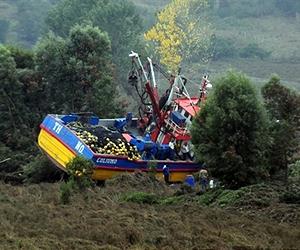
One month after Chile's massive earthquake, Captain Cesar Pena is still amazed by the force of the tsunami wave that followed the quake and swept his trawler into a field far from the ocean.
His brightly painted ship, the "Aguila Real II" (Royal Eagle II), is wedged between two trees some five kilometers (three miles) inland from Coliumo, a coastal town in southern Chile.
Pena was ready to go on a fishing expedition on that fateful February 27, but a 8.8 magnitude quake, one of the most powerful ever recorded, struck hours before the ship took to sea.
No one died in Coliumo, located some 450 kilometers (280 miles) south of Santiago.
"The earthquake was so powerful we couldn't stand up," said Pena, 48. "My mother immediately said that a tsunami was coming … and that's what happened."
Pena, who was in the nearby town of Tome when the quake struck at 3:34 am, drove to Coliumo at sunrise to see how his ship did — and was shocked to find it close to the road near the town entrance.
"Since then, people come by just to look at it. Sometimes there are lines of cars with people taking pictures just for fun, and not thinking that this is a tragedy for me," Pena told AFP.
"Can you imagine if I charged for each photograph? With that money I could be paying for some way to get my ship out of here."
The tsunami waves smashed homes in Coliumo, drowned animals, destroyed crops, and ruined farmland by leaving behind a salty residue.
Pena, who has been a fisherman since he was 16, has been mounting guard at his ship keeping a sharp eye out for looters.
Government workers "drive by but they only take pictures and leave. They are not capable of asking me how I am, if I need help, or what my plans are to get the ship out of here," he said.
At a glance the ship appears fine, though Pena says his 15-year-old craft has suffered some 57,000 dollars in structural damage.
"I have no work right now," Pena said. "I'm asking authorities to help me move the ship."
The magnitude 8.8 earthquake killed 452 people, according to official figures, and about 100 have been reported missing.
Eighteen of those killed died in Dichato, some 10 kilometers (six miles) north of Coliumo. The tsunami waves destroyed most of the town, leaving 3,000 people homeless.
One month after the quake 1,168 survivors live in tent camps in the surrounding hills, fearful of returning to the seaside. Another 1,800 have moved in with friends and relatives, local officials said.
Soldiers question people at the entrance to Dichato. "That way we prevent people who are just curious from coming to observe the tragedy," a soldier told AFP.
One of the refugees, Yolanda Acuna, was a street vendor from out of town whose cart with women's clothing was swept away by the tsunami.
"I don't have a home, I go from town to town with my merchandise," said Acuna, noting that some of the camp residents think she is taking advantage of the aid. "I lost everything too," she said.
Acuna however has not been given certificate of residence, which would allow her to receive future government benefits.
In the camps the bathroom is a hole in the ground behind the trees, and people take turns bathing with water scooped up in bottles.
Tennis and football stars have visited some of the camps bringing gifts for the children, but there are 15 tent camps, and the sports stars never have enough time to visit them all.
"The camps fight for the right to see them," said a military officer in Dichato. "Not only do we help distribute food, we also have to organize and distribute the visits of famous people."
Share This Article With Planet Earth
