
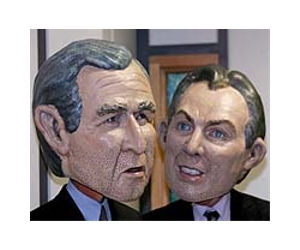
The British government lawyer who approved the 2003 invasion of Iraq admitted Wednesday he had doubted the legal case for war — but denied that Tony Blair's aides pressured him into changing his mind.
Giving evidence to the public inquiry into the war, former attorney general Peter Goldsmith said he had decided it was lawful just one month before the March 2003 invasion, following discussions with US and British officials.
He acknowledged he had amended his legal opinion in that period, but dismissed as "complete and utter nonsense" reports that this was after strong-arm tactics by aides to former prime minister Blair.
Goldsmith said the armed forces had requested that he give a simple 'yes' or 'no' on whether the war would be legal, amid concerns over possible prosecutions.
Their fears weighed on his mind, but "the consequences for the government did not", he said.
Blair is due to make his long-awaited appearance at the inquiry in London on Friday, where the legal arguments are likely to take centre stage following the declaration this week by two ex-government lawyers that the war was illegal.
There has been persistent speculation over whether Goldsmith was pressured into giving his approval, which was necessary for Blair to take Britain into the conflict alongside then US president George W. Bush.
Goldsmith said that in 2002 he had made clear to ministers, including Blair, that war would not be justified by self-defence because "I didn't see any evidence of an imminent threat" to Britain from Iraq.
Any action would therefore have to be based on United Nations declarations, such as resolution 1441 passed in November 2002, which gave Iraqi leader Saddam Hussein a final chance to give up weapons of mass destruction (WMD).
Goldsmith said he initially questioned this resolution as a basis for military action, saying it was "not crystal clear" and there was a "plausible" case for suggesting that a further UN resolution was needed to authorise force.
However, on February 27 he told Blair that, after talks with British and US officials about the 1441 negotiations and after examining the UN material, he believed that no such action was necessary.
"I was of the view that there was a reasonable case that a second resolution was not necessary," Goldsmith said, adding that the fact there was a reasonable case "was, on past precedent, sufficient to constitute a green light".
Goldsmith denied he should have consulted the French — who had led the opposition to military action in the Security Council — during his research, saying that British-French diplomatic tensions at the time made it impossible.
His legal opinion differs sharply from that of the two senior legal advisors in Britain's foreign ministry at the time, who told the inquiry on Tuesday that without a second resolution the war was illegal.
Deputy Foreign Office legal advisor Elizabeth Wilmshurst said she thought Goldsmith had agreed with her, and commentators have questioned why the attorney general appeared to change his advice in the run-up to war.
His draft advice on March 7, 2003 said there was a "reasonable" case for military action without a second resolution, but a formal opinion issued on March 17 — just days before the invasion — was much clearer.
Goldsmith explained he had not changed his mind, but for laymen, "I very quickly saw that actually this wasn't satisfactory from their point of view".
He said: "Our troops deserved more, our civil servants who might be on the line deserved more than my saying there was a reasonable case.
"So therefore it was important for me to come down clearly on one side of the argument or another."
Share This Article With Planet Earth
