
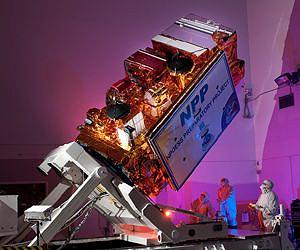
The Ball Aerospace and Technologies Corp. NPP satellite is encapsulated inside the fairing (nose cone) of a United Launch Alliance Delta II launch vehicle in preparation for liftoff from Space Launch Complex-2 at Vandenberg Air Force Base Space, October 28, 2011, at 2:48 PDT (5:48 EDT).
NPP is NASA's first Earth-observing satellite to measure both global climate changes and a host of key weather variables. Ball Aerospace built the NPP satellite BCP 2000 satellite bus for Goddard Space Flight Center under fixed-price terms. Ball also built one of five instruments for NPP – the Ozone Mapping and Profiler Suite (OMPS).
With LRR Complete, Teams Anticipate Friday Launch
The launch teams for NPP concluded their Launch Readiness Review and received the go-ahead to continue preparations for Friday morning's liftoff from Vandenberg Air Force Base, Calif.
The LRR, as it is known, is a standard session prior to launch to make sure the rocket and spacecraft are ready for flight. The weather forecast calls for a 100 percent chance of acceptable conditions Friday morning. Liftoff is scheduled for 5:48 EDT, the start of the NPP's 9-minute window.
Launch and mission managers briefed reporters afterward and expressed their excitement regarding the Earth-observing mission ahead.
"NPP has touched so many lives already," said Ken Schwer, NPP project manager from Goddard Space Flight Center in Greenbelt, Md. "My team is so excited for NPP to touch the rest of the world."
An NPP science briefing follows with Jim Gleason, NPP project scientist, Goddard and Mitch Goldberg, NOAA Joint Polar Satellite System program scientist, Silver Spring, Md.
A briefing detailing the ELaNa program will include Roland Coelho, program lead, California Polytechnic State University, San Luis Obispo and Garrett Skrobot, ELaNa mission manager, NASA Launch Services Program, Kennedy.
All the briefings will be shown on NASA TV and can be seen online by going to www.nasa.gov/ntv
The NPOESS Preparatory Project (NPP) represents a critical first step in building the next-generation Earth-observing satellite system that will collect data on both long-term climate change and short-term weather conditions.
NPP will extend and improve upon the Earth system data records established by NASA's Earth Observing System (EOS) fleet of satellites that have provided critical insights into the dynamics of the entire Earth system: clouds, oceans, vegetation, ice, solid Earth and atmosphere.
The mission is scheduled to launch on Oct. 28, 2011 at 2:48 a.m. PDT/ 5:48 a.m. EDT, from Vandenberg Air Force Base in California. NASA's Goddard Space Flight Center, Greenbelt, Md., is managing NPP for the Earth Science Division in NASA's Science Mission Directorate, Washington.
