
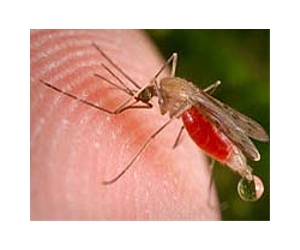
U.S. researchers say they've identified a strain of bacteria that can infect mosquitoes and make them resistant to the malaria parasite.
Since malaria is spread among people by the insects it is believed giving mosquitoes immunity to the parasites could reduce human cases of the disease that infects 220 million people worldwide each year, they said.
Scientists at Michigan State University examined Wolbachia bacterium, which commonly infects insects.
Anopheles mosquitoes that can carry the malaria parasite are not naturally plagued by Wolbachia, they said, but studies have demonstrated temporary infection made the insects immune to the parasite.
In an effort to make the temporary infection a permanent one, the researchers identified a particular strain of the bacteria that would persist through multiple generations of on species of the mosquitoes, Anopheles stephensi.
Anopheles stephensi carries malaria in the Middle East and South Asia; Anopheles gambiae, in Africa, presents a bigger problem, the scientists said.
"We have done only one strain," researcher Zhiyong Xi told the BBC. "If we target Anopheles gambiae we would need to apply the same technique again."
WHO says Cambodia can end HIV infections by 2020
Phnom Penh (AFP) May 10, 2013 –
Cambodia is on track to become one of the few countries in the world to successfully reverse its HIV epidemic and may eliminate new infections by 2020, the World Health Organization said Friday.
The Southeast Asian nation has reduced its HIV prevalence rate from a 1998 peak of 1.7 percent among people aged 15-49 to 0.7 percent in 2012 across the whole population, the WHO said in a joint statement with the Cambodian health ministry.
"Cambodia is moving towards an AIDS-free generation and is one of the few countries globally to have successfully reversed its HIV epidemic," the statement said, adding it was on track to meet the 2020 goal.
Nearly 75,000 Cambodians are living with HIV, according to local health authorities.
But new infections have dropped from around 15,500 annually in the early 1990s to about 2,100 in 2009 and 1,000 in 2011, the statement said.
The decline was attributed largely to a government prevention drive focusing on sex workers, HIV positive mothers and improved access to antiretroviral drugs for people living with the infection, it added.
But the review cautioned the 2020 target could be missed without continued investment in HIV prevention and care for the sick.
A 2010 study, compiled with assistance from UNAIDS and US-based Results for Development Institute, warned the country's widely hailed efforts in tackling HIV/AIDS were under threat with foreign donors likely to cut funding over the next two decades.
External partners fund 90 percent of the country's AIDS programme, which costs just over $50 million a year.
There is currently no vaccine against HIV on the market, and no cure for AIDS, which has killed some 35 million people around the globe.
According to the World Health Organization, 34 million people worldwide were living with HIV at the end of 2011.
