
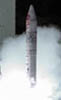
The Lockheed Martin small payload launcher Athena 1 lifted off from Florida SpacePort at Cape Canaveral this evening at 7.34pm EST Jan 26 carrying Taiwan's RocSat-1 built by TRW and subcontractors Acer Sertek Inc., TranSystem Inc., and Victory Industrial Corp.
The launch was only the second at the new commercial space launch facility at Cape Canaveral, and a welcome relief for Lockheed Martin's troubled Athena program. Which was passed over last year by NASA for its small expandable launch program in favor of Orbital Science's Pegasus and Taurus launchers. The Athena program has only five customers over the next 18 months.
However for Tawain the focus is all on RocSat 1, the nation's first experimental research satellite. The modular, lightweight spacecraft was developed by the TRW Space & Electronics Group jointly with the ROC's National Space Program Office (NSPO) and Taiwanese industry. The program was designed to achieve two goals: Develop a science satellite, and establish ROC satellite design and development capabilities.
NSPO engineers, resident at Space Park in Redondo Beach, Calif., worked alongside TRW engineers as full members of the development team, honing the technical and managerial skills needed to design, fabricate, test, launch and operate a spacecraft.
TRW and its subcontractors also worked closely with ROC companies to transfer the technological skills and knowledge necessary to build and test space-qualified hardware. Acer Sertek Inc., TranSystem Inc., and Victory Industrial Corp. delivered space-qualified hardware that has been integrated intn ROCSAT-1.
Acer Sertek built the on-board computer, TranSystem built the remote interface unit, and Victory built the S-band omni antenna and an RF assembly for the S-band link. ROCSAT-1 will be powered by a solar panel built by the Shihlin Electric and Engineering Corp.
The satellite hosts ROC-provided space physics, oceanography and communications experiments. The space physics experiment will gather data on the ionosphere near Taiwan; the low resolution camera will image ocean colors to determine such things as the presence of photoplankton, pollution and outfall from rivers; and the communications experiment will investigate Ka-band telecommunications relay performance.
TRW Space & Electronics Group was awarded a $61 million contract in 1994 to build the ROCSAT-1 spacecraft. TRW delivered the ROCSAT-1 spacecraft to Taiwan in 1997, where the spacecraft's payload was integrated and final satellite-level system test and integration was performed by NSPO. The satellite that will be launched from the Lockheed Martin Athena launch vehicle into a low-Earth orbit to perform its experimental science mission.
ROCSAT-1 is based on the TRW small spacecraft family, a series of small, modular satellites whose flexible design is readily tailored to mission-specific requirements. A similar size spacecraft built by TRW is currently orbiting successfully and collecting data on ozone for NASA. The modular, 400 kilogram spacecraft consists of three modules, a core module which provides spacecraft housekeeping functions; a reaction control subsystem that provide orbit adjust capability; and a payload module, which hosts the science experiments and electronics.
