
Over 100 people were killed when an undersea earthquake unleashed huge waves on Indonesia's Java island, echoing the devastating 2004 Asian tsunami, the Red Cross said Tuesday.
After a strong 7.7-magnitude quake convulsed the seabed off Java's south coast, waves up to three metres (10 feet) high wrecked buildings and sent boats crashing ashore, prompting thousands of residents to flee in panic.
Tsunami alerts were issued for parts of Indonesia and Australia, but they did not reach the victims, as there was no early warning system working in the disaster zone, according to an official at the geophysics agency in Jakarta.
Putu Suryawan, an official at the Indonesian Red Cross disaster center in the capital Jakarta, told AFP by telephone that as of 3:45 am Tuesday (2045 GMT Monday), 105 people were confirmed dead and 127 others were reported missing.
"This is a preliminary report. There is still a possibility for the figures to change," he told AFP. "This is still the early stages of the disaster."
The dead were residents of West Java, Yogyakarta and Central Java provinces, Suryawan said.
"My wife died in my arms," said 45-year-old Ujang Sudarma, choking back tears as he sat in front of the main hospital morgue in the West Java seaside resort of Pangandaran, one of the areas hardest hit by the killer waves.
"She was still alive when I got her here. But there was nobody who could help her," he said, adding that his four-year-old son had been swept away and was still unaccounted for.
"I don't know what to do and I don't have a reason to live."
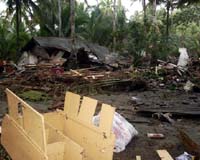
Chunks of concrete, wooden planks and roof tiles littered the streets of Pangandaran and the beachfront, where 15-foot boats were thrown ashore.
Plastic beach chairs and children's swim toys were strewn along the roads. Live wires crackled in the street, and dead fish were embedded in the sand.
The stench of dead bodies permeated the early morning air. A few residents sat outside on wooden chairs, smoking and drinking coffee.
"The situation is almost similar to Aceh," local lawmaker Rudi Supriatna Bahro told Metro TV, referring to the Indonesian province where 168,000 people died in the giant waves of 2004.
The legislator added that thousands of people had taken shelter in mosques and other safe places.
"Many of the injured were suffering from broken bones," he said.
The state Antara news agency said hundreds had been injured and were in urgent need of medical supplies.
Early Tuesday, some 150 people were sheltering in Pangandaran's main mosque, softly chanting Islamic prayers or sleeping on straw mats, AFP witnessed.
On Monday, President Susilo Bambang Yudhoyono called on residents to evacuate vulnerable areas along the coast.
"The search is ongoing for those who are still missing," he said, adding that military and rescue teams had been sent to the site. "It is important to take care of the dead and the injured."
At least five aftershocks rattled the area after the quake, which hit around 3:19 pm (0819 GMT), with the epicenter in the sea off Pangandaran southeast of Jakarta, according to Indonesia's seismology center.
"At that moment, I was very fearful, very afraid for my life and hers," 26-year-old Swiss tourist Heff Martin said, gesturing to his 36-year-old Indonesian fiancee.
Martin, wearing only his black swim trunks, said he was able to salvage his wallet, but that his other belongings had been destroyed by the waves.
Two Swedish children aged between five and 10 years old, along with four Dutch tourists, were reported missing in Pangandaran after the tsunami, officials in Sweden and the Netherlands said.
Fifteen inmates on the Nusakambangan prison island near Pangandaran were also missing, Metro TV reported.
The prison is currently holding three militants on death row for the 2002 Bali bombings.
The seabed tremor was felt for more than one minute and rattled workers in tall office buildings in Jakarta and in the West Java provincial capital Bandung.
Indonesia was the nation hardest hit by the devastating December 2004 Indian Ocean tsunami catastrophe, which killed around 220,000 people across the region — and 168,000 in Aceh alone.
But the official at the geophysics agency in Jakarta told AFP: "We still don't have a tsunami early warning system in place."
Indonesia sits on the Pacific "Ring of Fire", where the meeting of continental plates causes high volcanic and seismic activity.
Both the Pacific Tsunami Warning Center in Hawaii and the Japan Meteorological Agency issued tsunami alerts for parts of Indonesia and Australia after the quake hit.
A tsunami warning was also issued by local authorities for India's Nicobar islands, but no immediate damage was reported there or in Australia.
Source: Agence France-Presse
