
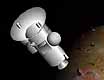
AeroAstro, Inc., a premier micro-satellite technology and services company, today announced an authorization to proceed to build the first ever commercial interplanetary spacecraft.
The spacecraft, purchased by Encounter 2001 LLC of Houston, Texas, will contain photos, messages, and symbolic representations (in the form of human hair) from literally millions of Earth's inhabitants (made possible by the latest data-compression technology), as well as one or more scientific and educational payloads.
To date over 45,000 participants are signed up to include their material aboard the Encounter mission. Dr. Rick Fleeter, AeroAstro's President and CEO, noted, "Encounter is the first private interplanetary spacecraft, not dependent on government involvement, due to our highly cost-effective, micro-satellite technology. The mission demonstrates advanced AeroAstro innovations to be incorporated into its future scientific, communications, remote sensing and technology development missions."
Encounter will contain the Bitsy Satellite Core Kernel, a functional satellite building block weighing as little as 1 kg (2.2 lb.), and will demonstrate an advanced version of the SPORT (Small Payload Orbit Transfer) system, both developed by AeroAstro. SPORT transports small payloads from their initial orbits to final orbital destinations.
The vehicle will be launched in late 2001 using a small "piggyback" slot on an Ariane V heavy-lift rocket operated by Arianespace of Evry, France. Once leaving Earth's orbit using on-board propulsion, it will fly by Jupiter, using the planet's gravity to propel itself out of the solar system.
Charles M. Chafer, Encounter 2001's President, said, "For a very modest expenditure, we expect millions of people to participate in the Encounter 2001 mission. Those interested can call 1-800-868-5005, or visit www.worldofscience.com or any World of Science, Inc. outlet nationwide."
AeroAstro, a pioneer of micro-spacecraft applications, led the trend towards "smaller, better, cheaper, faster" spacecraft — now NASA's mantra — with its highly successful ALEXIS satellite begun in 1988 and currently in its seventh year operating on-orbit.
AeroAstro has since designed, constructed, tested and supported the launch of several other satellites; as well as completing numerous spacecraft systems programs and manufacturing low-cost small rocket engines, nano-satellites and spacecraft components. NASA, the Air Force, and commercial and university customers have all employed AeroAstro in its 11-year history.
