
ESA, together with the British National Space Center and the U.K. space industry, is exhibiting in the International Space Pavilion at Farnborough International Air Show this week.
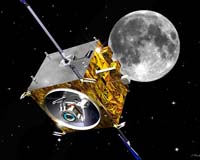
In a joint exhibition area, ESA and its partners will feature a real journey of discovery, leading visitors into outer space with the spectacular results of its many ongoing planetary missions, such as Mars Express, Venus Express, SMART-1 – currently in orbit around the Moon – and the Huygens probe, which successfully landed on Saturn's mysterious moon Titan in January 2005.
The ExoMars rover, slated to land on the red planet in mid-2011, highlights future European programs for space exploration. The model is displayed on a replica of a Martian landscape together with a highly impressive fly-by of stunning 3-dimensional sequences taken by the High Resolution Stereo Camera aboard Mars Express.
There also is a glimpse of the International Space Station and the ongoing Astrolab mission, during which ESA astronaut Thomas Reiter will stay aboard the ISS for six months.
Returning to the immediate Earth environment, visitors can discover the Galileo satellite navigation system, European telecommunications satellites, meteorology satellites MetOp and Meteosat Second Generation, and the new Sentinel spacecraft, part of the EU/ESA initiative for global monitoring, environment and security.
A spherical projection system shows how satellites can provide a global view of our home planet to monitor critical environmental issues and serves as a backdrop for ESA's Earth Explorers, a series of dedicated missions to further our understanding of the Earth system.
Still other exhibits feature Europe's autonomous space transportation system, including the heavy launcher Ariane 5, ESA's new launcher Vega for placing small satellites into space, and cooperation with Russia on the medium-size Soyuz launcher, soon to be exploited from Europe's Spaceport at Kourou, in French Guiana.
During the exhibition, ESA, BNSC, industry, research establishments and other international space agencies are participating in a series of high-level conferences organized and led by the U.K. space industry.
The conferences cover such topics as climate change, the international future of space and satellite navigation.
